Showing posts with label Marshland Habitats. Show all posts

Monday, 13 January 2014

RSPB Minsmere ~ Otters and Marsh Harriers

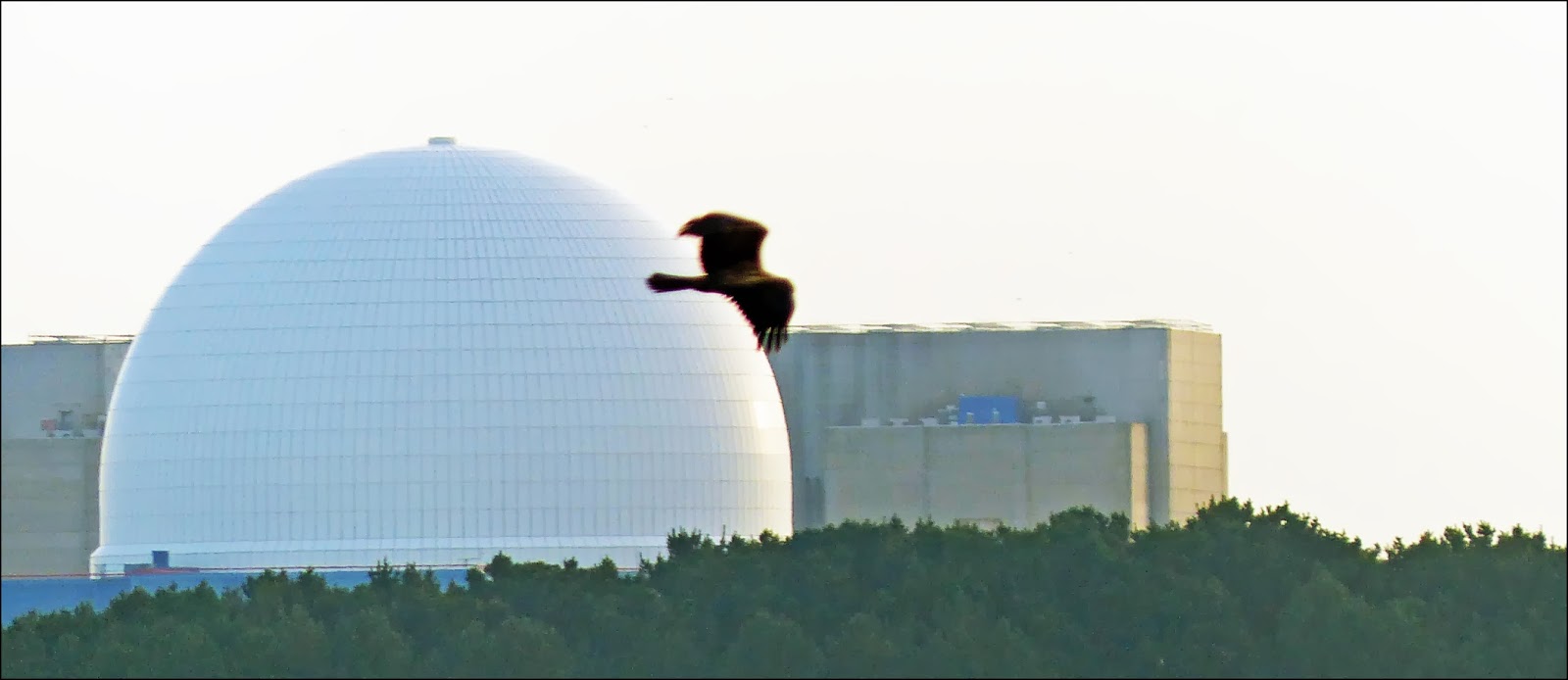
We had barely sat down in the hide at RSPB Minsmere when we saw this Marsh Harrier coursing the marsh ...

... in the fading sunlight.

An eerie juxtaposition: the stately Marsh Harrier flying in front of Sizewell Nucear Power Station.

Swans were flying inland towards Island mere ...

... while the Harrier kept turning and swooping,

hovering and lifting ...

hovering ...

... and soaring.

Suddenly there were two ...

... followed by two Red Deer does.
This little dyke seemed pretty still ...

... when all of a sudden there was the flick of a tail ...


... and the telltale ring of bright water

It became apparent that there were two Otters swimming backwards and forwards.

Every so often a dark shape would emerge ...

... and at one point this Otter swam across with a fish in its mouth.

Such a magnificent sight, and one I have never seen at Minsmere before ...

... though we kept looking in the hope that it was only a matter of time.

What fabulous creatures!

Soon there was a scuffle and a ripple ... and the otters disappeared. 

But there was one last surprise in store ...

... our first Common Scoter (a drake).

This is such a magnificent reserve ...

... with its history (chapel remains of the former Leiston Abbey), Harriers ...

... and swathes of East Anglian light.

Wednesday, 8 May 2013

Nature Reserves: (a Spider on) Carlton Marshes, Suffolk


We enjoyed a walk at Carlton Marshes, near Oulton Broad, on Saturday in warm spring sunshine. The reserve belongs to the Suffolk Wildlife Trust, and is linked at one end to the far side of the river by a ferry service from the Waveney River Centre. It was our first visit to the area, and the sound of warbling in the reeds and blackthorn was a delight. 


This teasel caught my eye as it had been eaten by some creature. I soon noticed this Spider. I haven't been able to identify it exactly, but it may be (related to) Xysticus cristatus (and here). I would be grateful for a definite ID!

I would initially have suspected a Crab Spider, but I have discovered that Crab Spiders use their front legs instead of spinning webs to catch their prey. There is a rather prominent piece of webbing in the photo above on the left. There is some helpful information about true Crab Spiders on the Arkive site.


Thursday, 11 April 2013

Beautiful Birds: Goldcrest at Minsmere


I had never had a definite sighting of a Goldcrest before our move to Suffolk, so it was a thrill to watch two of these fine birds last Saturday at Minsmere. They are very small and skittish, and hard to catch on camera! They love to be in among the twigs; and while Saturday was a beautiful day, the sun brought its accompanying shadows, which added an extra level of difficulty to our photography challenge!


You can just about make out the distinguishing gold crest in the photo above. Apparently the Goldcrest is the smallest European bird.

© David Gill, used with permission!

This photo (above) was taken by David: can you spot the bird?


This is an enlargement of it.


It was lovely to see the pussy-willow buds developing apace ...

... and we thought these coloured nestboxes were really fun, though the only nestbox we saw that seemed to be attracting a bird was a plain brown one. A Blue tit was hovering about and perching on it. 


This lovely Wren was hopping about in the undergrowth. This must be one of the smallest European birds, too!

Several Marsh Harriers were hunting over this bit of marshland.

What a change to have blue skies!


We came home 'via' Southwold, where we ate our chips, watching the starling roost, with its amazing murmuration of corporate flying formations. It was a dazzling performance, set off against a fabulous sunset. Perhaps Spring is here at last. You can watch a similar spectacle here on this video about starlings returning to Israel. And if you would like to read about this murmuration and roost phenomenon, I highly recommend Crow Country by Mark Cocker.

Monday, 23 July 2012

Herpetofauna (4): Common Lizard near Snape

Common Lizard
We were a few metres from the car at Iken Cliffs, on a walk back from Snape Maltings, when something caught my eye on an old tree stump. It was a female Common Lizard. She wasn't exactly basking in the sun, but I suspect she had been lured out by the warm temperatures. She was fairly well camouflaged, in her shadowy spot. These lizards are also known as Viviparous Lizards: they bear live young in cold areas and lay eggs in locations where the climate is warm. They tend to choose habitats with a mixture of sunlight and shadow, with open space to bask and cover for protection.
 I love the way in which the scales of her skin blend with the markings of the bark.
I wished I had had a bit longer to observe her, but there were other people coming up behind us on the narrow path, so we had to make way for them. This was my first lizard of 2012 ... and a fine specimen!
The iconic reedbed landscape between Iken Cliffs and Snape Maltings, Suffolk, England

Friday, 22 June 2012

Beautiful Birds (47): Summer Visitors at Snape

I had a wander around Snape Maltings in the sunshine ...
... when a bird of prey soared across the reedbeds,

... over the trees,
... and across the sky.
Was it another Marsh Harrier? I am not sure.
Closer at hand, the Swallows and House Martins ...
... were dive-bombing for insects.


Small birds were darting about at infrequent intervals in the reeds. I saw a flash of white, but nothing more. If you would like to see a couple of stunning photos of East Anglian reed dwellers, I suggest you pop over to the Kirkstall Creatures blog here.