Showing posts with label adder. Show all posts

Monday, 6 April 2026

RSPB Minsmere


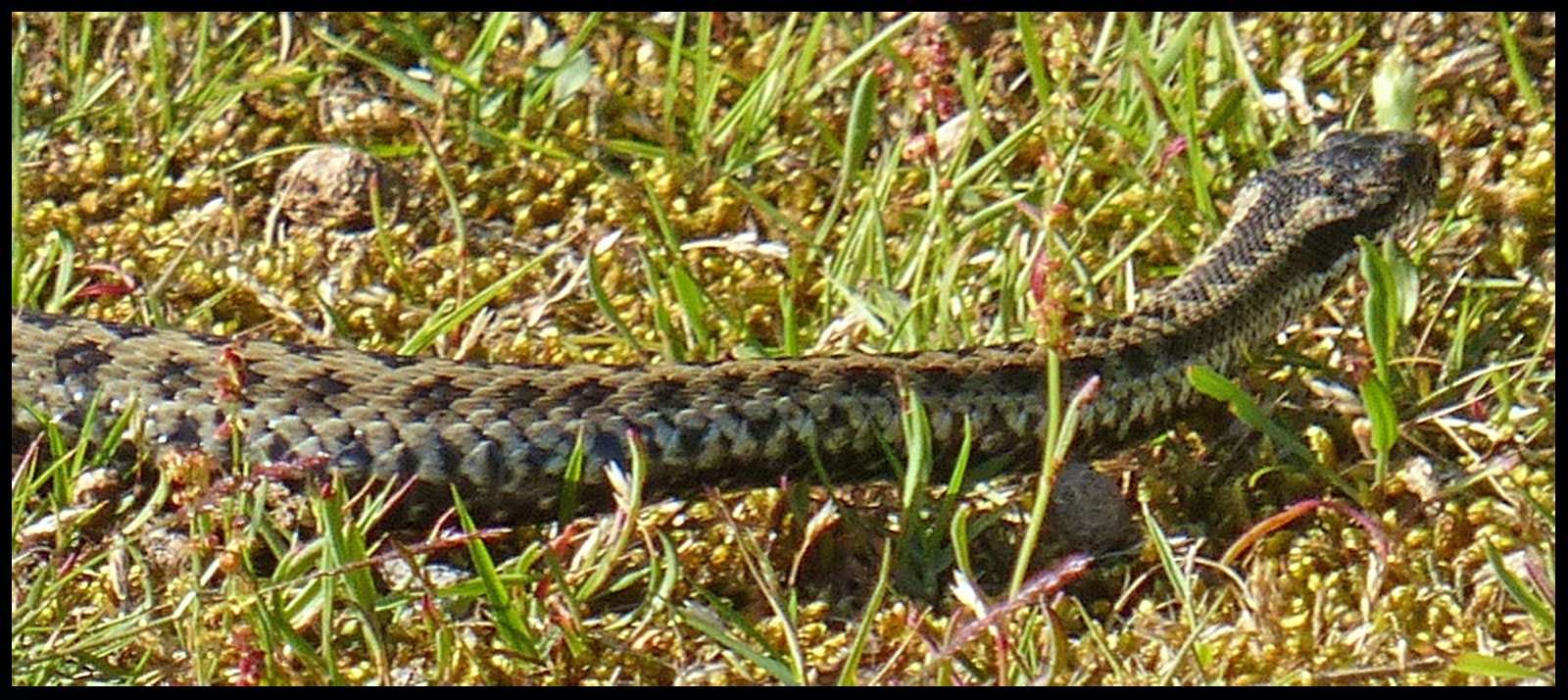
A male Adder in the sunshine


What a bonus to see an Adder this afternoon, and only minutes after we had seen a Water Vole. Peacock butterflies were showing well in the sheltered spots. 


The Adder photographs were taken on a Zoom lens from the safety of the railed boardwalk. 


Above: Looking up the coast towards Dunwich Heath. 

Below: 'his' and 'her' treats back at the Visitors' Centre, with Sand Martins overhead.  


Below: shades of things to come ... Sizewell C. 
Last photo: Minsmere today, and surely as it should be.  


Tuesday, 12 August 2025

Snake in the Undergrowth at Dunwich Heath

Above. Photo credit: David Gill

We took a picnic to Dunwich Heath today, and down in Docwra's Ditch our eyes alighted on a very small slithery thing, a young adder. It was about 9cm in length and (from a respectable distance) reminded me of a fat earthworm. What a beautiful creature!  
 

David at the 'entrance' to the heath

The beach at Dunwich, with a single jogger and a single swimmer in sight


Tuesday, 23 June 2020

Day 23, #30DaysWildCreativity: Conservation Collage


'Will we permit the rewilding of our hearts and minds, 
that is so needed now?' 

for today's #30DaysWildCreativity meme 


I wanted to remind myself of some of the threatened wildlife I have encountered over the years, and I hope you may also enjoy seeing my pictures of these fine creatures. 

I recall seeing a whale washed up on a Cornish beach several decades ago. It was dead, and the memory stays with me. The 'Save the Whales' slogan certainly made an impact on me as a teenager, even if I did not know how these magnificent mammals might be saved. 

Picture 1: Otter
Many of us read about otters as children and teenagers in books like The Wind in the Willows, Tarka the Otter and A Ring of Bright Water. I visited the Otter Trust near Bungay in the 1970s, but I did not see an otter in the wild until I visited Skye some thirteen years ago. I have also watched them off Mull and the Kintyre peninsula. Miriam Darlington writes about otters she has encountered and observed in Scotland (and also in Devon, Cornwall and other quiet corners of the British Isles) in her wonderfully evocative book, Otter Country.  

Picture 2: Purple Emperor Butterfly
We were visiting Chedworth Roman villa in Gloucestershire when we were called over to see an unusual butterfly. It seemed to be in need of a little sugar and water, which the cafe supplied. I took this photo, and sent it off to Matthew Oates, who confirmed that we had been looking at Her Imperial Majesty, the Purple Emperor (you can read his upbeat reply in the Postscript to my post here). The fact that this resplendent, if slightly dehydrated, Emperor was visiting a Roman villa made us smile. I hope she revived and lived her butterfly life to the full.  

Picture 3: Bittern
When I was growing up, one of our family board games was Conservation, a game produced by the RSPB to encourage young people to learn about endangered birds in Britain. The Bittern was one of these species, and it was a bird I never thought I would see despite the fact that our home was only about a mile from some of the Norfolk reedbeds. It was only when I moved to Suffolk some eight years ago that I finally saw, and heard, my first Bittern at RSPB Minsmere. I remember the wave of excitement that rushed through me when I set eyes on a sight I thought I would never see.

Picture 4: Water Vole
Speaking of The Wind in the Willows, I believe I was in my 40s when I first realised that Ratty was in fact a Water Vole. The photo above was taken (with zoom lens) at RSPB Minsmere. You can read about the conservation status of this delightful species here

Picture 5: Red Squirrel
Like thousands of other children, I first encountered the Red Squirrel in the pages of The Tale of squirrel Nutkin by Beatrix Potter. Later on, when I was about eight, I saw one or two for myself on Brownsea Island. More recently I have watched them in the Cairngorms and in Dumfries and Galloway. You can read about their situation here

Pictures 6 and 7: Grass Snake and Adder
I had seen very few snakes in the wild here in the UK until we moved to Suffolk. Since then I have seen a handful on a couple of reserves, namely RSPB Minsmere (Adder and Grass Snake) and SWT Carlton Marshes, where I photographed the Grass Snake in the picture above. The adder in the photo was on the Minsmere Adder Trail: an RSPB official pointed us in its direction, and there were in fact two snakes coiled round one another. What a privilege to see these reptiles.

Picture 8: Swallowtail butterfly larva
Ah, I had been longing to see a Swallowtail butterfly, and here at last was a Swallowtail larva on the NWT reserve at Hickling! I had spent my teenage years in Norfolk at the edge of The Broads at a time when these butterflies were practically non-existent so the thrill of seeing this magnificent caterpillar was almost overwhelming. 
 
*
I hope you have enjoyed my 'conservation' selection. The lockdown has certainly allowed our wildlife to experience a more peaceful few months than usual. Let's acknowledge that there may be lessons we can learn. It is wonderful when people join together to put measures in place, whether political or environmental, to enable threatened species to fight back. 
 

Tuesday, 12 April 2016

An(other) Adder - at Minsmere


I can hardly believe that I have seen three Adders this year so far. This is the latest, which, like the others was almost hidden in the undergrowth at RSPB Minsmere. This photo was taken with a zoom lens. I love the beady eye!

We also saw a Cetti's Warbler, a Little Grebe, a Little Egret, Sand Martins, Reed Buntings, Great Crested Grebes and much else besides.

Monday, 4 April 2016

Suddenly ... Spring (and Adders!)

This last week has produced a rich variety of wildlife. I shall be posting about some of my sightings in the days to come, but let's begin with the letter A ... for Adder, although the snakes in question have been named Bentley and Victory for ID purposes. Victory has particularly clear V-shaped markings. 

We arrived at RSPB Minsmere to discover that there had been sightings of two adders. There was a scope positioned with the snakes in view, so this helped us to get our initial bearings. Both snakes were tucked under the undergrowth and while this was not our best Adder encounter on account of the twigs and bracken, it was still terrific to see them.


The cross-over of bramble twigs was a useful marker and helped us to find the Adders ...


The scales seemed surprisingly dark. 


 The last photo shows the tail beginning to slide out of sight.


Tuesday, 19 May 2015

RSPB Minsmere - The Adder Trail

Sharing with Eileen at Viewing Nature With Eileen ...


There is certainly a BBC Springwatch buzz at RSPB Minsmere.

We decided to take a look along the Adder trail for signs of snake.

We had a very satisfatory sighting, but it was not only the reptiles who caused a stir.

The Avocets were on their nests. There were several Little Egrets on the scrape.
The Bearded tits were hard to photograph but a delight to watch. 
The Bluebells were a joy to behold. We saw (and heard) two Bitterns.
We heard a Water Rail and were serenaded by a Cuckoo.
The Sand Martins were busy re-claiming their nests.
David saw our first dragonfly of 2015 - a Hairy Dragonfly.
I came across my first Grasshopper of the season.

N.B. Adders are dangerous when they bite.
I took all the photographs below from the path side of the roped-off viewing area.


A seasonal sea of Bluebells


Camouflage! Adders head to head ... (look for the eyes)


Both snakes look right ...


It can be hard to see where one Adder ends and the other begins!


Such fine markings.

Snakes in the grass ...

Close-up. I wonder if the Adder can feel those thorns!

You can see how mottled shade in the undergrowth provides the perfect habitat.

A personal favourite!

Prepare for action ...

I see that the Springwatch team will be following specific Adders this year. 
You can read about the plans if you click here and scroll down 
to the BBC Springwatch paragraph called 'Adders on the Move'. 
It will be fascinating to see what traits are revealed. 

* * *
My blog
  • Previous post: Red insects including the Fire Bug and (green and red) Ruby-tailed Wasp ...

The RSPB blog

Wednesday, 3 July 2013

Herpetofauna: Adder at Minsmere

I had been wondering how long it would be before I encountered one of the Adders that frequent RSPB Minsmere, and thanks to the warm sunny conditions last weekend, I was able to take these photographs. My instinctive reaction was to jump, and then to warn David to keep a sensible distance away. At that point we watched the snake together. I got out my camera and took these shots, using my zoom lens, before the reptile slithered off into the shade of the undergrowth. 

Adders are a protected species under the 1981 Wildlife and Countryside Act. They are protected from being taken from the wild, from being killed and from being sold. These snakes do not bite unless startled or provoked. About 100 people receive an adder bite in the UK each year. Immediate medical attention must be sought in the case of such an eventuality.  

I have recorded the sighting here on the 'Add an Adder' section of The Amphibian & Reptile Conservation Trust, for the purposes of monitoring and conservation. 


Forked tongue (and red iris)


A veritable snake in the grass . . .