Monday, 14 May 2012

Ladybird Alert (10): Harlequin, 14-spot ... and thirty-seven 7-spots!

In my previous post, I mentioned our walk through a local nature reserve. These are the Ladybirds we encountered. The 7-spots (all thirty-seven of them) were too numerous to photograph on this occasion as we had walked a fair way and needed to get back. The top photograph shows a Harlequin Ladybird. The others are native to the UK. I particularly like the last photo!

As ever, I shall send these sighting-records in to be counted. You can find details of ...
  • the UK Ladybird Survey here
  • the Harlequin Ladybird Survey here
Incidentally, if you would like to read my earlier post about the other creatures we saw on our walk in the nature reserve, this link here will take you to the page. 

I take this to be the HARLEQUIN LADYBIRD, Harmonia axyridis succinea © David Gill 2012

7-spot, Coccinella 7-punctata, of sorts?

14-spot Ladybird - these Ladybirds are very small and are not Harlequins
Propylea 14-punctata

As above ... a second one
I note that Professor P. Brain, who is based near our previous home in South Wales, also recorded a Propylea 14-punctata this weekend.

I love the Ladybird's 'composition' here . . . One of the thirty-seven 7-spots we saw yesterday!


Nature Reserve Notes (1): From Butterflies to Beetles

We took advantage of the dry afternoon and ventured out to explore a local nature reserve in Suffolk, UK. The photographs below show some of the flora and fauna we noticed. We heard a lot of birdsong from the canopy, but saw surprisingly few birds. I will add the Ladybirds in a separate post, to make it easier for the those at the UK Ladybird Survey, who may like to compare my photos with my submitted records. 


I had been puzzling over this creature as it didn't seem to fit the ID marks of a Cardinal Beetle. I believe it is a Lily Beetle, as it was shorter and somewhat rounder than a Cardinal and it was marked with dimples. If you follow the link here, you can click to hear the Lily Beetle's alarm call.


I was hoping that we might see a mammal of some kind. The bushy tail here belongs to a Grey Squirrel, who was too shy to show his face. We were told that there were deer about, but we didn't see any. We did however see this spider, which i have not been able to identify ...


Readers of this blog will know that I saw my first Orange-tip Butterfly of the season a couple of days ago. On our nature reserve walk, we saw one or two more ...


This one had just landed on a clump of Alkanet.


It (or rather 'he' since the female Orange-tip does not have orange markings) closed its wings more tightly, revealing the fine mottled patterning on the outside.


This butterfly foxed me for a moment. It didn't quite seem to be a Common Blue, my first thought, but I am guessing that it is a male Holly Blue, since these small butterflies are often seen early in the season and have almost white wings (with dark speckles) on the outside.

© David Gill 2012

© David Gill 2012

I have thrown a link to this before, but I can't resist the opportunity to add that you will find Robert Frost's delightful poem, Blue-butterfly Day here.

Nature Reserve Notes: a list of species recognised (or discovered!). I saw many more insects and plants that I have not (yet) identified.

Mammals
1] Grey Squirrel, 13 May 2012

Birds
1] Moorhen, 13 May 2012
2] Jay, 13 May 2012
3] Dunnock, 13 May 2012 ~ Total 3
4] Wood pigeon, 13 May 2012

Insects
1] Lily Beetle, 13 May 2012
2] 7-spot Ladybird, 13 May 2012 ~ Total 37! 
3] 14-spot Ladybirds, 13 May 2012 ~ Total 2
4] Harlequin Ladybird, Harmonia axyridis succinea, 13 May 2012
3] Buff-tailed Bumblebee, 13 May 2012
4] Holly Blue Butterfly, 13 May 2012
5] Orange-tip Butterfly, 13 May 2012
6] A kind of ?Carpenter bee (on a wooden post with bore holes), 13 May 2012


Molluscs
1] A green Brown-lipped Snail, 13 May 2012
2] Slug, 13 May 2012

Plants
1] Alkanet, 13 May 2012
2] Forget-me-not, 13 May 2012
3] Stinging nettles, 13 May 2012
4] Blackberry brambles, 13 May 2012

I must keep an eye out for the trees next time. I noted one interesting conifer along the way ...

Saturday, 12 May 2012

Butterlies and Moths (4): Orange-tip Butterfly


At last: an Orange-tip Butterfly! This one, the male of the species, alighted on the foliage and scented blossom in our garden this afternoon.

Friday, 11 May 2012

Ladybird Alert (9): Another 7-Spot and a small Pine Ladybird (red on black)

7-spot Ladybird on Spirea (?Gold Flame)

Both these Ladybirds were spotted in my garden today. The one below was very small indeed. Neither of these is a Harlequin. I am about to log them on the UK Ladybird Survey site here (and you may like to do the same if you find Ladybirds).

Pine Ladybird (Exochomus 4-pustulatus)


Eye-catching Insects (10): Mystery ?Moth ?Micro-moth


I noticed a small flutter of mystery insects, flying around my Spirea in the sunshine yesterday. I was delighted to find that these creatures were still there today. Each time the sun emerged from the cloudy sky, the insects opened their wings and took to the air. Five seconds later when the sun went in again, the insects landed on the leaves. From my window they looked like small moths. Having seen them at close range today, I am no longer so sure. On account of their iridescence (a bit like that of a silverfish!) and of their skittish manner, they have proved quite hard to photograph. If the sun stays out for more than a few seconds, I will have a further attempt.

Meanwhile, if anyone can identify these insects, I would love to know!

P.S. The sun did come out again and I took a few more shots. There were fewer of these insects about ...


Red arrows showing long antennae

Wednesday, 9 May 2012

Home Patch (11): Mystery Bird ...

Who's that hiding on my fence?

It has been an 'exciting' morning in the garden ... probably a bit too exciting if you happen to be a small bird. Not only did we receive a visit from this bird of prey, which I take to be a Sparrowhawk (please confirm or correct!), but I also heard a long burst of Cuckoo song. I have not heard a Cuckoo in England for a long time (or in Wales for that matter), but in recent years we have enjoyed listening to the clarity of Cuckoo song in Scotland above the water between Skye and the mainland.

The photo above was taken through glass on a dreary wet morning. I had seen what seemed to be a Sparrowhawk or possibly a Kestrel a few days ago, so I was keeping a wary out eye for a second appearance. When the bird landed this morning, the shrub was in my way, but there was little I could do with the glass between us! A beady eye has been caught on camera ...

We had three Mallard fly overhead yesterday, so it's time to update my Home Patch bird list ...
  • Cuckoo ... heard but not seen on 9 May 2012!  RED Conservation status
  • Mallard (these flew past without landing)
Incidentally, on the subject of birds, I have just read that there was a Flamingo (with photo here) at Trimley Reserve, not far my new Suffolk home, and a Hoopoe (a bird I would so love to see ...) at Whiteford Burrows, a few miles from my previous Swansea home! 

    Tuesday, 8 May 2012

    Home Patch (10): A Bumblebee ... but which?


    I found this sluggish bee in my garden back on 17 April, and it has been puzzling me ever since. I had a hunch that it was a queen, but something about it made me think it was a bit different to the other Buff-tailed Bumbles I had been watching.

    I began to think that it was perhaps a Cuckoo Bumblebee, Bombus bohemicus, and visited Stuart's Donegal Wildlife blog for assistance. However, I now have my doubts for various reasons. You can't see the back legs in my photo, and I don't know whether the honey coloured parts in the front legs are signs of pollen. 'My' bee has a central golden band ... so perhaps it is just another Buff-tailed Bumblebee after all.

    Now that I have been alerted to the existence of the Cuckoo Bumble, I will be on the look-out for these wily creatures. Do let me know if you can give me an ID for the creature in my photo!

    • Colour guide for identification purposes from the Natural History Museum

    Thursday, 3 May 2012

    Home Patch (9): Birds old and new


    It was lovely to see this Thrush hopping about the garden again today. It was quite a shy bird, preferring the cover of the long grass around the area of decking. It is only the second time I have noticed it, and it seemed to be finding a feast of snails.

    A Brown-lipped Snail (I believe) next to the leaf
    The Goldfinches were back and the Great tits, but I also had a couple of new visitors in the guise of a pair of Collared Doves. Their distinctive cuc-koo koo sound caught my attention: I looked up from my keyboard to see one of the birds alighting on the aerial. I didn't have my camera to hand, but will try to take a photograph when they return.

    I thought I saw a Grey Heron flying overhead, but it was a bit cloudy and I couldn't be sure. My updated 'bird tally' for our new home patch runs as follows:

    Tuesday, 1 May 2012

    Home Patch (8): Jay and Young Robin

    The young Robin, drying off after torrential rain
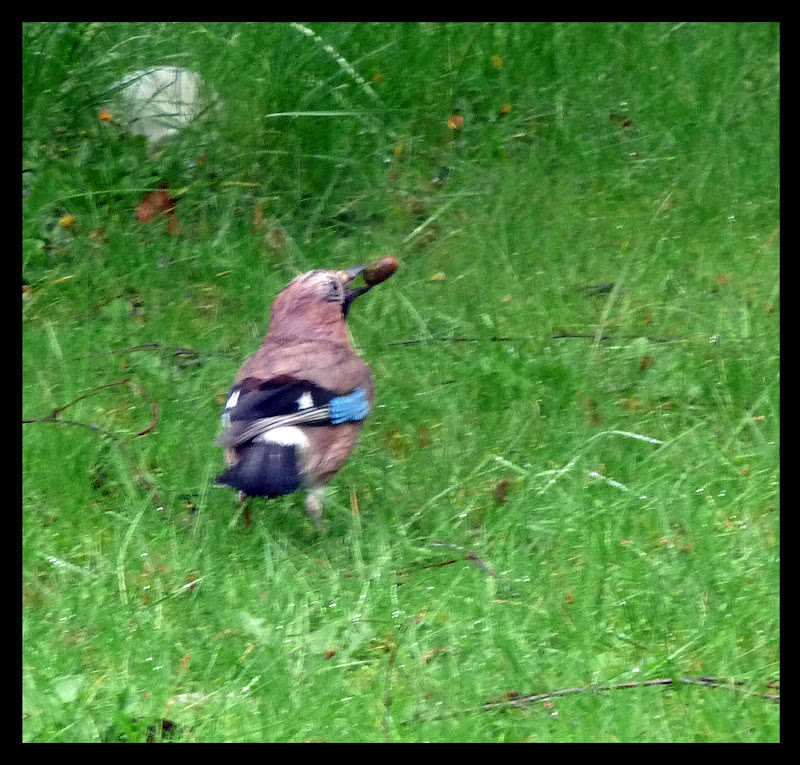
    Buried treasure! I hope the Jay sticks to acorns and leaves the fledgling alone ...

    Both photos were taken through glass as the rain was so heavy ...

    Tuesday, 24 April 2012

    Home Patch (7): LBJ? ... Not Quite


    I noticed over at 10,000 Birds that there was a post on the Best Bird of the Weekend. I may be running a few hours late, but that need not stop me from posting my pictures of this LBJ. The bird scuttled in the undergrowth between showers, and at first I thought it was going to be one of the resident Dunnocks. I got my camera out and took the pictures that you see, keeping my distance as the bird was clearly shy, and using my maximum zoom. The bird splashed about in the rain water, before turning to face the window.


    It wasn't a Dunnock, but it took me a while to realise that ...


    ... this fluffy little bird would soon fall out of the LBJ category for it was in fact ...


    ... a young British Robin!

    It was hopping about in the company of its father, who kept a certain distance, presumably so that the youngster would begin to gain a measure of confident independence. Adolescent birds lose their speckles at the age of about 2 months and only gain their highly visible feathers of resplendent red once these creatures are of an age to handle territorial squabbles and boundary disputes!

    The one in the photos above may be the first juvenile Robin I have ever seen or noticed. I shall continue to watch its progress with interest - and, who knows, if it stays around in the garden, it may soon feel able to venture out from the cover of the twigs and brambles and show off its fiery adult plumage. 


    More about the Robin ...

    STOP PRESS: I posted this with an anecdote in mind from a new book by USA poet-playwright John Dotson. John's latest publication, entitled Love for Ever Meridian and subtitled Finding Dylan Thomas in the 21st Century charts the author's 2007 journey to South Wales, where I lived for 19 years. John explored the Swansea and Laugharne area in the footsteps of Dylan  and in the company of Peter Thabit Jones, editor of The Seventh Quarry, and Dylan's daughter, Aeronwy. You can read more about the book here ... and if you decide to acquire a copy, you will find the robin episode on p.61!  

      Monday, 23 April 2012

      Rainbows and Reflections (1): April Showers


      We saw this beautiful rainbow yesterday in between the showers.

      I wonder if you can make out the colours in this order:

      red orange yellow green blue indigo violet

      I reckon I can see these, but then I also sense a couple more colours underneath, so perhaps this was more than one rainbow! A rainbow is formed by the two processes of reflection and refraction. Sunlight and water droplets are needed: you can read about the process here. 

      We live on the edge of 'Constable country' ... and I love the artist's painting of a double rainbow, which you can see here. You can read more about Constable here - and about the Stour Valley 'Managing a Masterpiece' project.
       

      Flatford Mill, UK

      Thursday, 19 April 2012

      Eye-catching Insects (9): Hoverfly

      I have very little knowledge about Hoverflies, but having caught a few on camera, I thought I would post a photo of my latest 'catch'. I know Stuart of Donegal Wildlife knows a fair bit about these insects, so you may like to take a look at his blog.


      The insect above was enjoying the euonymus in my garden two days ago, before the chilly weather set in. I thought it might be a member of the species Epistrophe grossulariae, which is prevalent in Britain, but I am guessing that it is too early for this species. In my previous post, I looked at the Bee-fly, which mimics a bee for the purpose of keeping predators at bay, for fear of being stung. [Aside: do insects experience 'fear', I wonder?]. A similar mimicry thing is going on here with the wasp-like stripes of the Hoverfly.  

      The Buglife website is full of 'Hoverfly Superfacts' here.  


      I have added in these two previous photographs to demonstate the range of preferred flora and the diversity of habitat frequented by the Hoverfly. The insect above was in a dappled stream in Wales and the one below was enjoying a sunny garden.

      An incredible 68 species of Hoverfly have been recorded for my postcode! Why not tap in your location to find out more ... this may only be for the UK. I shall certainly be keeping my eyes open. There are more Hoverflies over at Pencil and Leaf.  

      Wednesday, 18 April 2012

      Home Patch (6): A Visiting Bee-Fly


      We had a typical British 'April day', with showers, hail, a rainbow and eventually a short spell of hot sun. I was delighted to find that the Bee-fly (or one of its relations) I had seen on 27 March 2012 had returned to the garden. It was a good opportunity to take a few quick photos before the sun went in again. The Bee-fly darted about, beating its wings very fast and alighting every so often for a short spell on the Flowering Currant.

      Since I last saw this creature in the garden I discovered that there is also a Dotted Bee-fly, so I was keen to take a special look at its wings. No dots ~ no matter!


      These insects look so furry ... and I would prefer them to be bees rather than flies, but, of course, they are what they are - and for good reason. Other creatures are aware that bees can sting - and are therefore keen to keep their distance.


      Can you make out the long proboscis, through which it sucks nectar? 


      You can read more about the Bee-fly here. I did not know that the insect in its larval stage makes its home in the nests of Solitary Bees.  


      You will find my earlier Bee-fly of the season here, but I would particularly encourage you to take a look at Rosie's beautiful photographs over at Leavesnbloom.

      Monday, 16 April 2012

      Home Patch (5): Blackbird Profile


      This female Blackbird is becoming quite a regular. She appears to have a number of suitors, who make quite a noise when they land in the garden. I presume the female bird is already beginning to prepare a nest: you can see tufts of grass in her beak.


      For those who live outside the UK, it is worth pointing out that it is only the male Blackbird who sports black plumage. The female is brown, and sometimes has dark speckles on her chest. What I believe is a little unusual about this female is that she has so much white. The bird is obviously not an albino for she most of her pigment is dark and she does not have pink eyes. I am guessing that she has a measure of leucism, particularly since many of her kind are known to have been affected by this genetic anomaly. You can read about Blackbirds and leucistic tendencies on the British Trust for Ornithology (BTO) website here.


      I shall record this Blackbird on the BTO Abnormal Plumage Survey here ... and on the subject of recording wildlife, I would like to point out Juliet Wilson's informative post here.

      Have you seen anything slightly unusual in your home patch recently? 

      One of our male garden Blackbirds - in 'standard' Blackbird plumage

      Saturday, 14 April 2012

      Home Patch (4): Long-tailed Tit

      Long-tailed tit on left: Blue tit on right

      Not a good photo - and not taken in my home patch - BUT since we enjoyed a short visit from a single Long-tailed tit in our new garden on Saturday, I thought I would post this old photo for those who are not familiar with these delightful birds. We have also seen Blue tits and Great tits. My 'bird tally' for our new home patch runs as follows:


        Incidentally, I was surprised to see a single Long-tailed tit as I always think of these birds flying around in small flocks. Although often listed alongside other tits, the Long-tailed Tit is apparently not a true tit, but a member of the Aegithalidae family.

        I have also spotted an as yet unidentified bird of prey overhead (I know it wasn't a Red Kite, Kestrel or Buzzard!) - and a couple of geese.

        Thursday, 12 April 2012

        Ladybird Alert (8): More 7-Spots

        7-Spot Ladybird in my garden today

        Close-up of Ladybird above

        A different 7-Spot in my garden (and the 3rd one scuttled away before I could photograph it!)

        I have seen three more 7-Spot Ladybirds, which makes a pleasing change after my previous sighting of a Harlequin!

        I shall be logging these 7-Spots with the UK Ladybird Survey, and would encourage you to do the same if you have Ladybird encounters! If you have Harlequin ladybird encounters, you might care to log them here on the Harlequin Ladybird Survey site.

        You might also be interested in Project Noah (networked organisms and habitats), described as 'a tool to explore and document wildlife and a platform to harness the power of citizen scientists everywhere.' I have only just discovered this wildlife platform, but I believe it covers the world. My thanks to Andrea (see Comments below) for setting me on the trail to find it!