Showing posts with label Seasonal Splash. Show all posts

Sunday, 28 February 2021

First Go with TrailCam and a Mixed-Bag of Garden Sightings

The top photograph shows David installing our new TrailCam in the hope that we might be able to record a few night visitors over the coming weeks. We have never used one before, but spurred on by reports from a couple of friends who have recently set up these cameras, we thought we would buy a fairly basic model and see what happened. I have a good idea of the creatures who visit our garden by day from the Homepatch Species List I have been keeping for the last few years, but little idea of what happens after dark or when we are inside. 

The second photo shows a kind of tunnel between the ivy and the fir tree. We have often seen cats in that area, but two of the regular felines have now moved elsewhere with their families, and we rarely see a cat in the garden. 

36 hours on and we uploaded the film. There are no great revelations to date (and thankfully perhaps, not even a rat), but the camera had been triggered several times, mainly in the dark, once yesterday morning in thick fog, and a few times in the daylight. 

The Blackbird below is the first identifiable creature to be caught on camera. Watch this space!


We have checked the garden for more ladybirds, and have located more 7-spot and Pine varieties. We have also seen a couple of bees . . .


. . . and a hoverfly (below), complete with shadow.


The 7-spot below is definitely keeping company with what are probably spiders, though I haven't been able to count their legs with any accuracy. I had wondered if they were Dock bug nymphs as we get a lot of Dock bugs in this part of the garden, but I don't think they are a good enough match.


We have had wasps' nests in the garden the last couple of years (well, one in the shower vent, so perhaps more in house than garden), so it was no real surprise to see this insect inspecting last year's nest site, which, thankfully was definitely in the garden and not in the house. I am fascinated by most insects, but do not get on well with ticks or the Common Wasp. I shall post this picture on to iSpot.


It has been a joy to see our Crocus, Miniatire Iris and other bulbs opening in the sunshine. We have a good show, albeit a miniature one, of Tête-à-têtes, in readiness for St David's Day (though these may technically be more Narcissus than Daffodil ... I wonder if you know).


Back to our mix of ladybirds again ...


And finally for now, a rather gruesome photo of what seems to be some kind of (perhaps beetle or weevil) larva demolishing an earthworm. A tiny corner of roofing felt came adrift from the old shed and this is what was underneath it ... I am hoping the folk on iSpot can enlighten me as to what exactly is going on.
 

After some fairly dormant months in our home patch, it suddenly seems as though there is a lot of activity even if I am still awaiting my first butterfly sighting!

Saturday, 20 February 2021

An Early Spring Morning in the Garden


We spent an hour in the garden this morning, enjoying some early spring sunshine and birdsong. These first two photographs, which were also the first two I uploaded, were actually taken on 12 February when the Fieldfares were still in our trees. All the other pictures were taken today.

We always enjoy seeing Goldfinches. This one was in the Silver Birch, which some of you may remember from the Tree Following meme.
 

This 'woody' corner of the old decking seems to suit these small Cyclamen. They don't seem to spread much, but are always a joy to see. But it was the miniature Iris reticulata in bloom that particularly caught my eye this morning. 

As you may know, we have been keeping an eye on four Wasp spider egg sacs over the winter. What you see in the photo below is, we can only think, the remains of one of them. The grassy area in which all four were last seen was under about 20cm of snow for almost a week earlier this month. All our snow has melted, but the long grass is bent over in swathes. 

Back in the summer, we were visited not only by Wasp spiders, but also by a couple of Common Lizards who, to our great excitement, were sighted on our patch for the first time. These 'firsts' may be totally unrelated, but it was nevertheless intriguing to read on @Tone_Killick's Twitter page for 15 December 2020 that it is extremely rare in the UK, there being probably only one instance, to find a photograph of a spider with vertebrate prey. It just made me wonder whether the spiders on our land were after the lizards, and not the other way round, as I might have supposed.

As for the egg sacs, well, time alone will tell whether the colony of Wasp spiders increases here or whether the wind and cold weather have killed off the overwintering eggs. 


On a more cheerful note, it was good to find two different kinds of ladybird making the most of the sunshine. The 7-spot emerged from a large pile of twigs, and what seems to be (the much smaller) Pine ladybird (Exochomus qadripustulatus), with its rim around the elytra, was perching on a leaf.

 
There were a couple of (?Nursery web) spiders running about on the relative warmth of the old tray. 

It was a delight to find two Daisies in the grass.

Here's a close-up of our first Iris . . .

. . . and photos of our first Crocuses.


This is our new feeding pole, which although empty in this picture, has already attracted Long-tailed tits, Great tits, a Robin, a Pigeon, Blue tits and Starlings. There is plenty of food for all comers, and yet the Blue tits, in particular, insist on dive-bombing their fellow Blue tits and also the Long-tailed tits. 

We have never had an Aconite in the garden before. There is just the one, in a very scruffy old pot, so I am intrigued whether perhaps we planted a few bulbs last autumn.

And finally, do let me know your thoughts on the (pretty shy) bird above. I thought it was a Sparrow, until I took the photo below, which is certainly one. The two bills don't look the same shape to me, but I am really pleased to find a House Sparrow in our garden. There was a little colony down the road, but it dispersed last summer when one of the houses had building work which interfered with a particular hedge. 

The last House Sparrow record for our garden is June 2020. These once-common birds are now categorised as Red in terms of conservation on the RSPB site. I hope we will see more of them in the days to come.


Sunday, 23 February 2020

Female Hooded Merganser in Christchurch Park, Ipswich


Earlier in the week I had read a post on Facebook (David Quinton, Suffolk Birds, 21 February 2020) with photos of a female Hooded Merganser in Christchurch Park. We decided to take a look to see if the bird was still in the area. As you can see, she was, though the sunlight was intermittent and my photos are little more than record shots. I have read on the internet that the bird was introduced by the park authorities in the hope that this female would mate with a male, but I have not verified this suggestion.

What I do know is that a certain male Hooded Merganser recently went for a waddle down Tavern Street in the town centre, and had to be returned to the Christchurch pond by park rangers. According to the report in The Ipswich Star, the bird is almost certainly not a wild one.

Hooded Mergansers hail from North America, and the female in the photo is the first I have knowingly seen. Having watched a good number of Goosanders and Red-breasted Mergansers in the north of Britain, I was surprised at the small size of the bird in the park.


You can see her ginger 'tuft' in the photo below as she leaves the geese to their rest and heads out alone onto the water.


David thought he saw a Song Thrush in the garden a couple of days ago. I missed it, but was pleased to see this thrush in the park hopping about in the twigs.


The photo below shows one of the Coots we noticed.


There was a large queen Bumblebee on the pussy willow below, but by the time I had focused my camera, she had flown off. Just look at the pollen she left behind.


We noticed a few Manadrin ducks. There are usually some in or around the pond.


Christchurch Park is really very convenient for Ipswich. The church below, St Margaret's, in the town centre can be seen from the park. 


Flowers and blossom are beginning to grace us with their presence. I believe this flower, with its distinctive speckled leaves, is Lungwort or Pulmonaria.


The yew in the photo below is the oldest tree in the park, and has its own sign which explains that yews are among the hardest 'soft wood' trees. The tree is over 14m high and at least 600 years old.


What fascinating bark and trunk structures...


There were several Grey Squirrels darting about and skimming up and down trees. The ground was littered with what looked distinctly like half nibbled chestnuts.


Thomas Wolsey was an Ipswich man...


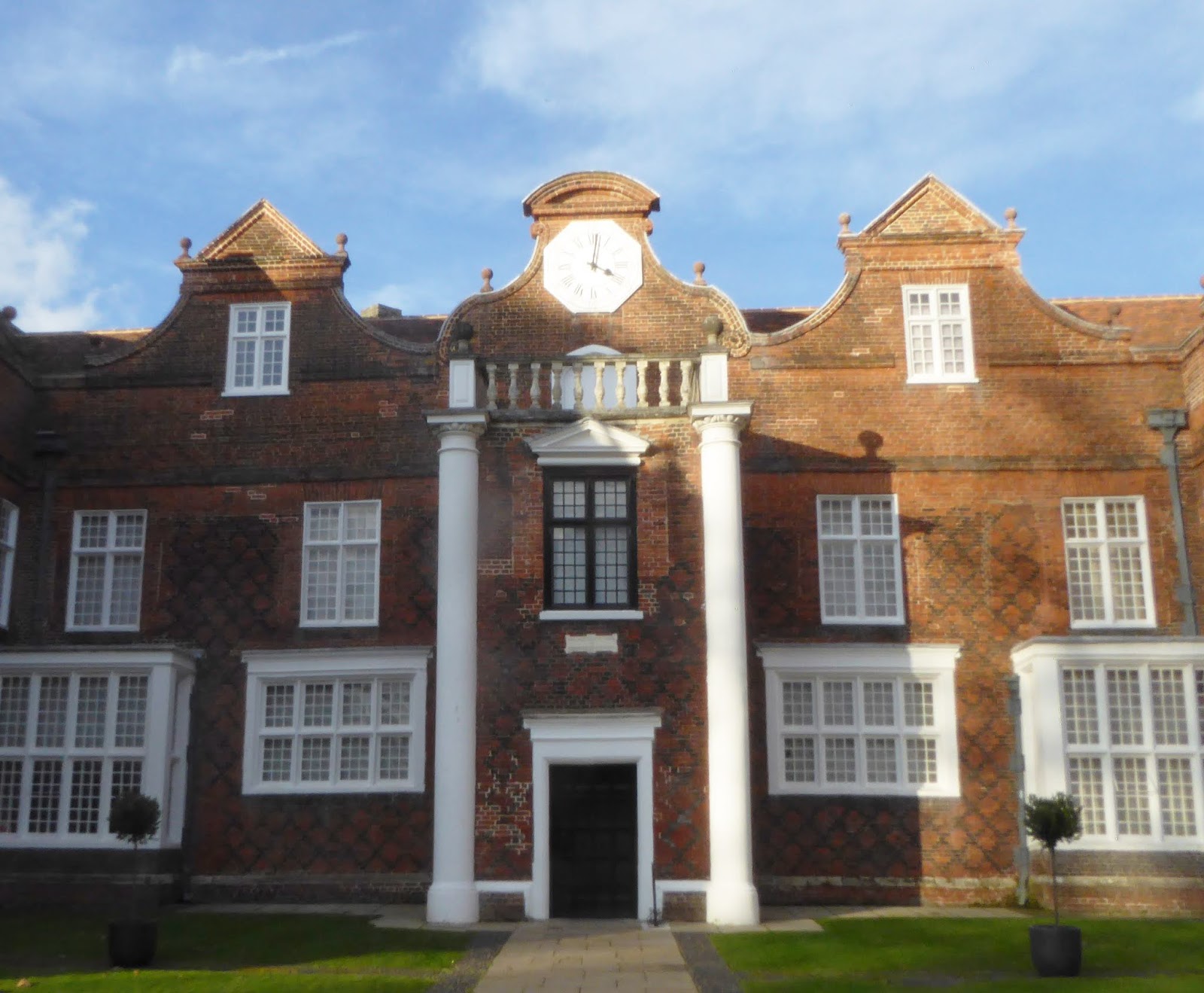
The picture below shows part of the facade of Christchurch Mansion, which is situated in the park. It was constructed on the 12th century site of Holy Trinity Priory, which failed to survive the Dissolution of the Monasteries under King Henry VIII.


This plaque with the date 1550 rather appealed to me.


My Latin is pretty rusty but if you think along the lines of making the most of your talents, you probably won't go far wrong...


It was good to have made the most of the sunshine...


...and to have enjoyed birdsong from the bushes. The Robin below was looking magnificent.


* * *


The light was fading by the time we reached home, but I was thrilled to find that our single Snowdrop had become a tiny drift...


...and with a very early tulip braving the wind and a hungry Blue tit feeding from the coconut, it began to feel just a little like spring.