Showing posts with label Aldeburgh. Show all posts

Wednesday, 22 July 2020

Damselfly Deliberations

Photo credit: David Gill 2020

I posted my photograph of this damselfly in my previous post about Aldeburgh sightings

My somewhat limited damselfly ID skills are rather rusty at present as I have only seen about five of these insects this season due to my shielding. Two of you offered identifications for which I am very grateful. However, I am left with a dilemma: is this a Small Red-eyed Damselfly or is it a female Common Blue? 

I have decided to pursue the matter a little further by (a) posting further photographs, the ones in this post which were taken by David (and used with his permission!), and (b) posting the photos on iSpot so that others also have the chance to have a look and offer an opinion. I will let you know how I get on. Meanwhile, please feel free, as ever, to let me know your thoughts in the Comments section. Thank you!

Photo credit: David Gill 2020


Photo credit: David Gill 2020

Photo credit: David Gill 2020

P.S. Update as of 23 July 2020. Many thanks to A.J. Parr, the Dragonfly Recorder for Suffolk, who has informed me that this is a female Small Red-eyed Damselfly, quite probably part of a local (Thorpeness) population. He explains that a female Common Blue would have 'only one, not two, dark streaks on the side of the thorax'.

Monday, 20 July 2020

A 'Floral' Afternoon on the Beach at Aldeburgh


We spent a little time on the beach at Aldeburgh yesterday afternoon. As expected there were a lot of people out and about on the footpath that runs between the car park and the beach, but there were very few people on the shingle and only three in the sea. As you can see there was nobody in the vicinity of the iconic Scallop.

My thanks to Conehead54 for advising me that this is Fennel (see comments)

There were few birds about, just the odd gull overhead and a single juvenile on the beach. There did not seem to many insects either, so I decided to photograph some of the plants. Many, if not most of these, are fragile and rare; and consequently cannot be picked.

I think this is Restharrow

This may be Common Restharrow. I find I am a bit rusty on my wildflower names. The insect is probably a Cinnamon Bug. I hadn't realised it was there until I uploaded the photograph.


Possibly a Blue-tailed Damselfly: what do you think? (* see below)

There was a straggly clump of bramble near the footpath, and David noticed this rather well-camouflaged damselfly.  


The leaves in the photo above look similar to a Bindweed. But I really don't know whether I am on the right track with this red and yellow bud.


There were a few clumps of Ragwort, so we kept a close eye out for Cinnabar caterpillars. I am wondering if the insect in the photo above is a type of (possibly damaged) Earwig. Do let me know if you recognise it, and meanwhile, I shall post it on the iSpot site. 

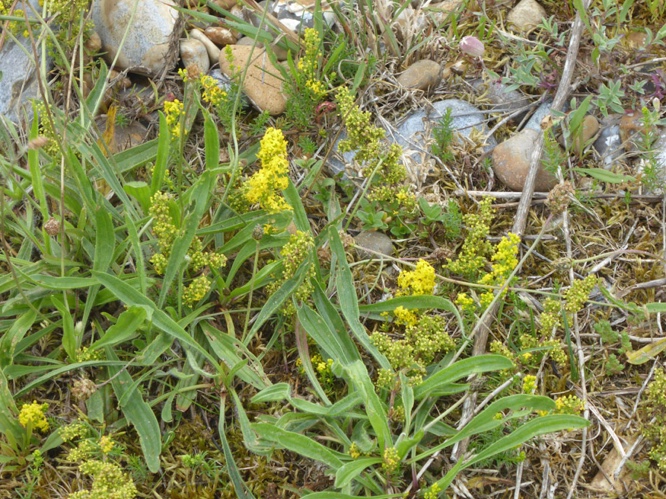
Lady's bedstraw?

There seem to be quite a few yellow plants along this stretch of coast. I presume there must be a reason: could it be linked to salt-tolerance?


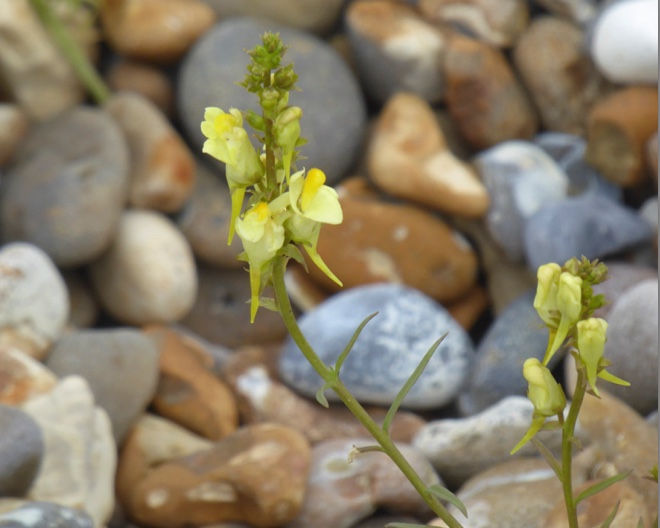
Yellow Toadflax

I always get confused when it comes to saxifrages and stonecrops. I wonder whether the clump of vegetation below may be related to Biting Stonecrop.


White Campion is fairly distinct, but Sea Campion and Bladder Campion are not so easy to tell apart. However, I believe the plant below is Sea Campion. There were quite a few clumps on the shingle ridge.


I don't often encounter Groundsel these days, but we came across a small specimen (below) near the upper edge of the beach. 


And here is the juvenile gull!


I love the patterning on its scapulars and coverts.


Lichen is usually an indicator of clear air. Aldeburgh is considered a healthy, if bracing, place to live. 


The sea, the sea...


I'm guessing this is a variety of Yarrow above.


The yellow flowers of the Horned Poppy are unmistakable.  


We noticed a couple of 'mermaid's purses'.  


There were  several clumps of this yellow plant in the photo below; and in one of the dandelion-like flower heads, I noticed what I thought at first was a small moth. Closer inspection suggested a bee of some sort, and I hope someone on iSpot will be able to enlighten me. I apologise for the poor quality: stem and insect were rocking to and fro in the wind.


The photo below shows how empty the beach had become by about 4.30 in the afternoon. The village with the tower is Thorpeness.


Sea Kale, in the pictures above and below, seems to grow well here on the stony beach.


It is a plant protected under the Wildlife and Countryside Act of 1981 and should not be picked.


I am always intrigued by these lookout poles. In my childhood we knew them as 'bear poles'.


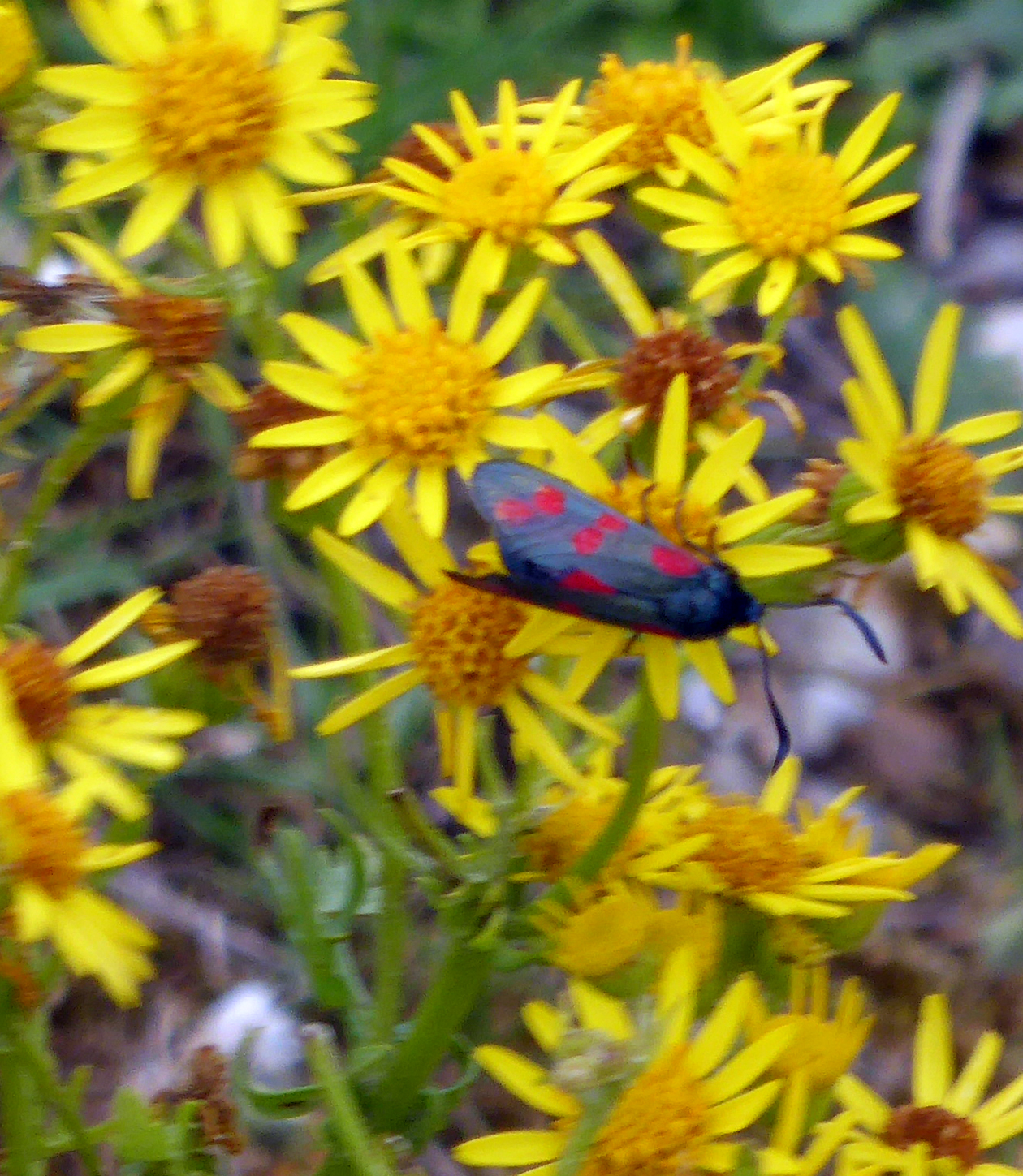
We kept looking at the stems of Ragwort...


... and eventually found one 6-spot Burnet moth ...


... and a single striped Cinnabar caterpillar. 


The plant in the photo below is the Sea Pea, another legally-protected plant that is well adapted to the harsh terrain. Its low-lying nature means that it is sheltered from the force of the winds on this exposed east coast. 


And finally, as we returned to the point where the beach joins the path, I noticed a few red Poppies. 


P.S. My thanks to the author of Odo-meter and Imperfect and Tense blogs for informing me that the damselfly seems to be a female Small Red-eyed specimen, a variety new to me. Further thanks to Conehead54 for indicating that the same damselfly is a female Common Blue. I will see if we have a better photograph which may possibly make a more definitive ID possible. Watch this space! 

Monday, 14 May 2018

An Afternoon at Snape and Aldeburgh


The forecast was not very promising, but when we reached Snape Maltings yesterday afternoon the sun appeared and it was sufficiently warm for a small Common Lizard to venture out of the reedbed. Lizards are not only wary of humans but they are also protected under law, so this photo was taken with my zoom lens extended. The camera has focused on the thorax: what intricate designs these lovely reptiles have.


I have no idea whether the skin patterns are entirely for camouflage in this species or whether colour and appearance play any part in mating rituals. You can read about some Aegean Wall Lizard research on this topic here.


The photo above shows Snape in the hazy sunshine. 


Some creature, possibly a deer, has carved out a private path through the reeds.


Humans can walk through the reedbeds in the direction of Iken on this slatted boardwalk.


The light was very strange at this point, but the iconic tower of Iken Church, dedicated to St Botolph, was very prominent on the far side of the water.


Hawthorn, also known as May, blossom was bursting into flower. We left Snape, and since the afternoon was still dry, we moved on to Aldeburgh ... 


... where we were greeted by this rather fierce Herring Gull.


I am not sure what the blue line signifies, but this is where the gull chose to stand on patrol.


I saw a couple of people eating fish and chips in a car as we left, so perhaps the bird knew that it was in exactly the right place for its favourite snack.


It began to look as though the promised rain was on its way. In fact, we somehow seemed to avoid it, so perhaps the storm broke out at sea.


It is always a joy to see the emergence of summer flowers, and the Aldeburgh area has some unusual coastal varieties. This was the first Sea Campion I had encountered in 2018.


David walked on towards the martello tower. We could see Orford lighthouse in the distance and the eerie defence 'pagodas' on Orford Ness.


This was the view on the landward side of the path. This water-bound area, just south of Aldeburgh and around the river Alde, is known as Slaughden. It was once a vibrant commercial centre. The tide has already claimed so much of this fragile maritime environment.


Oystercatchers were calling on the landward side of the path,


 ... and a Mute Swan was doing a spot of preening. Look at the size of that webbed foot!
Meanwhile, out at sea ...


... the beautiful head of a seal was bobbing up and down. The photo above was the best my camera produce as the seal was quite a way out in the deeper channels and the light was very stormy.

Back home in the garden, it was good to see a variety of Soldier Beetle I had noted in May last year.


There were several Dandelion clocks on the lawn..


... a sign, I would like to think, that the settled sunny weather ...


... will return before long.