|
| Sophie Dawes - her story |
Our destination on the Thursday morning was St Helens in the east of the island, with its spacious village greens. It was pouring with rain on our arrival, so we spent a happy hour in the excellent secondhand bookshop, Mother Goose Books, where I selected a couple of volumes on the island's literary links.

We drove towards the Duver at the mouth of Bembridge Harbour. The word 'Duver' is an interesting one as you will see if you click the link. The more usual word is 'dune', as in sand dune. Cornwall has 'towans' and the Welsh word is not dissimilar to this.
The Duver is a small spit of land running across the mouth of the River Yar. It is made up of sand dunes and shingle beaches, and is bordered by saltmarsh. A golf course was built here in the 1890s, but that has now gone. It is a wildlife-rich area, part of it being a Site of Special Scientific Interest (SSSI). Autumn Squill is one of the rareties that grows in this special habitat. You can read about the insects here.
We had our picnic lunch on the foreshore in the rain and set off towards Nodes Point. I was amazed at the number of shells.

The scallop below was my favourite.

This is its underside (below)...

I wonder how many varieties there are in this photo. Are many of these Slipper Limpets, do you think?

There were a number of oyster shells like the one below. I expect the Romans enjoyed finding these in days gone by.

The photo below shows a Common Otter Shell.

And here in the photo below, with a cockle on the right, is what I think is the egg case of the Common Whelk.

Shells were not the only thing of interest. There was a notice about Priory Point, named after a former Cluniac house. We took a walk around the remains of the ruined 13th century tower of St Helen's church.

You may be able to tell from the photo below that the outer wall of the ruined tower has been painted white. This is because it is used as a sea mark. I love the formation of the rocks in the foreground.


We could see the Bembridge lifeboat in the distance from St Helens.

We went on to Bembridge for a pot of tea and large slices of chocolate cake.
*
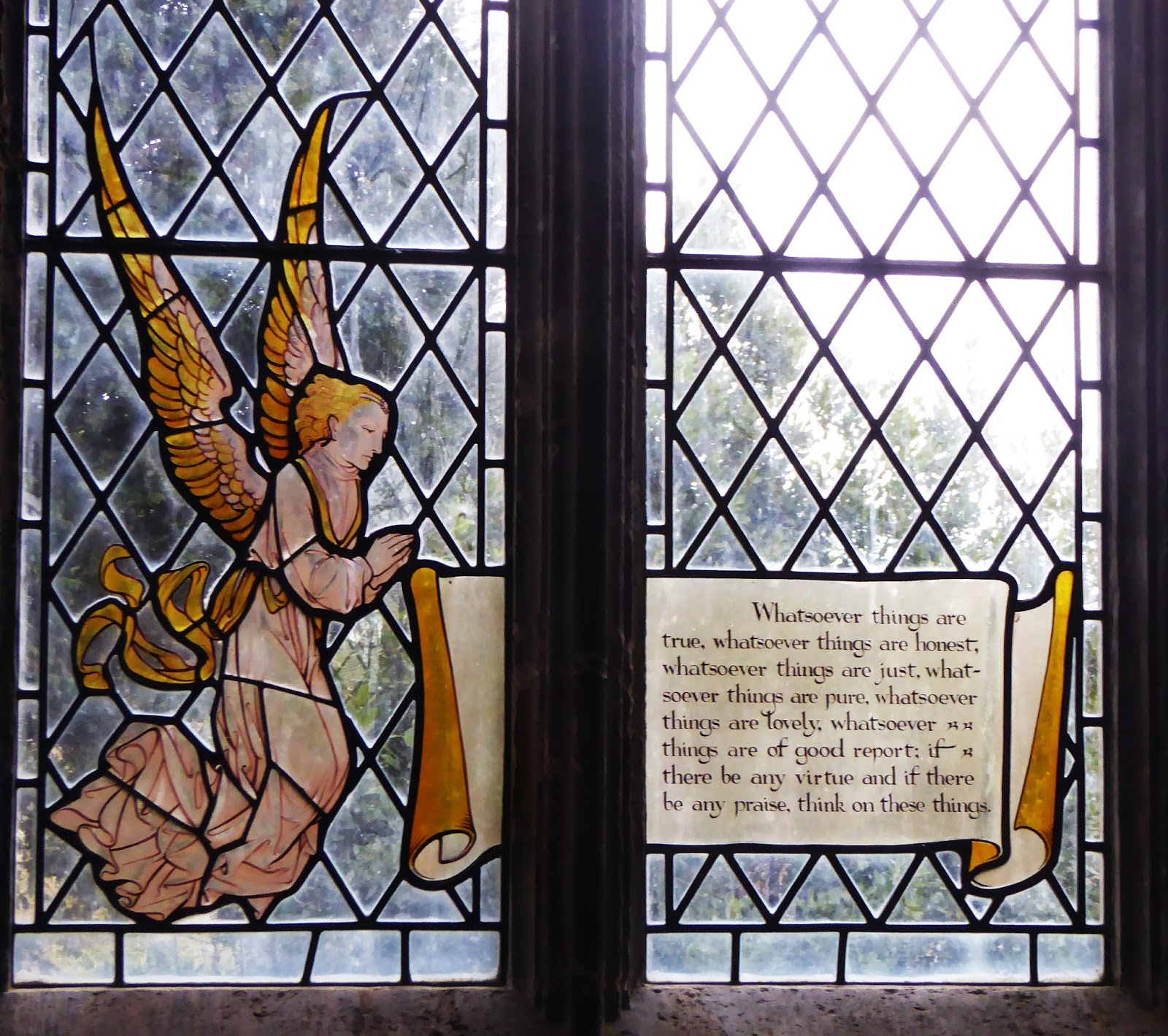
I mentioned in a previous post that the church with Pre-Raphaelite windows at St Lawrence near Ventnor was locked on our first visit. The rain continued so we thought we would try again, and this time the door opened. The stained glass was well worth seeing as you can tell from this small piece below. I wonder what the white birds are meant to be. I think the scene is from verse 4 of the parable of The Sower.

I haven't been able to work out how to add my next three photos on the same line. They comprise a 19th century stained glass triptych in the south wall of the church, showing Peter (carrying the keys of the Kingdom), Luke (the doctor with a medicinal plant), and finally John the Evangelist.

Peter, from a cartoon by Burne-Jones

Luke, from a cartoon by Ford Madox Brown

Close-up of Luke's medicinal plant

John, from a cartoon by Burne-Jones
You can read more about the windows here.
We left the church and went down to the beach at Ventnor to watch the waves.

We noticed a rainbow and hoped the rain was on its way out.

I am almost at the end of these Isle of Wight posts, but before I reach that point I want to add in a few corners that have been missed out up until now.
David was interested in the forts around the coast, so you will not be surprised to learn that we visited Fort Victoria one afternoon in glorious sunshine. I can't say it was a favourite spot on the island for me, but the views along the Solent were well worth seeing.

We even saw a dolphin ... of sorts ...

I have hardly touched upon our excursions along and above the Military Road on the south of the island. We reached St Catherine's Oratory, aka the Pepperpot, late one afternoon. It was time to buy supper in Ventnor, so we only stopped for a moment and I took this record shot from the car park below, which is why the other half of the tower appears to be missing.

On this occasion we had come from the Compton Down area, where we spent a little time watching the surfers at Hanover Point.

I saw my only Stonechat of the holiday in this area.

This part of the island is in the care of the National Trust. Iguanodon are said to have inhabited these parts in former times. Dinosaur bones and footprints have been identified.

This white 'ammonite' below was the only 'fossil' we found during our holiday!

Sadly these wonderful cliffs are eroding at a rapid rate. The fossils that they yield may help our knowledge of science, but there is something very tragic about erosion. The scene below reminded us just how fragile our environment can be.

When we turned our backs to the sea we had this wonderful view of the down.

The photo below shows the Five Barrows in the evening light.

Our visit was too early in the season, but these downs are good butterfly habitats. The National Trust have produced a Butterfly Walk. The organisation has recently acquired land in the Dunsbury area: you can read about the trail here. You can read about one of the rare butterfly species, the Glanville Fritillary, here - and also here on the National Trust website.
The light was fading fast. We ate our picnic overlooking the beach as the sun set on the far side of Tennyson Down. Edward Thomas, one of my favourite poets, wrote that...
'nothing impedes the eye in its travelling far westward over a long procession of downs ... and the long sheer white walls of the Freshwater and Highdown Cliffs, under the windy grey and white of the huge sky.'
The Isle of Wight by Edward Thomas

*
Sadly Yarmouth Castle did not open until the day we were due to catch the ferry back to the mainland. We reached Yarmouth in good time despite having to follow a traction engine, and David whizzed in to the castle for a quick look. There is so much we still have to see, and I hope we return sometime during the butterfly season.
We boarded the 'Wight Sky' and set off for Lymington. We were the only passengers on deck. It was bracing and bitterly cold. I was glad of all the clothes I had worn in Philadelphia in January seven years ago!

As we set sail, I did get to see just a little of Yarmouth castle after all ...


It was not long before our 'berth' in Lymington came into view.

Our 2018 Isle of Wight Posts
- Caroline's post on Osborne House and Carisbrooke Castle
- Caroline's post on Brading Roman Villa
- Caroline's post on Newport Roman Villa
- Caroline's post on Tennyson's Home at Farringford
- Caroline's post on the rainbow sands at Alum Bay
- Caroline's post on Mottistone, Newtown and Wildlife
- This post on St Helens, St Lawrence and other destinations
- David Gill's posts on the Heritage Futures blog
I have been blogging for quite a number of years now, and owe so much to the blogging community. I am very indebted to fellow blogger, Ragged Robin, whose wonderful posts inspired many of our Isle of Wight expeditions. Thank you, RR, so much for all the tips, the photographs, the wildlife information and so much more. May the web continue to be a source for the sharing of good things.
*
During my Cornish childhood holidays, we often used to chant the Benedicite, a canticle in praise of creation, in church on Sunday mornings. I referred to the fact in a previous post that Tennyson loved the stars which shine brightly on the island due to the lack of pollution. I thought I would end my Isle of Wight posts with this photo of a phrase from the canticle on part of the roof of the chapel of St Nicholas in Castro which lies within the walls of Carisbrooke Castle ...