Showing posts with label Islands. Show all posts

Monday, 11 April 2022

RSPB Boyton Marshes and (views of) Havergate Island


We decided to revisit RSPB Boyton Marshes yesterday afternoon, a Suffolk nature reserve we have been to once, or at most twice, in the past. We had hardly left the farm, the cattle and the car park behind when we saw Avocets. We have watched these elegant birds a few times over here in East Anglia (and have even seen chicks at WWT Welney); but when I was a teenager in Norfolk, they were fighting for survival. Many of you will recognise the Avocet from the RSPB logo. 

We saw some other beautiful birds on the reserve: Mute Swans, Teal, Curlew, Grey Heron and Marsh Harrier, to name but a few. We also had good views across to Havergate, Suffolk's only island. You can see the western end of the island in the photo below (you can click on the photo to enlarge it), with the spit of Orford Ness on the horizon in the far distance. 

I love islands and was thrilled to locate this one. It is run by the RSPB for the benefit of wildlife. Visitors arrive on boats from Orford, bringing their own refreshments as there are no food or drink outlets. There are, however, a few hides to facilitate bird-watching activities.


The tidal flats on the salt marsh began to fill up as the tide turned during the afternoon. 
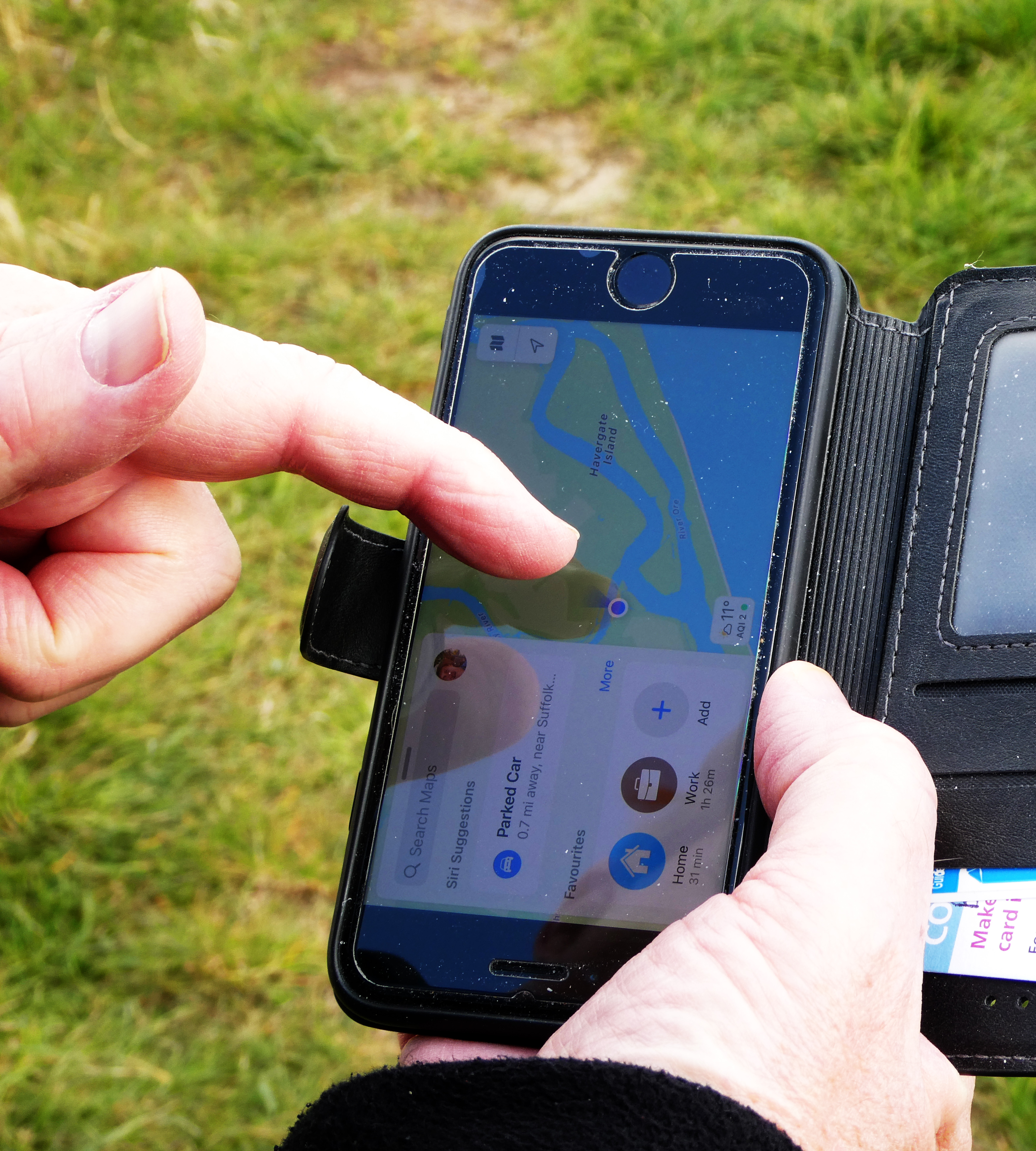
 

David was able to show me how the island nestles behind the spit of Orford Ness, the green strip on the right in the map on his iPhone screen.


You can see one of the hides in the photo above. This was taken with my zoom lens extended in strange shadowy light. We had a mix of sun, showers and even a couple of hailstones. I hadn't even noticed this particular Curlew when I took the photograph.

We were delighted to see a variety of ducks on the mainland reserve. These were near the Avocets. The ducks we saw included the Shelduck, ...


 ... the Eurasian Teal (a female in this case,
with her vibrant green streak) ...


... and the Shoveler.


During the course of the afternoon we encountered several Grey Heron.  


You can see from the next photo why it is such an ideal landscape for ducks.


The area around Boyton Marshes is very varied, which means there are a number of different habitats within and around the reserve. I noted the following (and our total of 15 species of bird sightings, counted in about an hour in a casual kind of way):

  • inland ponds (Teal, Shoveler, Shelduck, Avocets, geese)
  • farmyard with cows and bushes (Chaffinch, Carrion Crows)
  • reedbeds (where we could hear birdsong. A group of birders had their scopes trained on these)
  • estuary, Butley Creek (Curlew, Little Egret, Redshank) 
  • grassy sea wall (Marsh Harrier overhead, Oystercatcher at base)
  • fields, ?water meadows (a flock of Mute Swans, Greylag Geese, Canada Geese, Lapwing)
  • island, Havergate Island (gulls on roof of a hide, though I couldn't see which)
  • shingle spit, Orford Ness - too far out to see specific species
  • North Sea - too far out to see specific species


The photo above shows the grassy bank to the right. On the left you can see that there are reedbeds and a watercourse receding into the distance. Butley Creek, a tributary of the river Ore (as in Orford), can be seen from the top of the bank, as shown in the next photo.


The ruined building above constitutes the scant remains of Boyton Dock. For a fairly short period in the mid-seventeenth century, substantial amounts of 'potter's clay' were loaded on to ships from this part of the estuary. Some of the clay was used in America and the Netherlands while some was used in the London Delftware industry. The mid-nineteenth century saw Boyton sending coprolite to Ipswich by barge for the manufacture of fertiliser. I spent a year of my life in Ipswich as a resident of Coprolite Street.

There are, in fact, several ruined buildings in this part of Boyton and its environs, many linked to defensive measures. The name 'Boyton' stems from 'Bay Town', the bay being nearby Hollesley. Boyton was one of the Suffolk locations picked for the filming of The Dig

The photo below shows the view from the Dock, with some of the more distant ruins on the eerie spit of Orford Ness beyond the far bank (and over the water, which it hides). 


I felt a few hailstones on my face as this Marsh Harrier flew high above our heads ...


We took a final look at Havergate Island and turned for home. 


Our view of the creek once we had turned round.


Tuesday, 30 June 2020

Day 30, Final Day of #30dayswildcreativity: The Sea and its Islands

Two Noah's Ark panels of stained glass from St Neot's Church, Bodmin Moor

I discovered very early on that I enjoyed drawing. When I was about four or five I was asked to draw Noah's Ark, a challenge I relished as I loved animals. I also loved the sea, being by the sea and paddling: it took me a long time to learn to swim. Sadly I failed to keep that drawing, but the version in the stained glass above always make me smile when I see the dove being sent off to look for dry land in one panel and the dove returning in another with what must be the olive leaf in its bill. 

There is something about setting off from the security of the shore and heading out into the vastness of the ocean. I was a timid swimmer and it was many years until I was finally awarded my bronze Personal Survival Medal. I am also a timid sailor in choppy seas. But I love a short excursion out into the ocean, particularly when there is the lure of an island at the far end of the voyage. 

Back in 2011 we were holidaying in Lochinvar in Assynt in the north-west of Scotland. The weather in that magnificent region is very unpredictable, though it is usually safe to predict rain. We checked the weather forecast at breakfast and decided that all was set as fair as it was likely to be. 


We boarded a vessel to the Summer Isles and set out in fine weather...


... and were soon leaving the brooding silhouettes of Stac Pollaidh and Suilven behind.


A few minutes later the sun came out and we were able to feast our eyes on these intense ocean blues.


By the time we reached the island of Tanera Mòr, it had turned into a beautiful afternoon. 


There was just time to call in at the Post Office, which has been issuing its own stamps since the 1970s, before heading back along the bank to enjoy some local wildlife. Stamps bought on the island can only be used to transport an envelope or postcard as far as the mainland. Thereafter a missive will only reach its destination if it also carries a regular stamp.


We noticed some orchids, and as we drew closer we saw...


... this 6-spot Burnet moth ...


... and this one that landed on David's hand. The bank was full of these colouful insects, and judging by their shiny appearance, I think they had just emerged and were drying off their wings in the bright sunshine.  


Another surprise took the form of this impressive (and ferocious) Green Tiger Beetle

Our time on this special island was fast drawing to a close. I looked up at the remains of an old dwelling and paused to wonder what life would have been like in the 1880s when a population of 119 was recorded. Doubtless many, or most, of these would have been linked to the herring industry

Everything changes, including Scottish islands. Tanera Mòr has been sold since our visit, and a new vision is taking shape. 


As we waited by the shore for our return voyage, we watched these female Eiders drifting through the tranquil waters.  


The photograph above shows me in my element aboard a boat on the water in fabulous weather, and with the mainland not far away. The Tate (Tate Britain, I believe) holds an 'aquatint on paper' of the pier at Tanera Mor, produced by William Daniell, who died in 1837, the year before members of my Scottish family emigrated from the Cairngorm area under the Lang Bounty Scheme, via Oban, to Sydney. What a voyage that must have entailed. Their fortitude is something I find hard to imagine; but, like Noah on Mount Ararat, they reached the safety of dry land. 

* * *  

This post was written in response to Dr Miriam Darlington's final #30dayswildcreativity meme on her Facebook page. We were invited to write about something we had fallen 'in love with as a child', and I have chosen to focus on a number of different threads, many of which weave together in my life as I enjoy the natural world and its oceans. 

Threads represented in my 'sea collage' below include time spent afloat, looking in rockpools, watching wildlife, writing, sketching and taking photographs. 


Thank you, Miriam, so much for your inspiring themes and memes. I have thoroughly enjoyed responding to them in word and image. Thank you, too, for the literary excerpts and poems you have introduced us to along the way.  


Wednesday, 22 July 2015

2015 Scottish Odyssey (1) Mammals

We had a wonderful 'summer' holiday in Scotland. The weather was particularly mixed this year; but despite the cool temperatures, we had not expected to find spring primroses and bluebells and quite so much snow around in mid-June. It might even have been good weather for penguins!

Sign on the lovely Scottish island of Gigha

Snow around Kintail


Heading north through Glencoe


Insects were rather thin on the ground this time, but we saw quite a few birds (like the Arctic Terns in the photo below) and an interesting selection of animals.


Dunvegan, Skye      © David Gill 2015

I shall begin with my 2015 mammal list:
  • Bottlenose Dolphin (from the ferry to Lochranza on Arran)
  • Common/Harbour Seal (largely at Dunvegan on Skye)
  • Grey Squirrel (Culzean)
  • Hare (particularly at Kilmartin and on the way to the Mull of Kintyre)
  • Otter (Skye and Argyll)
  • Pine Marten (sadly no photograph, but a first for us)
  • Rabbit (Skye)
  • Red Deer (several locations)
  • Red Squirrel (just one ... adjacent to Loch Awe)
  • Roe Deer (several locations)
  • Shrew (a nest, Attadale) 
Sadly we failed to see any of the Knapdale Beavers (the weather was particularly deluge-like that day), but we enjoyed looking. Their watery realm was straight out of a fairytale!


Beavers may have eluded us in 2015, but (despite a week on Mull last year), we had our best Otter sightings ever ...


First view: was it an Otter?
Definitely!


Last view before it disappeared into the water ...

Bluebells (and Primroses) on Midsummer's Day

Thursday, 10 July 2014

Scottish Odyssey 2014 ~ The Crex-Crex of the Corncrake


"... a summer noise among the meadow hay…" 
John Clare

Corncrake making its 'Crex- crex' song. Photo credit: © David Gill 2014

I have a new 'lifer' on my bird list. David and I were on Skye two weeks ago, watching Corncrakes!

Yes, we actually saw two Corncrakes, one in flight and the other some distance away from the first in long vegetation. These birds have been given Red conservation status by the RSPB. They were far more prevalent in the past before updated agricultural practices began to interfere with the Corncrake habitats. You can read about the legal protection of this species here.

Many folk in the islands off the west coast of Scotland will have heard the distinctive 'crex-crex' sound, but few will have seen these shy birds in recent years. After our Skye sightings we kept a sharp eye open on Iona, but failed to spot any more. We knew they were close by as several males were calling loudly.

We sent this iPad audio recording of a male Corncrake, with David's photo, to the RSPB, along with details of the Corncrakes we saw and heard ... It may take a few seconds to load on this page.


Photo and audio credit: © David Gill 2014, used with permission

Corncrakes are fascinating birds. Unlike most members of their bird family - the Coots, Water Rails and Moorhens - they rarely inhabit wetland landscapes, preferring meadows with long grass and wild flowers and fields in which the crops have reached a decent height for cover.

Each winter the birds migrate to the grassy plains of sub-Saharan Africa and each spring they make the long journey to the islands off the west coast of Scotland.

My photo ... you can see how hidden the Corncrake was. Photo shot with zoom lens.

Male Corncrake singing. Photo credit: © David Gill 2014

Deep in the foliage ...

... with one eye peeping out. Photo credit: © David Gill 2014

Corncrakes breed in their first year, with the female incubating the clutch of about ten eggs while the male moves on to mate with another partner. I was given the impression that the Corncrake is a bird who loves to skulk away from the limelight, so I was not surprised to discover that nests are laid low on the ground in the middle of areas covered by vegetation.

The Corncrake is also known as the Landrail. You might like to read this RSPB blog post by Mark Avery - and the rest of John Clare's poem, The Landrail, which features in it ...


Recommended reading
  • Corncrakes by Rhys Green and Heather Riley (Scottish Natural Heritage, 2005 edition)

Website suggestions

Monday, 16 August 2010

Beautiful Birds (8): ASBO Puffin


Those who follow my blogs will know that the Puffin is probably my favourite bird, though I have been greatly enjoying the Little Penguins on the television programme, Penguin Island, narrated by Rolf Harris.

I recently blogged about humans eating Puffins on the Shiant Islands, but the RSPB has issued a report about adult Puffins attacking a young one at Sumburgh Head on Shetland. It may be that the chick-less, would-be parents are venting their frustration on the Puffling. You can read more about the story here. Thankfully, despite the attcks by 'ASBO Puffin', the youngster was strong enough to fledge on 11 August 2010.