
Those of you who have followed the winding path of this blog will know that I find an unusual sign hard to resist. Sadly, as I have mentioned in a previous post, we failed to catch a glimpse of one of these beautiful Red Squirrels. We came across the sign near the Botanic Garden in Ventnor en route to St Lawrence, where one of the churches has Pre-Raphaelite stained glass. I had hoped to visit the gardens, but by this stage in the week the weather had turned against us. I would love to return in summer to watch the native or naturalised Wall Lizards.
Earlier in the week we had spent a glorious afternoon exploring the gardens at NT Mottistone. The manor here was first mentioned in the Domesday Book. The gardens, by contrast, were planted and restored by Lady Nicholson in the 1960s.

The manor provides a wonderful backdrop to the gardens, but is not open to the public. John Seely, 2nd Lord Mottistone, restored the manor house in 1926.

What a joy to see a bank of primroses as we approached the garden.

There were more signs of spring in the grounds, even if these were of a more cultivated kind.

The photo above shows the Manor as you see it on arrival.

This is the view from further round.

Some of you may remember that I like to post photos of the shepherds' huts I encounter. The Shack above is not one of those, but it reminded me of them in a way. Architect John Seely, 2nd Lord Mottistone, designed it with Paul Paget in the 1930s and, according to the National Trust, it was used as a country office and rural retreat. It began life at Freshwater and was built along the lines of a two-berth cabin on a boat.

We were surprised not only by the number of corvids on the island but also by the number of raptors. I was rewarded with this sighting of a Buzzard while David climbed to the heights in search of the Long Stone.

It was cloudy, but apparently the views from the top of the down were wonderful. You can see the Long Stone standing proud in the photo below.

The name, Mottistone probably, probably derives from 'moot stone', a stone to mark the meeting place, or moot, in Anglo-Saxon times. The stone itself predates these days and is thought to be the entrance to a neolithic Long Barrow, or burial chamber. It was excavated in 1956.
We had an exceptionally good National Trust tea in the garden and made our way across the road to the parish church of St Peter and St Paul.

The churchyard was a wonderful wildlife habitat, apparently attracting butterflies and bats, though we were too early in the year to see these creatures for ourselves.


We went inside to have a look around. Some of the roof timbers in the chancel had once been part of the 'Cedrene', a Bermudan barque that had been wrecked off the coast.

The seahorse banners were beautiful. I suspect they are linked to the Seely family as, according to The Oldest House in London by Fiona Rule, Paget included two seahorses as a memorial to 'John Mottistone' (John Seely of Mottistone) in a niche in a clergy house they had renovated together in Westminster Abbey's Little Cloister.
There was a little sunlight shining through the stained glass below as we left the church.
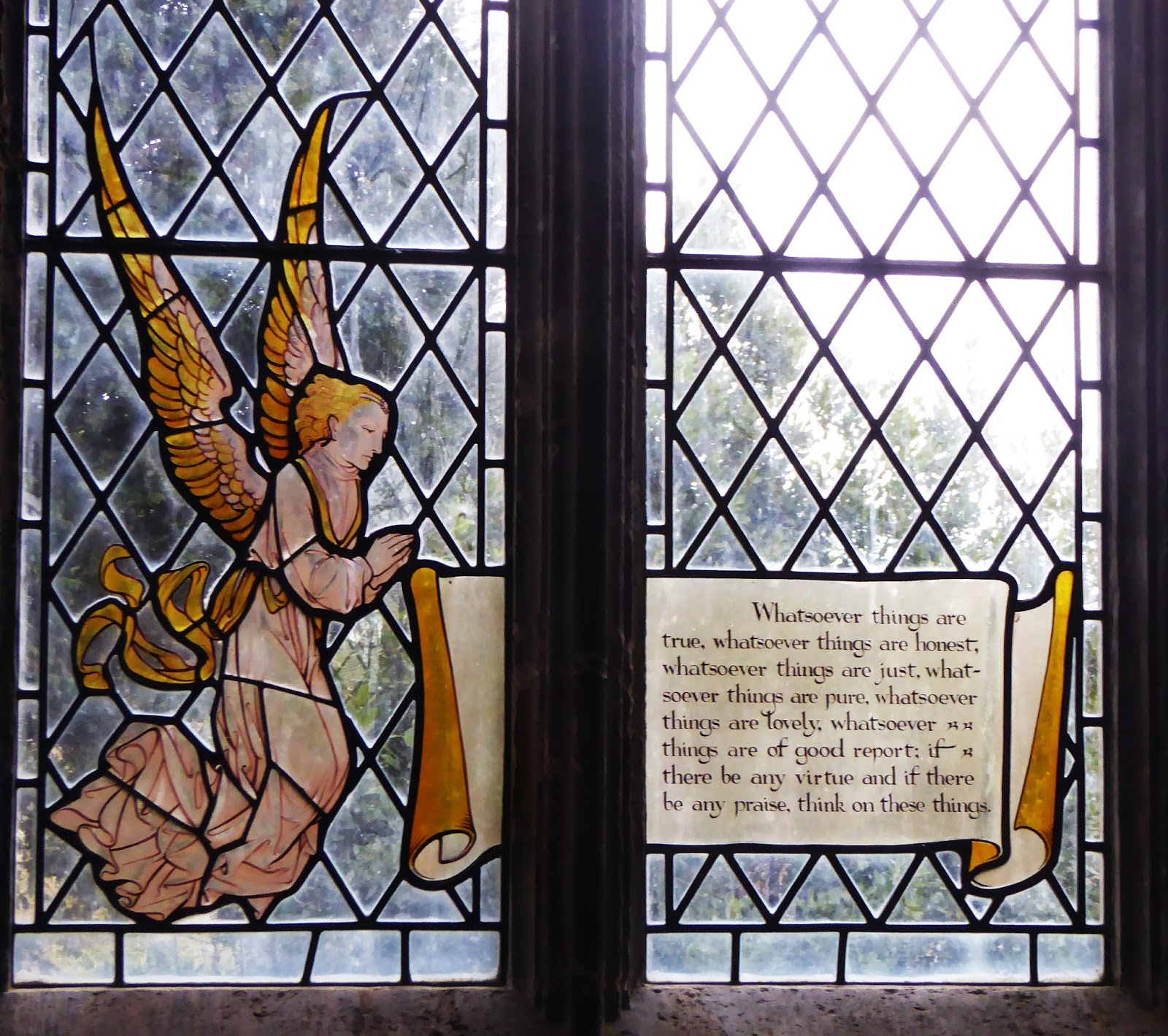
We headed off to East Cowes for a sunset picnic, watching the hovercraft, cruise ships and ferries on the Solent.
*
It was lovely to see corners of the Isle of Wight given over to wildlife. In addition to the nature reserves and the wildlife churchyard at Mottistone, we discovered a wildlife garden in the NT grounds of Bembridge Windmill.

We visited the mill on a particularly chilly morning, and were lured inside by the enticing aroma of hot coffee.

I had a quick look around the ground floor of the mill, and was particularly taken with the only owl I saw on the island...


I left David to climb the mill and ventured outside to see the sheep.

What a magnificent face.

The photo above shows the sheep high above the flat lands that are such a feature of this corner of the island.

I mentioned wildlife gardens, and while this was not a garden, it was good to see that land around the mill had been kept aside and given over to wildlife. The first nettles of the season were beginning to spring up.

I imagine this fungus will feed and play host to a huge variety of species. A previous post featured the Roman villa at Brading, and up above on Brading Down we had noticed more wildlife provision, as the board explained ...

Having looked, all too briefly, at gardens and wildlife provision on the island, I must move on to the nature reserve at Newtown. But before I do, I can't leave the Bembridge area without posting this photo below of Holy Trinity church: the palms that had been used on Palm Sunday a few days before had been laid out on the path, a practice we had not seen before.

And finally (in this post) to Newtown Nature Reserve!

We went via Yarmouth where we stopped for a quick look around and, having seen the horsetails on our way, noticed the board below advertising not only charabanc rides but also coal from the north east. We don't often see horsetails in our part of sandy Suffolk; but when I see them, they take me back to junior school and the work we did on early times such as the Carboniferous Era when these vascular plants were prolific. We know this because they have shown up in coal measures.

We moved on to the nature reserve at Newchurch, run by the National Trust.

As you can see, we came across two boards listing recent sightings. Our own list was far less impressive, but we thoroughly enjoyed watching the birds we managed to see.


We spent some time in the hide, looking over Clamerkin Lake. We noticed some geese in the distance and large flocks of Black-headed gulls.

There was some useful information in the hide, like the map-diagram below. We learned that the lake was situated on the East Atlantic Flyway, and was therefore a key spot for migrating birds.

You can see the gulls in the distance in the photo below.


The Solent area is renowned as a good place for sailing.

Once again it was the corvids who tried to steal the show: what a fine Jackdaw!

We always love to see Little Egrets so were very pleased when this one came into view. I recall the first one we ever saw, soon after our arrival (and, I believe, their arrival, too) in the Swansea area. That first one we spotted was on the Gower peninsula at the edge of the Loughor estuary back in the early 1990s.
My last photo in this post shows one of the Redshanks we watched. These birds probe in the shallows for their food.

Thank you for reading this far! My final post in this Isle of Wight series will include some of the sites we saw in and around St Helens (no apostrophe as I understand, like the city of St Davids in Wales; but please correct me if this is not the case). I will complete my tour with a few miscellaneous items that took my fancy along the way.


