Caroline Gill's Wildlife Record: Suffolk Horizons (and the World beyond her Window)
Showing posts with label shieldbug. Show all posts
Sunday, 29 March 2020
Gorse Shieldbug
This little insect, nearly 1 cm in length, was walking about on the woodbine (if that is what this kind of unruly honeysuckle is called) on Friday. I suspected it was a Shieldbug of some variety since the Dockbugs in the garden tend to be brown. The green on the scutellum was a very vivid shade and I thought the gold rim (which I believe is the connexivum) was rather unusual.
I popped the photo on iSpot and it has been identified as a Gorse Shieldbug. My immediate reaction was 'but our garden doesn't have any gorse'. However, we have sandy soil and live in the vicinity of heathland; and gorse, it seems, is not the only host plant. I wonder what other insects I will see in the days ahead: I guess I may be in the garden rather a lot (though today was bitter with strong winds, hail and snow showers) as I cannot go beyond our boundary at present in my self-isolating regime.
Saturday, 12 May 2018
Common Blue butterfly, Shield bug and 14-spot Ladybird
I haven't ventured further than the garden today, but I have enjoyed seeing the variety of insects that are suddenly beginning to emerge after the long lean months of winter.
I love blue butterflies: this Common Blue reminds me of Robert Frost's 'Blue-Butterfly Day' poem.
I wonder if it has been a particularly good year for Shield bugs (or Stink bugs) in your locality. I seem to have seen more than usual in the garden, including the two in the photos below .
![]() |
| The large triangle on the back is called a scutellam |
And finally, just when I was heading back indoors, I noticed a small yellow insect on a nettle - my first 14-spot Ladybird (Propylea 14-punctata) of 2018. I'm sorry it isn't a better photo, but I had no wish to get stung!
The 14-spot feeds on aphids and is a welcome addition to the fauna in our garden. Here in the UK our only other yellow Ladybird has 22 spots, and they are much more like spots than these rectangular blotches.
Saturday, 12 March 2016
My First Shieldbug of 2016 - perhaps
This is one of the first bugs I have seen in my garden this year. It was less than a centimetre long. The triangular marking makes me think it is something like a shieldbug or a stinkbug. It was small and narrow. I see that nymphs (in various instars) can often be more rounded in shape than adults. The size, however, might suggest a young insect, so I am rather confused. Do let me know if you can identify it.
On the 2016 insect front, we had a queen Buff-tailed Bumblebee quite a few weeks ago. Since then there have been one or two Ladybirds (no Harlequins here yet) and a couple of Bluebottle-type flies.
I am still waiting to see my first butterfly.
--------------------------------------------------
Update: 21 March 2016
Thanks to the kind people on iSpot, it seems this is not a Shield Bug but a Mirid, possibly European Tarnished Plant Bug (Lygus rugulipennis).
Wednesday, 9 September 2015
Early Autumn ... a mixed bag
![]() |
| Hoverfly Syrphus sp. (I think) on the last of my Californian Poppies |
I spent ten or twelve minutes in our garden with my camera this afternoon, having a look around to see what was about. There was a dragonfly, but it was on the wing and never gave me the chance to see it properly. I could hear a few birds rustling in the bushes, but the only one to break cover was a female Blackbird. There were a number of insects, as you will see ...
![]() |
| Hoverfly Syrphus sp. |
![]() |
| Marmalade Hoverfly Episyrphus balteatus (I think) |
![]() |
| Early autumn berries on the Hawthorn |
![]() |
| Blackberries arriving over the garden fence! |
The photograph above intrigued me. There is a Small White (Pieris rapae) caterpillar on my Nasturtium leaf, but what is that white mark at the tip of of my orange arrow?
As far as I can see, caterpillars do not leave a trail of slime in the way that slugs and snails do. However, I have discovered from Reg Fry on the UKLeps website (you will need to search or scroll down once you have clicked the link) that White (Pierid) caterpillars spin a silkpad as part of the pupation process.
Intriguingly, it does not actually look to me as though the 'silk' in my photos is going to be used in this way. Do let me know if you have any thoughts.
I wish my photographs were clearer, but I was leaning over an unruly clump of wild honeysuckle, and had no wish to topple over!
![]() |
| Close-up of ?silk |
The photo above shows a couple of Nasturtium plants that have largely survived the onslaught of the caterpillars thus far. However, as you can see the leaves have been eroded by Leaf Miners (you will need to scroll down once you have clicked the link). I blogged about these two years ago in July. My Nasturtiums have been much later this year.
What interests me, though, is whether any of the parasitic wasps that have frequented this part of our garden around my insect hotel have been laying eggs in the Miner larvae. This thought may not be for the squeamish!
Above: something more straight forward - a Daddy Longlegs or Cranefly. I expect these will soon be making their way into our homes.
And finally, a Shieldbug nymph (I think it is the Common Shieldbug nymph, 4th instar, but, as ever, please let me know if this is not correct).
Wednesday, 2 September 2015
Constable Country - RSPB Flatford Wildlife Garden
![]() |
| Flatford Mill, painted by John Constable |
Saturday was a 'reasonable' afternoon by the standards of the summer. We entered the garden and were a bit surprised to see so many autumnal seedheads in August!
I don't think we managed to spot one butterfly, but the volunteer staff member was very helpful and pointed out some other insects that we might well have missed.
The selection below shows these creatures and also a couple of mini-beasts that we spotted for ourselves.
![]() |
| Camouflaged Shieldbug instar nymph on sage |
![]() |
| Not an insect this time, but an as yet unidentified arachnid! |
![]() |
| The closest we came to a butterfly! A Mint Moth (thank you, RR, for confirming ID!) |
![]() |
| A Willow Emerald damselfly |
![]() |
| There were quite a few Bumblebees around |
Labels:
art,
Constable Country,
Damselflies,
Essex,
Flatford Mill,
RSPB,
shieldbug,
Stour Valley
Thursday, 7 May 2015
Tree Following - April to May
Welcome to my Tree Following post for May. What a lot of transformations have taken place this month.
But before we take a look, I just want to add that these tree posts form part of a wider project run by Lucy Corrander from the Loose and Leafy blog. I am following a Silver Birch, B. pendula, in Suffolk, UK and what has up to now remained something of a mystery tree. You will find the other Tree Follower links on the Loose and Leafy blog ... so do take the chance to catch up with happenings in the arboreal world!
[1] My new tree for 2015
Words drafted on 1 May: this tree has changed quite significantly in the last few weeks, but I am still (slightly) unsure of its identification. It was suggested to me that it might be a kind of Prunus, but I was not totally convinced. It seems to have some Maple aspects, but I do not think it is totally maple-like either! Please let me know if you have further ideas.
Update of 5 May: my latest thought ... could it be an Ash-leaf Maple (Acer negundo - also known as Box Elder)? If so, these trees are called Junk Trees in Michigan because of their prevalence. Despite the name, these trees are not Elders: they belong to the Sapindaceae group. They are also known as Sugar Ash, Red River Maple and Black Ash.
The shoots are essentially green, but they have a rose-coloured waxy coating in the spring (see two photos down). The leaves are pinnate (good illustration; though remember, this tree is not an Elder!) in arrangement.
![]() |
| Close-up of new leaf growth, with leaf nodes opposite one another on the stem |
![]() | |
| Small tresses of double seed-keys |
![]() |
| As above |
![]() |
| My 'new' 2015 tree |
Part of my initial fascination with the new tree (apart from wanting to identify it) was the fact that, unlike the Silver Birch, it did not seem to attract birds. So far I have only spotted a single feathered creature - a Chaffinch - on its boughs. Perhaps the leaf growth will encourage others. There is an insect on the other side of the Atlantic called the Western Boxelder Bug.
[2] Silver Birch
The tree has suddenly become a mass of green leaves, but I sense that spring is later at this stage than a year ago - in my home patch at least. This time last year the tiny Flowering Cherry near the Silver Birch was sporting pale pink flowers and the Ceanothus was distinctly blue. This year they are both still green at this point. However, the Silver Birch is striding towards summer, and I feel its fellow trees and shrubs will follow soon.
Intermittent spells of warm sunshine have brought with them some early insects in the area around the Silver Birch. The photo below shows a Hoverfly (perhaps Syrphus?).
The next photo depicts a Green Shieldbug ...
... and I think the next photo may be a Cereal Leaf Beetle.
Perhaps most exciting (to me) was the discovery of the Zebra Spider on the decking posts near the Silver Birch. I was keeping a careful look-out as I have occasionally seen Ruby-tailed wasps (see post for last June - and scroll down a bit) on these posts. I think it is still a bit soon for these 'metallic' insects. However, it was not long before I noticed signs of movement from what appeared at first to be striped ant-like insects. It was only when I blew up the photos that I realised that they were not insects but arachnids on account of their eight legs. You can read about these jumping spiders on the Suffolk Wildlife Trust site here.
![]() |
| Two spiders attacking prey? |
Happy tree watching!
As ever, please feel free to comment or correct. I am very much feeling my way as I go. Meanwhile I will leave you with my latest list ...
Silver Birch Sighting Update
I have marked the 'wild things' seen during this last month in yellow.
Avian sightings (on, in and around the Silver Birch, seen at any time since I began Lucy's Tree Following project over a year ago) are shown in pink.
- TFb1 Great Spotted Woodpecker
- TFb2 Great tit (several, often on feeder)
- TFb3 Long-tailed Tit
- TFb4 Blackbird (I saw four at once, but no sign of the bald one)
- TFb5 Song Thrush
- TFb6 Blue tit (several frequently on feeder)
- TFb7 Robin (frequent appearances)
- TFb8 Magpie (about three frequently around below the feeder)
- TFb9 Wood Pigeon (up to ten perching around the feeder area)
- TFb10 Dunnock (two frequently below feeder)
- TFb11 Starling (several on feeder, noisy!)
- TFb12 Carrion Crow (one every so often, once with nesting material in bill)
- TFb13 Goldfinch (a small charm on a couple of occasions)
- TFb14 Jay
- TFb15 Green Woodpecker
- TFb16 Wren
- TFb17 Bullfinch (a pair)
- TFb18 Sparrowhawk
- TFb19 Mallard (two pairs overhead - or was it the same pair twice?)
Mammal sightings include ...
- TFm1 (?Wood) Mouse
- TFm2 Bat ... STOP PRESS first 2015 garden sighting 7 May 2015 [Apr/May 2015]
- TFm3 Shrew
- TFm4 Grey Squirrel
On the insect front, sightings include ...
- TFi1 Small Tortoiseshell Butterfly [March 2014]
- TFi2 Buff-tailed Bumblebee [March 2014]
- TFi3 Brimstone Butterfly [April 2014]
- TFi4 7-spot Ladybird [April 2014] [October 2014] [Apr/May 2015]
- TFi5 Skipper Butterfly [July 2014]
- TFi6 Meadow Brown Butterfly [July 2014]
- TFi7 Large White Butterfly [July 2014]
- TFi8 14-spot Yellow Ladybirds [July 2014]
- TFi9 Small White Butterfly [May 2014] [Apr/May 2015]
- TFi10 Orange tip Butterfly [May 2014]
- TFi11 Harlequin ladybird [May 2014]
- TFi12 Garden Chafer (Phyllopertha horticola) [June 2014]
- TFi13 Ruby-tail Wasp [June 2014]
- TFi14 Blackfly [June 2014]
- TFi15 Marmalade Hoverfly [July 2014]
- TFi16 Shield bug [July 2014] [Apr/May 2015]
- TFi17 Migrant Hawker dragonflies [July 2014]
- TFi18 Unidentified Damselfly [August 2014]
- TFi19 Comma butterfly [August 2014]
- TFi20 Red Admiral butterfly [August 2014] [October 2014]
- TFi21 Peacock butterfly [August 2014]
- TFi22 Green bottle flies [August 2014]
- TFi23 Ants [August 2014] [Apr/May 2015]
- TFi24 Squashbug aka Dock Bug, Coreus marginatus [August 2014]
- TFi25 Birch Shieldbug (late instar?) [September 2014]
- TFi26 Lacewing [October 2014] (about fifteen)
- TFi27 Harlequin Ladybird [October 2014]
- TFi28 Moths (though not so many in December) [Nov/Dec 2014] [Feb/Mar 2015]
- TFi29 Cereal Leaf Beetle [Apr/May 2015]
Arachnids
- TFa1 Zebra Spider (about ten) [Apr/May 2015]
MY PREVIOUS TREE FOLLOWING POSTS
Tuesday, 7 October 2014
Tree Following ~ Silver Birch in October
Tree Following ~ The Silver Birch in October
This post is the seventh in my Tree Following series, part of a wider project run by Lucy Corrander from the Loose and Leafy blog. I am following a Silver Birch, B. pendula, in Suffolk, UK. You will find the other Tree Follower links on the Loose and Leafy blog ... so do take the chance to go on a virtual exploration of the arboreal world!
Meanwhile, back at the ranch, let's begin with a couple of diary entries ...
________ _ ________
Diary
Sunday 21 September
Noon
Weather: fair
David had seen a Jay TFb13 in the garden some days before, and this time it was my turn to watch the bird pecking around in the sandy soil for caches of acorns. We have had a Jay in the garden in previous years, but these two sightings constituted the first visits for 2014, as far as we are aware. I expect the underground acorn store in which fresh supplies could be deposited for the winter was the attraction, but since the bird was very close to the Silver Birch, it seems right to record its presence in this post.
![]() |
| Jay in garden a year ago |
Wednesday 25 September
Mid-morning
Weather: fair after a cold start
A flicker of silver caught my attention as a Grey Squirrel tail disappeared in the foliage, only to re-emerge moments later. I have not seen a Grey Squirrel TFm4 in the garden for quite a while. The creature perched on the trellis, looking towards the coconut feeders that dangle from the Silver Birch. I waited but the Squirrel headed off towards the Local Nature Reserve. I am wondering if it was sniffing out a previous subterranean acorn stash that needed replenishing before the winter.
Postscript: the Grey Squirrel re-emerged on the trellis a couple of days later, but has not been spotted since.
________ _ ________
General round-up
I had anticipated a major change this month, and while it's true that the Silver Birch has been shedding more leaves, it is far from bare. In fact, there are still patches that are still full of green leaves.
There are other patches in which gold predominates.
Strangely the 'other Birch', just the width of the house away, is looking far more autumnal. The ground below is a carpet of leaves and the foliage is lacking the green sheen of its near neighbour.
![]() |
| Below the 'other' birch, Swedish Birch, B. pendula 'Darlecarlica' |
The two birches are not identical specimens since my birch is Silver Birch, B. Pendula and the other is B. pendula 'Darlecarlica', but I wonder whether this is the only factor causing the different leaf-shedding rates.
New Sightings
I have been particularly interested in two new sightings. One involved a shield bug and the other a woodpecker. We were watching the Great Spotted Woodpecker, no longer such a juvenile, as he (the red patch on the back of the head makes me think it is a male) flitted cautiously from the decking to the coconut.
He pecked away for a few seconds before flying off towards the local nature reserve. No sooner had he departed than a new arrival swept in. It was a Green Woodpecker TFb14, and a 'first sighting' for our garden. The green bird pecked away in the grass, presumably devouring grubs or ants. What a thrill!
![]() |
| Note eyelid: is this its nictitating membrane ... and if so, why is it showing at this point? |
The second newcomer was a strange reddish Shield Bug. I have yet to get a definite ID, but I suspect it may be a late instar Birch Shield Bug TFi24. If my hunch is correct, there are no prizes for guessing why it might have arrived in our garden. I have to say, though, that it looks more (though not exactly) like the Red Shield Bug. My jury on this one is still out.
PREVIOUS SIGHTINGS of birds (on, in and around the Silver Birch) include ...
- TFb1 Great Spotted Woodpecker
- TFb2 Great tit (several frequently on feeder)
- TFb4 Blackbird (I have not seen the Blackbirds so much this month)
- TFb6 Blue tit (several frequently on feeder)
- TFb7 Robin (one or two appearances)
- TFb8 Magpie (about three frequently dive-bombing feeder)
- TFb9 Wood Pigeon (up to ten perching around the feeder area)
- TFb10 Dunnock (two frequently below feeder)
- TFb11 Starling (infrequent appearances of up to three birds)
Previous birds not seen this month ...
- TFb3 Long-tailed Tit
- TFb5 Song Thrush
- TFb12 Carrion Crow (on fence at back of Silver Birch) - first seen on 14 May 2014
- TFb13 Goldfinch
- TFm1 (?Wood) Mouse
- TFm2 Bats
- TFm3 Shrew
- TFm4 Grey Squirrel
- TFi1 Small Tortoiseshell Butterfly [March]
- TFi2 Buff-tailed Bumblebee [March]
- TFi3 Brimstone Butterfly [April]
- TFi4 7-spot Ladybirds [April]
- TFi5 Skipper Butterfly [July]
- TFi6 Meadow Brown Butterfly [July]
- TFi7 Large White Butterfly [July]
- TFi8 14-spot Yellow Ladybirds [July]
- TFi9 Small White Butterfly [May]
- TFi10 Orange tip Butterfly [May]
- TFi11 Harlequin ladybird [May]
- TFi12 Garden Chafer (Phyllopertha horticola) [June]
- TFi13 Ruby-tail Wasp [June]
- TFi14 Blackfly [June]
- TFi15 Marmalade Hoverfly [July]
- TFi16 Shield bug [July]
- TFi17 Migrant Hawker dragonflies [July]
- TFi18 Unidentified Damselfly [August]
- TFi19 Comma butterfly [August]
- TFi20 Red Admiral butterfly [August]
- TFi21 Peacock butterfly [August]
- TFi22 Green bottle flies [August]
- TFi23 Ants [August]
- TFi24 Squashbug aka Dock Bug, Coreus marginatus [August]
MY PREVIOUS TREE FOLLOWING POSTS
Wednesday, 10 September 2014
Tree Following ~ The Silver Birch in September
This post is the seventh in my Tree Following series, part of a wider project run by Lucy Corrander from the Loose and Leafy blog. I am following a Silver Birch in Suffolk, UK. You will find the other Tree Follower links for September 2014 here ... so do take the chance to go on a virtual exploration of the arboreal world!
Welcome
to my Tree Following post for September.
I'm sorry it is a bit late but I've been a busy bee recently. As you can see, the Bluetits are still enjoying the coconut feeders that hang from my Silver Birch. I hope to return to my usual posting for October, but meanwhile, here is a round-up of life in, on, under, over and around my chosen tree.
The Silver Birch itself is showing a few autumnal signs, with small tinges of brown and yellow on the leaves. However, my tree seems to be changing slowly compared with the Horse Chestnuts and Virginia Creeper in the locality.
The usual pair of Dunnocks have continued to rootle around below the branches. They are very elusive most of the time.
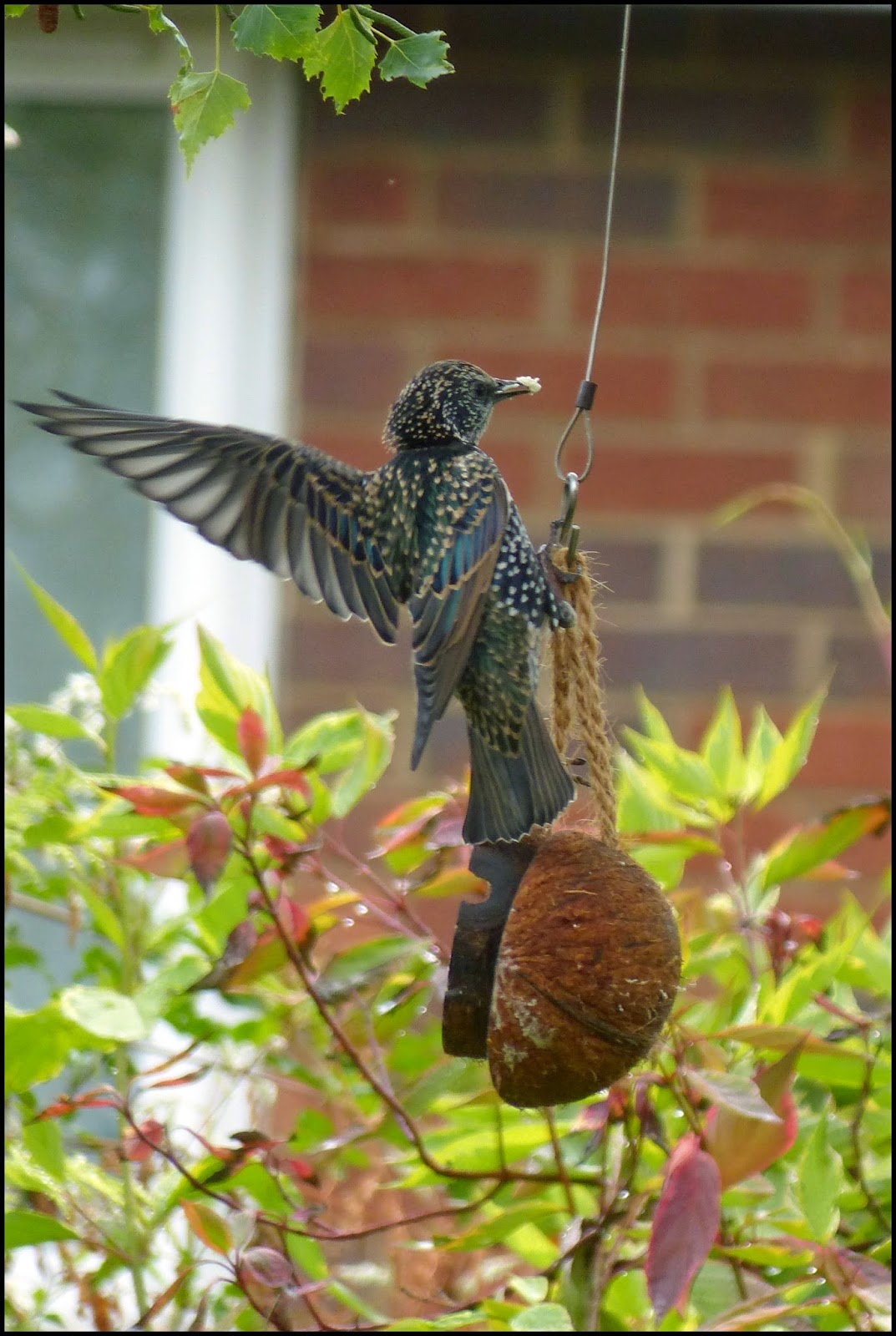
The Starlings continue to visit and seem to enjoy the chance of a bit of friendly rivalry. They certainly make their presence felt with displays of wing-flapping and squawking!
The Blue tits hold back a bit when the Starlings are on the rampage. The Blue tit in this photo is dangling from a Silver Birch frond and as you can see if you follow the arrow, the tree is still sporting its catkins.
The Robin, Woodpecker, Great tits, Magpies and Wood Pigeons have continued to visit. The (other) silver birch to the front of the house had a Chaffinch perched in its branches one morning. As you can see in the photo above, there have been at least two female Blackbirds.
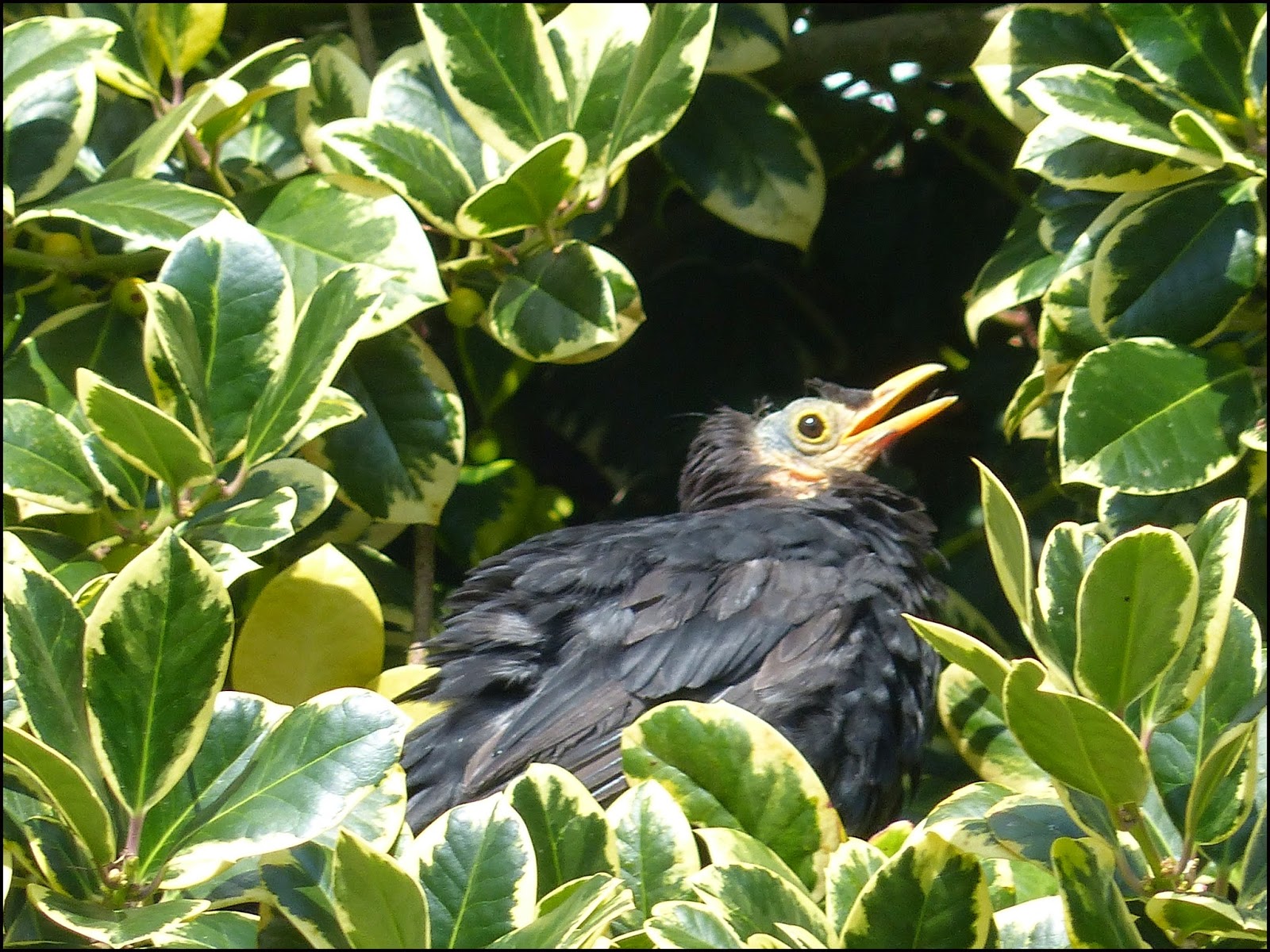
The scruffy fellow in the photo above is probably the most regular Blackbird visitor to the Silver Birch. He pecks at the coconut on occasions but is more often to be found underneath the tree. I have been rather concerned about him and began to wonder whether he was showing signs of disease or infestation. However (and this is sad), it seems he may be manifesting an avian form of 'relationship stress' that causes blackbirds to lose their head feathers. If this is the case, at least it means that he is not suffering from an infection or infestation that could spread.
The photo above was taken about a month ago. I think it is the same bird, which suggests that he has become even more bald in recent weeks. I wonder if he will recover now that the 2014 mating season must be drawing to a close. Do let me know in the Comments if you find any more literature on this condition ... or if you have a different diagnosis.
And finally, there have been a few dragonflies swarming around, but few have landed. The Shieldbug below was looking up from a fence post near the Silver Birch. I think it is probably a 4th instar.
MY PREVIOUS TREE FOLLOWING POSTS
Labels:
bald-Blackbirds,
Dunnock,
shieldbug,
Silver Birch,
Starling,
Suffolk,
Tree Following 2014,
Woodpecker
Subscribe to:
Posts (Atom)