Showing posts with label #30DaysWild. Show all posts

Wednesday, 9 June 2021

#30DaysWild, Day 9, A Streak of Green


We sat outside, drinking our coffee, in the hope that we might see some butterflies. Apart from a couple of Soldier Beetles and two 7-spot Ladybirds in the long grass, there were few insects making their presence known. After a few minutes we noticed a couple of lively Holly Blues on the wing. 

I thought perhaps there might be some bees on the Ceanothus so went over to inspect, when a flutter of iridescence caught my eye in the form of a Green Hairstreak. I had never seen a Hairstreak of any description before our move to Suffolk nearly a decade ago, and have now seen three species, the Green and the Purple in our garden, and the White-letter in the Local Nature Reserve up the road.

My thanks to David for the top two photographs. I have recorded today's butterfly sightings on the Garden Butterfly Survey

 • • •

P.S. In case any of you were here earlier today, I had posted my updated Garden Species List, but something happened to the formatting, so I have withdrawn that post while I sort out the code. 

 P.P.S. No further False Widow sightings ... to date.


Tuesday, 8 June 2021

#30DaysWild, Day 8, Wild or Not-So-Wild Flowers in the Garden


For the last ten years I have wondered what this small plant might be. I have made a quick search every so often but have failed to trace the species. I don't think I am entirely there now, but I feel I am heading in the right direction for this evening I finally discovered that it is a variety of Oxalis, a plant related to Wood Sorrel. As soon as I saw the word, something felt right. 

The plant in the photo above, with its distinctive five-petalled flowers and burgundy, almost shamrock-shaped leaves, grows outside our patio door between paving slabs. I have no idea how it came to take root in this spot, but it is always a joy to see. 

I am not entirely sure that it qualifies for a #30DaysWild post as it seems it can be bought in garden centres, but since I have found it described as 'weedy ground-cover', I think it can just squeak into my garden wildflower list ...


1. Daisy (20  February)

2. Violet (18 March)

3. Chickweed (19 March)

4. Dandelion (19 March)

5. Herb Robert (9 April)

6. Red Valerian (29 March)

7. Goosegrass (with tiny white flowers) (21 May)

8. Buttercup (21 May)

9. Red Dead Nettle (21 May)

10. Common Storksbill (24 May)

11. Red Clover (25 May)

12. Oxalis (8 June)

13. Cut-leaved Cranesbill (8 June)

14. Cat's Ear (8 June)

15. Ox-eye Daisy (8 June)

16. Meadow Salsify (16 June)

17. Smooth Sow-thistle (16 June)


 I wonder what will emerge next ...

Monday, 7 June 2021

#30DaysWild, Day 7, 7 June 2021 ... First Brown Argus of the Season


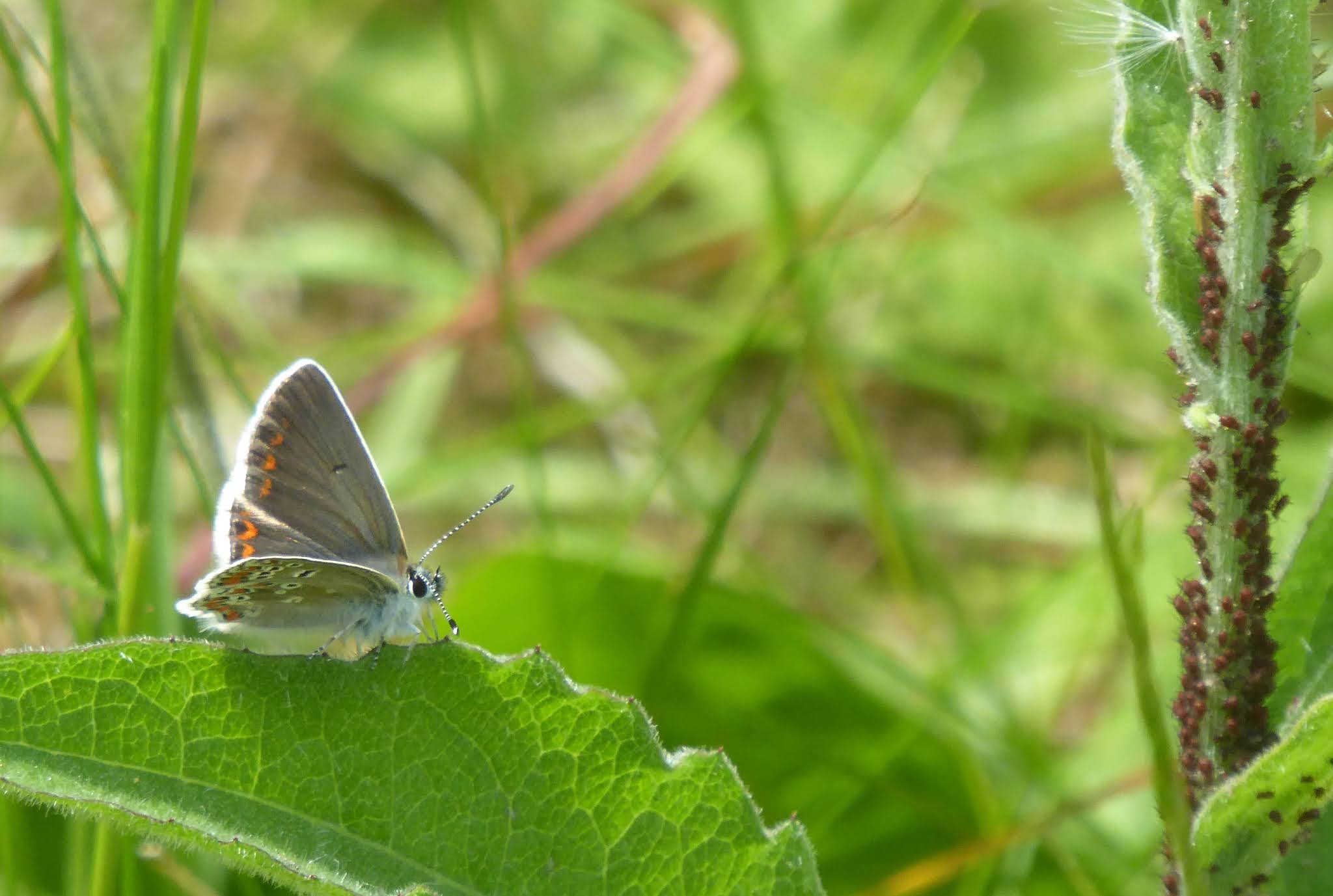
It was lunch time and I was about to go inside when something with a glossy sheen about it caught the corner of my eye. My first guess was a Hairstreak, but then I saw the wings open to the familiar chocolate-brown of the Brown Argus (or, on occasions, the female Common Blue). The not-particularly-prominent mark in the centre of the forewing makes me favour the Brown Argus, though I think it is dubious whether the diagnostic 4th spot on the outer wing is in fact present in the photo below. Despite the proximity of the Blackfly in the photo above, Brown Argus larva feed off vegetation such as Rock Rose and particular varieties of Cranesbill and Stoksbill.

We had these butterflies in our homepatch for the first time last year, so we are glad they have returned, now that the unmown grassland of a garden has gone without a mow for well over a year. 

It was only when I uploaded the photograph that I noticed the bonus insect, which could be a female Thick-legged Flower Beetle. 

And just a quick update on butterfly species seen in the garden to date in 2021:

  1. Peacock
  2. Brimstone
  3. Holly Blue
  4. Orange Tip
  5. Small White
  6. Large White
  7. Green Hairstreak
  8. Brown Argus.


Friday, 4 June 2021

#30DaysWild, 3rd and 4th June, False Widow Alert


I'm running a bit behind already, but never mind. I wonder what you make of my spider discoveries! I have posted the bulbous creature in the two top photos and the thin skeletal one in the two lower ones on iSpot, and will see if folk are able to confirm my guesses of False Widow (above) and moulting Harvestman (below). Both were seen in our garden on 3rd June, the top spider at the entrance to a cavity in our brickwork. 

If you can help with either of these IDs, do leave a comment. I will keep you posted. 


#30DaysWild, 4th June - I checked iSpot. 

It seems I am no further forward with the photo immediately above, but three iSpotters have pretty much confirmed my hunch that the top photos do indeed show a False Widow ... in the cavity wall of our home. This is not quite the #30DaysWild I was expecting!

Wednesday, 2 June 2021

2nd June 2021: #30DaysWild, Day 2


I have three garden sightings to report so far today (and a fourth, though I was not the one to see it).

[1] My first Small Copper of the year, which you see above.

[2] A bee flying in and out of one of our insect houses, despite the ant invasion. I failed to photograph the bee, though you can see the ants making their presence felt in the photo below, taken a few days ago. I hope the bee will prove to be a Leaf-cutter, which is what we had last year. 

[3] The blackbirds were making loud (?alarm) calls last night at dusk. We failed to see evidence of a magpie, jay or cat ... but this morning Star the female was perching in front of a rotund and fluffy semi-fledgling. No wonder Star has been such an active hunter-gatherer recently. 

... and ...

[4] from David, the first 2021 sighting of a Red Damselfly in the garden.  


Hard to tell if there are signs yet of leaf or bee!


Ant invasion!

I wonder what you have been doing or finding for Day 2 of #30DaysWild ...


Tuesday, 1 June 2021

1st June 2021: #30DaysWild, Day 1


I have filled in my #30DaysWild placemat. The day certainly warmed up later on; but unlike yesterday, there were few butterflies about. 

Star, the female Blackbird, was much in evidence. She seems to like the grassy path that snakes around our micro-meadow garden, and we often see her leaping for insects. We have a profusion of craneflies. 

Tuesday, 30 June 2020

Day 30, Final Day of #30dayswildcreativity: The Sea and its Islands

Two Noah's Ark panels of stained glass from St Neot's Church, Bodmin Moor

I discovered very early on that I enjoyed drawing. When I was about four or five I was asked to draw Noah's Ark, a challenge I relished as I loved animals. I also loved the sea, being by the sea and paddling: it took me a long time to learn to swim. Sadly I failed to keep that drawing, but the version in the stained glass above always make me smile when I see the dove being sent off to look for dry land in one panel and the dove returning in another with what must be the olive leaf in its bill. 

There is something about setting off from the security of the shore and heading out into the vastness of the ocean. I was a timid swimmer and it was many years until I was finally awarded my bronze Personal Survival Medal. I am also a timid sailor in choppy seas. But I love a short excursion out into the ocean, particularly when there is the lure of an island at the far end of the voyage. 

Back in 2011 we were holidaying in Lochinvar in Assynt in the north-west of Scotland. The weather in that magnificent region is very unpredictable, though it is usually safe to predict rain. We checked the weather forecast at breakfast and decided that all was set as fair as it was likely to be. 


We boarded a vessel to the Summer Isles and set out in fine weather...


... and were soon leaving the brooding silhouettes of Stac Pollaidh and Suilven behind.


A few minutes later the sun came out and we were able to feast our eyes on these intense ocean blues.


By the time we reached the island of Tanera Mòr, it had turned into a beautiful afternoon. 


There was just time to call in at the Post Office, which has been issuing its own stamps since the 1970s, before heading back along the bank to enjoy some local wildlife. Stamps bought on the island can only be used to transport an envelope or postcard as far as the mainland. Thereafter a missive will only reach its destination if it also carries a regular stamp.


We noticed some orchids, and as we drew closer we saw...


... this 6-spot Burnet moth ...


... and this one that landed on David's hand. The bank was full of these colouful insects, and judging by their shiny appearance, I think they had just emerged and were drying off their wings in the bright sunshine.  


Another surprise took the form of this impressive (and ferocious) Green Tiger Beetle

Our time on this special island was fast drawing to a close. I looked up at the remains of an old dwelling and paused to wonder what life would have been like in the 1880s when a population of 119 was recorded. Doubtless many, or most, of these would have been linked to the herring industry

Everything changes, including Scottish islands. Tanera Mòr has been sold since our visit, and a new vision is taking shape. 


As we waited by the shore for our return voyage, we watched these female Eiders drifting through the tranquil waters.  


The photograph above shows me in my element aboard a boat on the water in fabulous weather, and with the mainland not far away. The Tate (Tate Britain, I believe) holds an 'aquatint on paper' of the pier at Tanera Mor, produced by William Daniell, who died in 1837, the year before members of my Scottish family emigrated from the Cairngorm area under the Lang Bounty Scheme, via Oban, to Sydney. What a voyage that must have entailed. Their fortitude is something I find hard to imagine; but, like Noah on Mount Ararat, they reached the safety of dry land. 

* * *  

This post was written in response to Dr Miriam Darlington's final #30dayswildcreativity meme on her Facebook page. We were invited to write about something we had fallen 'in love with as a child', and I have chosen to focus on a number of different threads, many of which weave together in my life as I enjoy the natural world and its oceans. 

Threads represented in my 'sea collage' below include time spent afloat, looking in rockpools, watching wildlife, writing, sketching and taking photographs. 


Thank you, Miriam, so much for your inspiring themes and memes. I have thoroughly enjoyed responding to them in word and image. Thank you, too, for the literary excerpts and poems you have introduced us to along the way.  


Monday, 29 June 2020

Day 29 for #30dayswildcreativity: Winds (or Wings) of Change


The expanse between the garden and the wood is a turbulent ocean of leaves. The wind ruffles each branch in relentless pulses as it buffets the Silver Birch, Hawthorn and Horse Chestnut trees. No wonder the resident Blackbird’s sentinel perch at the top of the fir is currently untenanted. The 'crow’s nest' is Crow-less. Even the Magpies have made a dash for cover. Up above the highest branches, a tarpaulin of grey cloud blocks out the sun one might expect to see on this late June afternoon. Down below, flurries of Silver Birch seeds float in raindrops on the picnic table. The chairs we used for balmy alfresco meals only a few days ago have been carried indoors. 

A kit of Wood Pigeons has just flown past my window. I can hear the coo of the Collared Doves, but cannot see them. I wonder where the recently fledged Blue tits have hunkered down. The rambling rose bush is shedding peach-pink petals at an alarming rate. Its stems criss-cross in and out of the trellis and are still intact, but on a day like today I cannot help wondering whether the rose grower who gave the species the appellation of ‘High Hopes’ was feeling just a shade optimistic. The only plant that seems untouched by the strength of the gusts is, of course, the lofty and indestructible Mile-a-Minute.

Suddenly the sun appears for a few fleeting minutes. Velvet-brown wings skitter past my arm and come to rest, wide open, on a shiny leaf of what I think is Woodbine. I see they are framed by a delicate line of white scales. It may be the force of the storm that is ruffling my lockdown hair, but it is the unexpected joy of seeing what is only our second-ever Ringlet here in the garden that causes my heart to flutter.     

 * * * 

This post was written as a response to Dr Miriam Darlington's #30dayswildcreativity 'Winds of Change' meme on her Facebook page

Saturday, 27 June 2020

#30DaysWild: (Lesser) Stag Beetle


We usually see a good number of Cockchafers flying around our Acer and Silver Birch trees on warm evenings. Occasionally we see Stag beetles, and this seems to have been a good year for them. A few days ago we even found a female climbing the brick wall on the outside of our house. Two evenings ago, when it was very warm and sultry, I wandered over to the fence after our alfresco meal, and noticed this large beetle on top of the plinth of one of our wooden planters. I wish I had taken a better photograph, but it was about 8.45 pm and the light was fading fast. Despite calling this a 'large beetle', which it was, I have a hunch it may be a (female?) Lesser Stag as it was certainly considerably smaller than some we have seen and was definitely a matt black colour. 


I posted these photographs on iSpot this evening, and it will be interesting to see whether others agree with my tentative identification or not. The People's Trust for Endangered Species (PTES) have an excellent website here, which includes information on the #greatstaghunt


Friday, 26 June 2020

#30DaysWild Day 26: Colourful Wasps

With the exception of the top right image, these photographs were all taken in Suffolk

Before we moved to Suffolk eight or so years ago a wasp to me was pretty much a wasp, an insect to be avoided at all costs if at all possible. I still fight shy of what is sometimes referred to as the Common Wasp, having ended up in A&E the last time I was stung.

However, I have discovered that a wasp is not a wasp is not a wasp. These insects come in many shapes, sizes and colours; and in terms of showiness, my favourite is undoubtedly the Ruby-tailed wasp which we sometimes see in our garden. It has cuckoo wasp traits, but I love the brightness of its iridescence, which is seen as shiny reds, greens and blues.

I decided to make a collage of some of my more colourful or unusual wasp photos for Day 26 of #30DaysWild. I wonder what picture comes to mind when you hear the 'wasp' word...

A wonderful site to visit... here.

Thursday, 25 June 2020

Day 25, #30 Days Wild: Ringlet butterfly


We saw our first Ringlet in the garden today, the first Ringlet we have ever seen here (though David noticed one on his walk around the block yesterday). I have just added it to my insect total for the garden: it is number 98 on my list. I am nearing 100, but it is taking a bit longer than I had expected.

Today's butterfly was very skittish, and I failed to photograph it before it fluttered over the fence; but when we set eyes on it, neither David nor I were in any doubt over its ID. The photos I have posted are from previous sightings in Yorkshire, Buckinghamshire and Scotland. 


I would like to think today's Ringlet was attracted by our long unmown grass. We have now seen a current total of 16 butterfly species in our suburban Suffolk garden this year: I know because I have been listing them on the Butterfly Conservation Garden Butterfly Survey. This year's Big Butterfly Count will run from 17 July to 9 August 2020 and I look forward to taking part.


Tuesday, 23 June 2020

Day 23, #30DaysWildCreativity: Conservation Collage


'Will we permit the rewilding of our hearts and minds, 
that is so needed now?' 

for today's #30DaysWildCreativity meme 


I wanted to remind myself of some of the threatened wildlife I have encountered over the years, and I hope you may also enjoy seeing my pictures of these fine creatures. 

I recall seeing a whale washed up on a Cornish beach several decades ago. It was dead, and the memory stays with me. The 'Save the Whales' slogan certainly made an impact on me as a teenager, even if I did not know how these magnificent mammals might be saved. 

Picture 1: Otter
Many of us read about otters as children and teenagers in books like The Wind in the Willows, Tarka the Otter and A Ring of Bright Water. I visited the Otter Trust near Bungay in the 1970s, but I did not see an otter in the wild until I visited Skye some thirteen years ago. I have also watched them off Mull and the Kintyre peninsula. Miriam Darlington writes about otters she has encountered and observed in Scotland (and also in Devon, Cornwall and other quiet corners of the British Isles) in her wonderfully evocative book, Otter Country.  

Picture 2: Purple Emperor Butterfly
We were visiting Chedworth Roman villa in Gloucestershire when we were called over to see an unusual butterfly. It seemed to be in need of a little sugar and water, which the cafe supplied. I took this photo, and sent it off to Matthew Oates, who confirmed that we had been looking at Her Imperial Majesty, the Purple Emperor (you can read his upbeat reply in the Postscript to my post here). The fact that this resplendent, if slightly dehydrated, Emperor was visiting a Roman villa made us smile. I hope she revived and lived her butterfly life to the full.  

Picture 3: Bittern
When I was growing up, one of our family board games was Conservation, a game produced by the RSPB to encourage young people to learn about endangered birds in Britain. The Bittern was one of these species, and it was a bird I never thought I would see despite the fact that our home was only about a mile from some of the Norfolk reedbeds. It was only when I moved to Suffolk some eight years ago that I finally saw, and heard, my first Bittern at RSPB Minsmere. I remember the wave of excitement that rushed through me when I set eyes on a sight I thought I would never see.

Picture 4: Water Vole
Speaking of The Wind in the Willows, I believe I was in my 40s when I first realised that Ratty was in fact a Water Vole. The photo above was taken (with zoom lens) at RSPB Minsmere. You can read about the conservation status of this delightful species here

Picture 5: Red Squirrel
Like thousands of other children, I first encountered the Red Squirrel in the pages of The Tale of squirrel Nutkin by Beatrix Potter. Later on, when I was about eight, I saw one or two for myself on Brownsea Island. More recently I have watched them in the Cairngorms and in Dumfries and Galloway. You can read about their situation here

Pictures 6 and 7: Grass Snake and Adder
I had seen very few snakes in the wild here in the UK until we moved to Suffolk. Since then I have seen a handful on a couple of reserves, namely RSPB Minsmere (Adder and Grass Snake) and SWT Carlton Marshes, where I photographed the Grass Snake in the picture above. The adder in the photo was on the Minsmere Adder Trail: an RSPB official pointed us in its direction, and there were in fact two snakes coiled round one another. What a privilege to see these reptiles.

Picture 8: Swallowtail butterfly larva
Ah, I had been longing to see a Swallowtail butterfly, and here at last was a Swallowtail larva on the NWT reserve at Hickling! I had spent my teenage years in Norfolk at the edge of The Broads at a time when these butterflies were practically non-existent so the thrill of seeing this magnificent caterpillar was almost overwhelming. 
 
*
I hope you have enjoyed my 'conservation' selection. The lockdown has certainly allowed our wildlife to experience a more peaceful few months than usual. Let's acknowledge that there may be lessons we can learn. It is wonderful when people join together to put measures in place, whether political or environmental, to enable threatened species to fight back. 
 

Monday, 22 June 2020

Day 22, #30DaysWildCreativity: Post-Solstice, 2020


Of Eyes and Iridescence
Monday, 22 June 2020


On this day when the first poppy opened
I sensed the tug of the long haul
towards winter through the amber light
of harvest, the embers of bonfires
and the muted music of freezing fog.

On this day when the first poppy opened
I buried my eyes in the corn marigold’s gold,
immersed myself in the deep sea-blue
of the cornflower, and delighted in the yellow
and white design of an ox-eye daisy.

On this day when the first poppy opened
I committed these flowers to memory,
afraid that fiery petals would soon flutter 
to the ground, fearful that I would miss
the eyespots of the peacock butterfly.


                                         © CG 2020


* * *
This post was composed this afternoon as my response to Dr Miriam Darlington's 'What do you miss, grieve for, as the year tips?' Facebook meme as part of #30DaysWildCreativity.

Sunday, 21 June 2020

Day 21 #30DaysWildCreativity: Paying Close Attention


This is a post in response to #30DaysWildCreativity, organised by Dr Miriam Darlington.

With the exception of my shielded 'exercise path', we are not mowing our garden this year. It has been very interesting to watch the weeds and wildflowers that have grown up in areas that would normally be lawn, albeit of a rather dry sandy-soil variety. 

The first plants to emerge unexpectedly were Ox-eye daisies (you can see my post here), and the second was the Common Knapweed you can see in the collage above. For several days now I have kept the Knapweed under close surveillance to see what insects it might attract. I think you will agree that with everything from Skipper butterflies to Thick-legged Flower Beetles and Red-tailed Bumblebees, I have had plenty to watch. I have found the ideal way of doing this is by placing an outdoor chair by the plant and waiting, trying to use not only my eyes but also my ears. 

In the scheme of things, the tiny ant was just as valuable a find as the showy Skipper, and I know I have benefited from these 'close observation' projects I set myself. The next stage on is not only to recognise the 'usual suspects' but to find out more about each species, and, as ever, I often turn to the kind folk on iSpot for a bit of help. 

Saturday, 20 June 2020

Day 20 #30DaysWild: Update on the Wildflower Seeds provided by Butterfly Conservation (Suffolk)


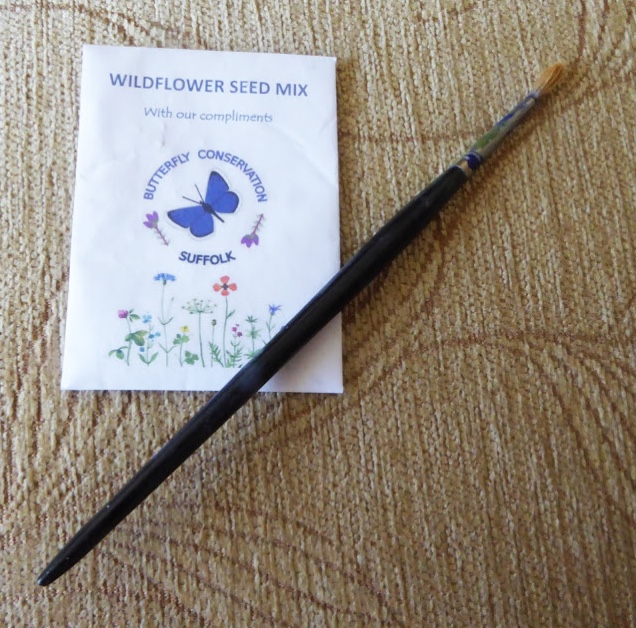
Back on 4 April, the day we on which we saw the only Comma we have seen in the garden so far, we planted a little pack of wildflower seeds that had arrived with our copy of The Suffolk Argus (vol. 77) from the Suffolk branch of Butterfly Conservation. I am glad to report that the seedlings and young plants survived swarms of blackfly and are just bursting into flower.


The Cornflower above was first to open...


...followed by this daisy-like flower (I must learn what this is)...


... and then finally this Corn marigold.

I so hope that these flowers will indeed attract more butterflies to the garden. It has been windy for much of the day, but I have seen five Meadow Browns, one Large White, one Holly Blue and...


...this beautiful Skipper. We have had Skippers in the garden before, but they are not frequent visitors. I so hope there will be more tomorrow. 

But where are the red butterflies, the Peacocks, Small Tortoiseshells and Red Admirals? Perhaps we will see more of these when the Buddleia comes into flower. Meanwhile I must update my sightings on the Garden Butterfly Survey

Oh, and I must add one final picture. Some of you may have read my post on our Nasturtiums for Dr Miriam Darlington's #30DaysWildCreativity meme for Day 17... well, the first flower opened today as you can see below. I hope it will attract insects. 


P.S. Is this a hoverfly nest in my next post, please?