Showing posts with label Red-banded Sand Wasp. Show all posts

Tuesday, 28 September 2021

Back on Dunwich Heath at last


We took a picnic to NT Dunwich Heath last weekend, hoping that perhaps there would be a few breaks in the cloud. 


You can see our picnic spot in the photo above. The white building is made up of old coastguard cottages. I took this picture with my back to the sea.


I love the archway above and have never noticed it before. The weather was overcast initially, but by about 2pm, the sun had broken through and we were able to watch a few damsels and dragons in the sheltered corners. 


As we peered into the water beneath the decking, our eyes alighted on two Great Diving Beetles. I was reminded of the giant water-beetle in The Tale of Mr. Jeremy Fisher by Beatrix Potter. 


David had his measuring card on him, so we were able to see if the beetles were three centimetres in length, the size of a Great Diving Beetle. We reckoned they were pretty well spot on, despite the fact that the remaining beetle's head had dipped down by this time. 


There were good numbers of Ruddy Darters; most, but not all (see below), were on the wing. The one in the photograph had rather ragged wings.


The dragons in the next photo were certainly making their presence felt!


We saw two Migrant Hawkers during the course of the afternoon (see above, first photo in this post), both hanging from their respective branches of twigs. They both had a blue aura about them, possibly a trick of the low light, but I think they are Migrant Hawkers as both displayed the characteristic yellow golf-tee mark.


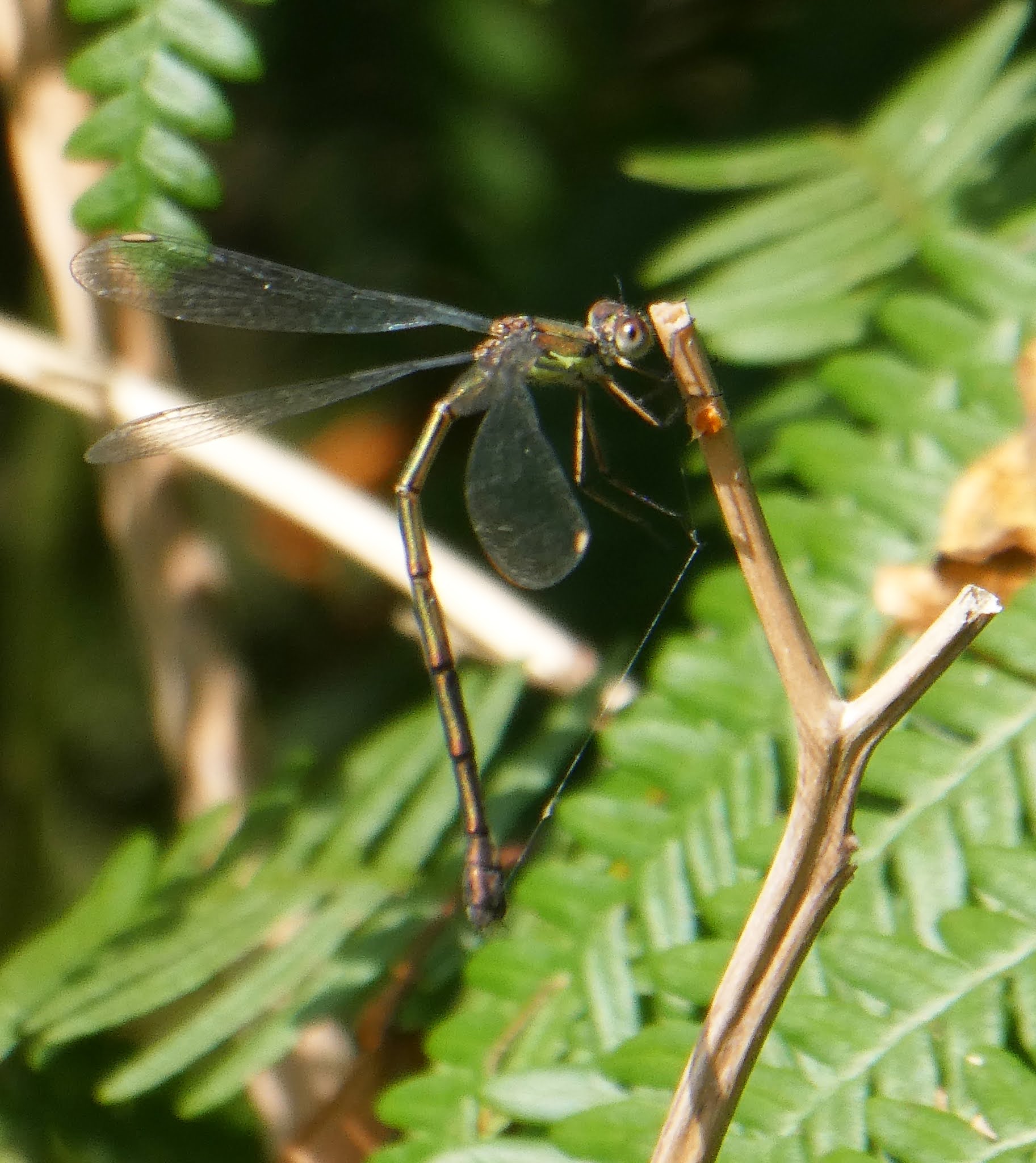
I have seen very few damsels this year, so was delighted to find the Emerald Damselfly (update, 29 Sept. 2021: please see comments where Conehead54 has informed me that this is actually a Willow Emerald) in the photo below).


The damselfly in the next two photos was a very obliging subject.


We found the sandy bank home of some Red-banded Sand Wasps. You can just about make out the pockmarks in the exposed part of the ridge. The photos below show one of the wasps entering the nest.


I had not expected the heather to be turning brown so soon, but there were still some small patches where most the flowers were still in bloom. I have always enjoyed seeing heathland, whether in Suffolk or Cornwall, alight with the pink of the heather and the golden glow of gorse.


We were soon back at our starting point by the coastguard cottages, staring out at the ocean. As you can see, there was no need for any social distancing down below on the shore!


Since last Saturday when these photographs were taken, the weather has turned much more autumnal, which is perhaps not surprising since we are now several days past the Autumn Equinox. I can hear lashing rain outside my window as I type, and I suspect it may be many months before we see scenes like the one below again. 


Dunwich Heath is a favourite haunt. It features in my poem, 'Dunwich in Winter', which can be found on p.14 of my recent poetry collection, Driftwood by Starlight (The Seventh Quarry Press, June 2021) - see here

This poem has also been reproduced on the Suffolk Poetry Society 70th Anniversary calendar for 2022.  


Saturday, 2 June 2018

Excavation at NT Sutton Hoo (and a Damselfly, of course)


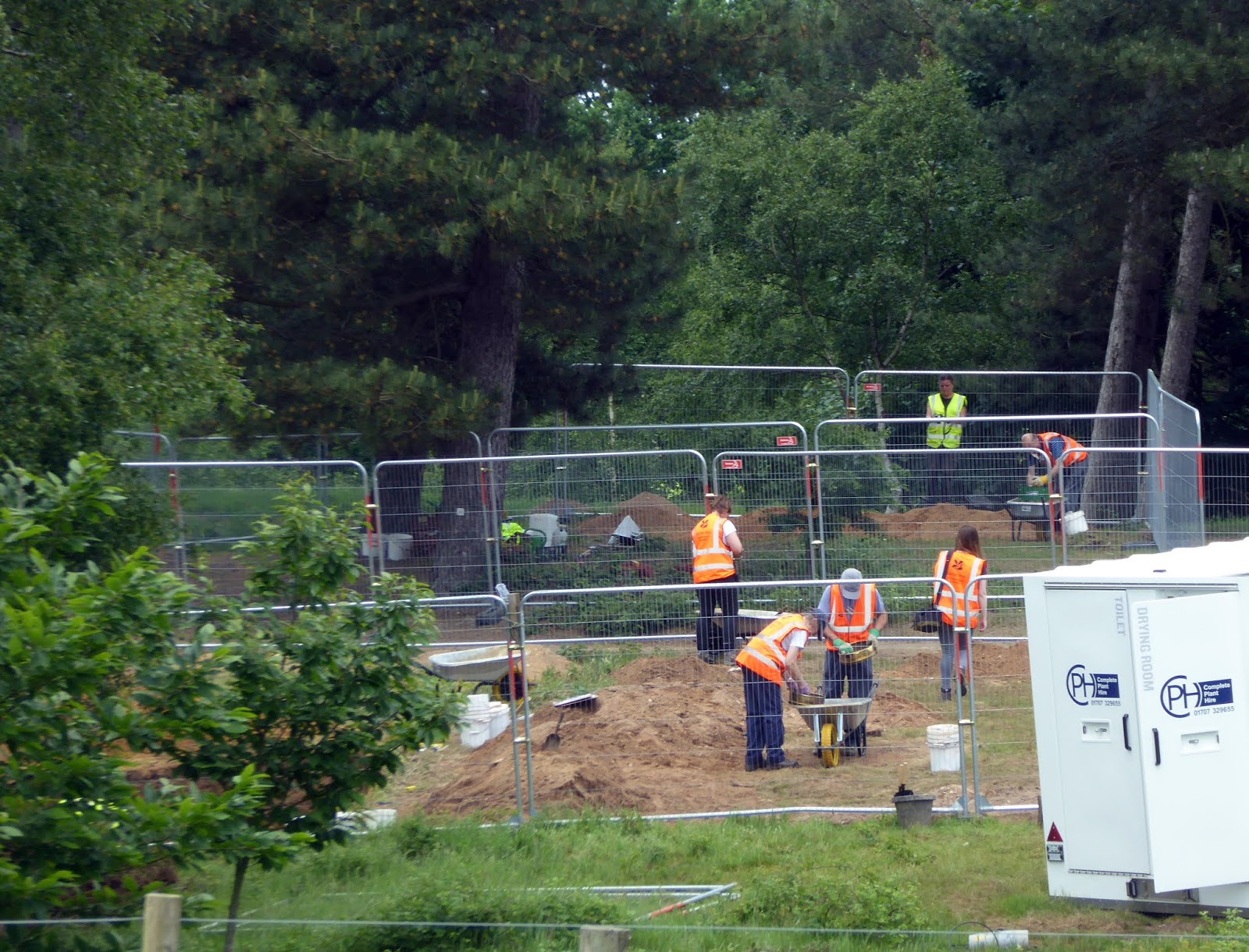
We decided to visit to NT Sutton Hoo again this afternoon before the heavy showers arrived, and we were so pleased that we did as we discovered it was the last day of an excavation, the first for almost three decades, which is being carried out by MOLA (see this link too). There was plenty of digging and panning going on, and we were able to see some Neolithic flints and Bronze Age potsherds that had come to light.


It was a strange afternoon, with short bursts of hot sun followed by humid swathes of grey cloud. There were plenty of people about but few insects. We noticed one very large orange and black sand wasp (like the Red-banded Sand Wasp here), but it was too fast for my camera. I see the linked website actually mentions Sutton Hoo as a location, so perhaps I am on the right ID track.


I presume these little holes in the area near the mounds were made by ants, wasps or some other 'digging' insect. 


What a lovely spot for an excavation! 


A new viewing tower is to be built in this area, but I was disappointed to find that there are no plans for a lift to make the feature more accessible.


 You can see just how sandy the soil is.


We had a good look around this area of the site before heading back towards Tranmer House (below).


I kept my eyes open for insects and eventually found (what I think may be) a Common Blue Damselfly on a leaf ...


On our way back to the exhibition area we paused to check the small patch given over to wild flowers...


There was a good-sized carpet of this yellow-green sedum: I'm not sure how 'wild' it is and I'm sure I know it by another name (update 4 June: the name I was trying to remember is Stonecrop). 


The dog rose below in the wild flower garden reminds me that June is already upon us. We bought a few bedding plants to brighten up our own garden on the way home, and hopefully to attract more insects. We checked again for bats this evening, but failed to see any. There was one Cockchafer/Stag Beetle floating around: it narrowly missed my hair!


Monday, 21 September 2015

NT Dunwich Heath - signs of autumn


We took a trip to the sea at Dunwich Heath on Saturday, and while we were there, we noticed two Red-banded Sand Wasps. One flew across our windscreen and you may just be able to make out the other in the photo above. I took a quick record shot (the photo you see), but the insect flitted off before I could take a better photograph.

I have noticed these unusual Sand Wasps on the heath before. This is what I wrote a year ago:

 '... my eyes fell upon this strange insect, which I guessed was a kind of ant. There were three of them in the area, if I remember correctly, but they were pretty speedy creatures and hard to catch on camera as the kept vanishing beyond the wire netting. I was browsing the web earlier today when I spotted a photo of the insect here on the RSPB Lakenheath Fen page. The creature turns out (it seems to me) to be Red-banded Sand Wasp (Ammophila sabulosa). It has even appeared on a Romanian postage stamp. You can read about the wasp's kleptoparasitic behaviour in the Comments here on the iSpot nature website. 
These wasps are quite striking. They are long, thin and ant-like.' 


My photo from 2014

 The heath was looking colourful, with the last flush of summer shades. 


There were a few insects about, though we saw few birds.

I'm guessing this is Hoverfly Syrphus vitripennis or Syrphus ribesii


The sign serves as a reminder that this coastal landscape is a very fragile one. The sandy cliffs are prone to erosion and at the mercy of east coast storms.


The heath divides the sea (right) from the a wooded area to the left of this photograph. It will soon be the deer rutting season.


I have a hunch that this is either Birch Brittlegill Russula betularum or a similar species. I believe it is poisonous. There were certainly plenty of birch trees at the back of the reserve. I see 'Red Russula' were recorded on nearby Westleton Heath.

Fungi identification is not my forte, so please feel free to leave a comment if you can help with an ID.

Is this a 'Blusher', Amanita rubescens, perhaps? (see last photo on this link)


The old coastcard cottages on the heath are now National Trust holiday properties, a cafe and shop.


We have seen more Kestrels than ever this summer. This one was a fair distance away, but we had a good view through binoculars.


My thanks to Facebook friends, Matt and Paul, for confirming that this looks like a juvenile Stonechat.


Saturday turned into such a lovely evening that we drove on the short distance to Southwold, where we had fish and chips overlooking the River Blyth. You can make out Walberswick on the far side. We were keeping an eye (and an ear) out for skeins of geese when we were suddenly alerted to the presence of a very strange gull silhouette. It was flying slowly over the water, and as it approached, we could see very clearly that it was a Barn Owl.

Friday, 15 August 2014

Mystery Insect at Dunwich Heath (Ammophila sabulosa)


Some weeks ago, around 18 July, we were out and about on Dunwich Heath in the early evening. The heather was in full flower and it had been a lovely day.


We were keeping an eye out for deer and for Stonechats, and while we failed to see either on this occasion, my eyes fell upon this strange insect, which I guessed was a kind of ant. There were three of them in the area, if I remember correctly, but they were pretty speedy creatures and hard to catch on camera as the kept vanishing beyond the wire netting.

I was browsing the web earlier today when I spotted a photo of the insect here on the RSPB Lakenheath Fen page. The creature turns out (it seems to me) to be Red-banded Sand Wasp (Ammophila sabulosa). It has even appeared on a Romanian postage stamp. You can read about the wasp's kleptoparasitic behaviour in the Comments here on the iSpot nature website. 

These wasps are quite striking. They are long, thin and ant-like. However, in my opinion, they are not as striking as their near neighbour, the Ruby-tailed wasp, which I have seen on the adjoining stretch of coast at Minsmere and in my Suffolk garden.

Ruby-tailed Wasp in my garden, 2014