Showing posts with label 14-spot ladybirds. Show all posts

Monday, 6 May 2024

A Mixed Bag of Bank Holiday Sightings from our Garden and Local Nature Reserve

14-spot Ladybirds mating on a nettle in our garden this morning


A rolled-up oak leaf on the reserve ... which may suggest that the dangling caterpillar below

... is the larva of Oak Leaf Roller moth Tortrix viridana

... though it could be the larval stage of the Winter moth (Operophtera)


Back in the garden, the caterpillar of the Bagworm (moth)

... turning this way and that


Garden: a Nursery Web spider (left) and a spider exoskeleton (right)

The exoskeleton

A parasitised caterpillar with eggs, apparently (thanks to iSpot), and claspers showing

If I receive more information from the kind iSpot enthusiasts, I will update the page.

Saturday, 12 May 2018

Common Blue butterfly, Shield bug and 14-spot Ladybird


I haven't ventured further than the garden today, but I have enjoyed seeing the variety of insects that are suddenly beginning to emerge after the long lean months of winter.

I love blue butterflies: this Common Blue reminds me of Robert Frost's 'Blue-Butterfly Day' poem. 


I wonder if it has been a particularly good year for Shield bugs (or Stink bugs) in your locality. I seem to have seen more than usual in the garden, including the two in the photos below . 


The large triangle on the back is called a scutellam

And finally, just when I was heading back indoors, I noticed a small yellow insect on a nettle - my first 14-spot Ladybird (Propylea 14-punctata) of 2018. I'm sorry it isn't a better photo, but I had no wish to get stung!

The 14-spot feeds on aphids and is a welcome addition to the fauna in our garden. Here in the UK our only other yellow Ladybird has 22 spots, and they are much more like spots than these rectangular blotches. 


Monday, 7 July 2014

Tree Following ~ Silver Birch in July


This post is the fifth in my Tree Following series, part of a wider project run by Lucy Corrander from the Loose and Leafy blog. I am following a Silver Birch in Suffolk, UK. You will find the other Tree Follower links for July 2014 here ... so do take the chance to go on a virtual exploration of the arboreal world!


Diary Entry

Technically this entry should have appeared a month ago, but I had already added my May-June contribution via Mr Linky when the sighting took place, so here it is.

Tuesday 10 June 2014, noon

I was looking out from my window ten minutes ago when a flicker of movement caught my eye from the fir tree adjacent to my Silver Birch. A young Grey Squirrel jumped to the ground and headed towards the trunk of the birch. There was a scuffle in the dense foliage of the Weigela, and a small squirrel head appeared at a height of 150 cm, very close to the coconut feeders that hang from the Silver Birch. I have a feeling the youngster may have lost its balance at that point as it emerged from the base of the shrub and scampered over to the decking. A moment later a Magpie landed just over a metre away. The Grey Squirrel looked small and vulnerable. The bird, however, only had eyes for the feeder, and the youngster hopped safely over to the far side of the garden. I often watch Grey Squirrels from my window as they chase along the tall trees that border the Local Nature Reserve, particularly when the trunks are bare, but I have not seen a Grey Squirrel on our side of the garden fence for some time. I hope this one will return and make it up the trunk of the Silver Birch to the feeders. 


Grey Squirrel (one I took earlier - no camera to hand on 10 June)

* * *

As of 7 July 2014, the squirrel has not been seen again ... yet. The only other animals to report this month are the bats that continue to flit and dive outside my window at dusk.


The Silver Birch is still a mass of green leaves, though shades of brown have crept in among them, reminding me that the longest day is now well and truly behind us. I keep reminding myself that most schools in England have yet to break up for their summer vacation!

The brown shades belong to the female catkins, which are filling out in response to wind pollination. The seeds or 'nutlets' are dispersed on the breeze. Like sycamore keys, the seeds have wings to enable them to travel. One or two have landed on us in the garden.


There are also a few yellow leaves like the one below, suggesting some kind of stress to the tree. I guessed this might be due to drought or mineral imbalance, but it seems from BBC Lancashire's Ask the Gardener programme that it may be due to waterlogged conditions around the roots. Of course, the weather conditions here in Suffolk are very different to those in the north-west, so who knows; but we did have a lot of rain in the county at times last winter.


I was particularly interested to discover that Silver Birch leaves attract aphids, which in turn attract Ladybirds. There is even a species of Silver Birch aphid (Euceraphis betulae). I have not seen any Ladybirds on the tree to date, but I noticed this striking pair on a nettle in the vicinity: 

14-spot yellow ladybirds (small, native species)

When it comes to birds, the garden has been somewhat quieter this month. The Blue tit and Starling families have fledged.

However, the following birds have deigned to put in the odd appearance on the Silver Birch itself or on the feeders that hang from its branches ...

Sightings include ...
  • TFb2  Great tit (several frequently on feeder)
  • TFb4  Blackbird (one male frequently below feeder, another on the feeder - and a female)
  • TFb6  Blue tit (several frequently on feeder)
  • TFb7  Robin (one or two appearances, including today)
  • TFb8  Magpie (about three frequently dive-bombing feeder)
  • TFb9  Wood Pigeon (up to ten perching around the feeder area)
  • TFb10 Dunnock (two frequently below feeder)  
  • TFb11 Starling (infrequent appearances of up to three birds) 

Previous birds not seen this month (and admittedly I was not at base all the time) ...
  • TFb1 Great Spotted Woodpecker 
  • TFb3 Long-tailed Tit
  • TFb5 Song Thrush 
  • TFb12 Carrion Crow (on fence at back of Silver Birch) - first seen on 14 May 2014
  • TFb13 Goldfinch
 
On the insect front, this month's sightings include ...

  • TFi5 Skipper Butterfly (three, definitely the first time I have seen these in my home patch)
  • TFi6 Meadow Brown Butterfly (two, definitely the first time I have seen these in my home patch)
  • TFi7 Large White Butterfly (one)
  • TFi8 14-spot Yellow Ladybirds (two)
  • TFi14 Blackfly (colony) 
  • TFi15 Marmalade Hoverfly (one) 
  • TFi16 Shield bug (still identifying exact species)
There have also been plenty of moths. Sadly my moth ID skills are sadly lacking. 

TFi5 Skipper butterfly (I'm not sure yet which variety)

TFi15 Marmalade Hoverfly on flowers beneath Silver Birch


Previous sightings around the Silver Birch include ...

  • TFi1 Small Tortoiseshell Butterfly [March]
  • TFi2 Buff-tailed Bumblebee [March] 
  • TFi3 Brimstone Butterfly [April]
  • TFi4 7-spot Ladybirds [April]
  • TFi9 Small White Butterfly [May]
  • TFi10 Orange tip Butterfly [May]
  • TFi11 Harlequin ladybird [May]
  • TFi12 Garden Chafer (Phyllopertha horticola) [June] 
  • TFi13 Ruby-tail Wasp [June]   
Of course it is often hard to tell whether the flora and fauna that I spot in, on, around or under the Silver Birch - or on the feeders that hang from its branches - are there specifically on account of the tree.

Next month will be August: where is the year going? But July is always a good month for growth and wildlife, so I shall keep my eyes and ears open meanwhile, as I continue to follow the Silver Birch. Thank you for calling by ... and for those of you who have been reading my posts on Skye and Mull, there will be a few more coming soon. 


MY PREVIOUS TREE FOLLOWING POSTS

Thursday, 7 June 2012

Ladybird Alert (11): 14-Spot at Melford Hall

(Propylea 14-punctata)

This 14-spot Ladybird was crouching on a nettle in the grounds of Melford Hall on Monday afternoon, 4 June 2012. These yellow Ladybirds are very small. I shall log it on the UK Ladybird Survey site.

Friday, 25 May 2012

Ladybird Alert (10): All Kinds at Kenilworth Castle


We visited Kenilworth Castle a couple of years ago when the reconstructed Elizabethan garden was almost in place but still under wraps, so we were keen to see how things had developed.

The flower gardens were looking beautiful and had been planted with flowers that would have been popular in the time of Queen Elizabeth I. Some of these, e.g. the strawberry flower and the rose, are depicted on Elizabethan needlework and had special meanings. Our eyes, however, were soon diverted from the flora and foliage by the activity of Ladybirds.
We counted one hundred and forty-nine 7-spot Ladybirds (Coccinella 7-punctata), like the one above. Some were on grass but many were scuttling about on roses, small evergreen shrubs and leaves. 


I wondered whether this one above was laying eggs, but I can't be sure. You can see a selection of pictures of Ladybird eggs here.

These 7-spots above appeared to be mating.

These were some of the flowers in the new garden, so there was plenty of choice when it came to Ladybird habitat.


We saw five 2-spots (Adalia 2-punctata) like the one above, but some were too difficult to photograph easily as they were buried in between leaves. Some were extremely small and made me realise that a pair of glasses would have been helpful!   


My thanks to David for taking the picture above of another 2-spot ...
... and another. As you can see, there is also a 7-spot in the lower right-hand corner of the photo.


I noticed two Ladybirds like the one above. I wondered if they were Pine Ladybirds - or a melanic (black) form of the 2-spot (Adalia 2-punctata) since the markings were in the form of spots rather than commas - but I have it on good authority that they were 'one of the melanic forms of the Harlequin ladybird', like H. axyridis spectabilis. It was hard to tell with any sense of certainty whether these ladybirds had the telltale phlange around the base of the elytra that might have suggested an ID of Pine Ladybird. The one in the photo above was climbing along a wooden garden post. 
I encountered three 14-spot Ladybirds (Propylea 14-punctata) in the Elizabethan garden. They were small and pretty active, walking along leaves and over flowers ... and often disappearing just as I tried to click the shutter!


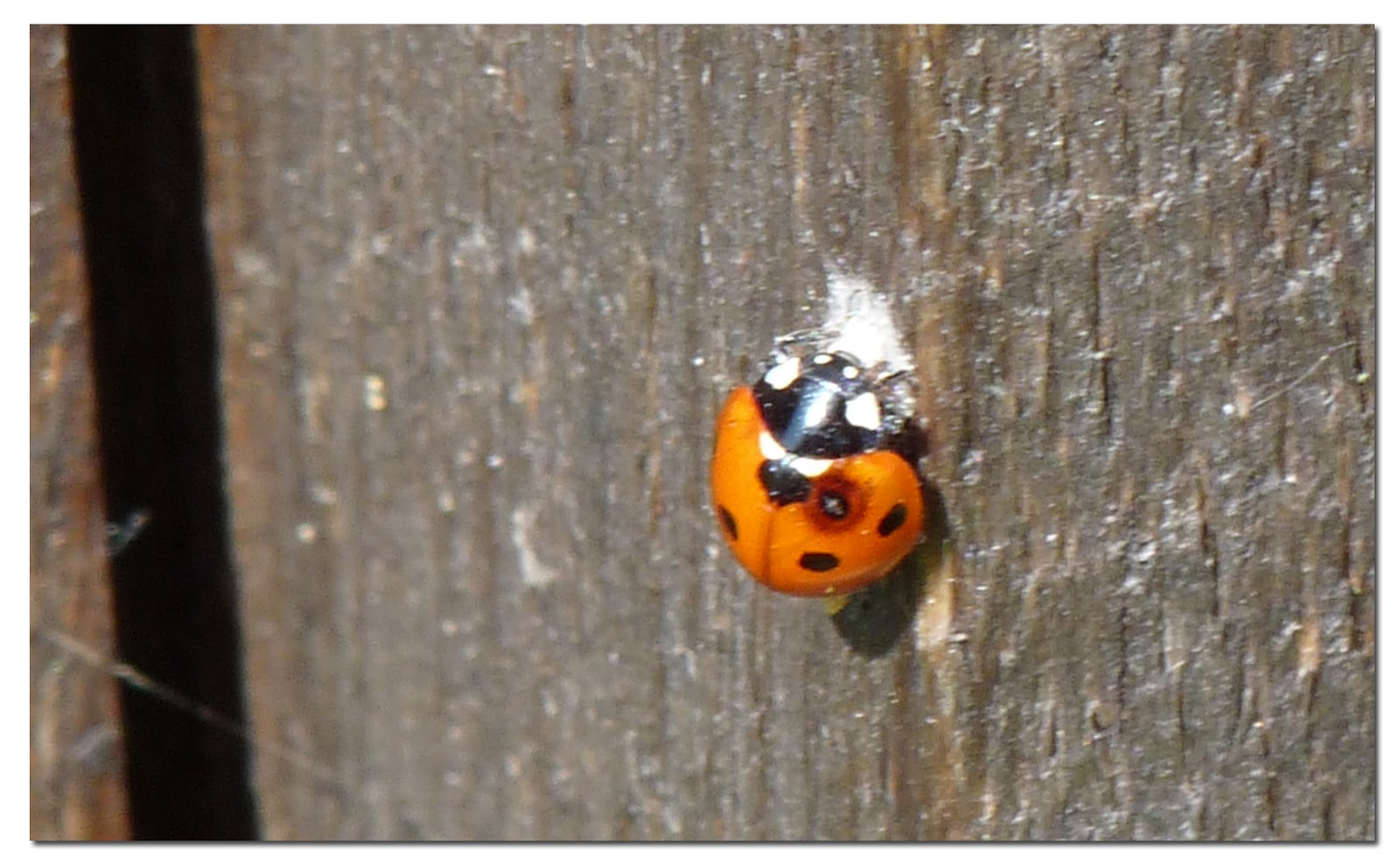
The seven-spot in the photograph above particularly caught my eye because it had what at first seemed to be an extra spot, the one with the 'halo' round it. I have no idea whether it is an extra spot or whether, perhaps, it could be an injury. I am wondering whether this ladybird was injected with an egg of the parasitic wasp, Dinocampus coccinellae. My reasons are as follows ...

  • The ladybird was pretty still on a warm day when most ladybirds we saw were active. Perhaps it had been paralyzed by the venom from the parasitic wasp.
  • It looks as though there is something underneath it at the front, which could be the wiry cocoon of the wasp.
  • It also looks (to my eye) as though there is something emerging from the rear of the ladybird, and while it could be an egg, it might be a yellow wasp larva. 

I have no idea whether the ladybird in the photo above had fallen victim to attack, but the subject is a fascinating, if unpleasant, one. A large proportion of ladybirds who encounter the parasitic wasp in this way fail to survive. It is believed that some kind of 'brain-washing' may be involved, due to chemical processes, because it has been noted that the ladybird appears in some instances to show protective behaviour towards the alien larva.

Scientist, Jacques Brodeur of the Department of Biological Science at the University of Montreal in Canada, has been studying this phenomenon and the ways in which the 'host' ladybird is affected by such an invasion. Observations have appeared in the Royal Society journal, Biology Letters.

You might like to read more on the BBC site here or  on a series of excellent National Geographic pages, starting here.

We also saw at least two (above and below) large multi-spotted ladybirds. I take these to be Harlequins (H. axyridis succinea). This was not good news for the native ladybirds.

As usual I shall be logging these Kenilworth sightings with the UK Ladybird Survey, and if you find ladybirds in the UK, I would encourage you to do the same. You can read about Dr Helen Roy and her ladybird work here. There was an excellent feature about it in The Times last weekend.

Monday, 14 May 2012

Ladybird Alert (10): Harlequin, 14-spot ... and thirty-seven 7-spots!

In my previous post, I mentioned our walk through a local nature reserve. These are the Ladybirds we encountered. The 7-spots (all thirty-seven of them) were too numerous to photograph on this occasion as we had walked a fair way and needed to get back. The top photograph shows a Harlequin Ladybird. The others are native to the UK. I particularly like the last photo!

As ever, I shall send these sighting-records in to be counted. You can find details of ...
  • the UK Ladybird Survey here
  • the Harlequin Ladybird Survey here
Incidentally, if you would like to read my earlier post about the other creatures we saw on our walk in the nature reserve, this link here will take you to the page. 

I take this to be the HARLEQUIN LADYBIRD, Harmonia axyridis succinea © David Gill 2012

7-spot, Coccinella 7-punctata, of sorts?

14-spot Ladybird - these Ladybirds are very small and are not Harlequins
Propylea 14-punctata

As above ... a second one
I note that Professor P. Brain, who is based near our previous home in South Wales, also recorded a Propylea 14-punctata this weekend.

I love the Ladybird's 'composition' here . . . One of the thirty-seven 7-spots we saw yesterday!