Caroline Gill's Wildlife Record: Suffolk Horizons (and the World beyond her Window)
Showing posts with label Migration. Show all posts
Thursday, 21 April 2016
'The Migrant Waders' - day of the launch
This is the day on which The Migrant Waders will be launched in Colchester.
This beautiful book is lavishly and exquisitely illustrated by designer Ella Johnston. You can see some of her drawings on the accompanying poster here in the Dunlin Press shop. The book, beautifully produced and edited by MW Bewick and Ella Johnston of Dunlin Press, is 'a collection of illustration, evocative prose, poetry and reportage that follows the migration routes of wading and shore birds from the high arctic to the tropics.'
One of the contributors, Samantha Franks, is a Research Ecologist with the BTO. Martin Harper is the Conservation Director of the RSPB.
My Bittern poem has been included; and in a serendipitous way, I see the RSPB have just posted a piece by Rachael Murray about this elusive bird, known more often by sound than sighting. The Bittern, as I recall, was one of the threatened species to feature in the RSPB 'Conservation' board game that we used to play in the mid 1970s. I saw my first Bittern some thirty years later at Minsmere, and have since seen - and heard - a few more on the reserve.
Labels:
BTO,
Dunlin Press,
Ecopoetry,
Ella Johnston,
Migration,
MW Bewick,
Poetry,
RSPB,
The Migrant Waders
Thursday, 29 May 2014
Sand Martins at RSPB Minsmere
We continue to be avid watchers of BBC Springwatch from RSPB Minsmere, our (pretty) local nature reserve. The photo above shows a sandy cliff on the reserve, and you can see where sand has been 'burrowed out' by ...
... Sand Martins, who are among the first spring migrants to appear in Suffolk from their winter quarters, south of the Sahara.
Labels:
BBC Springwatch,
Beautiful Birds,
Hirundinidae,
Migration,
Minsmere,
Nature Reserves,
RSPB,
Suffolk
Monday, 10 February 2014
A Lull in the Weather ~ a Stroll in the Park
![]() |
After a stormy night, the weather cleared a little on Sunday afternoon
so we visited one of our local parks.
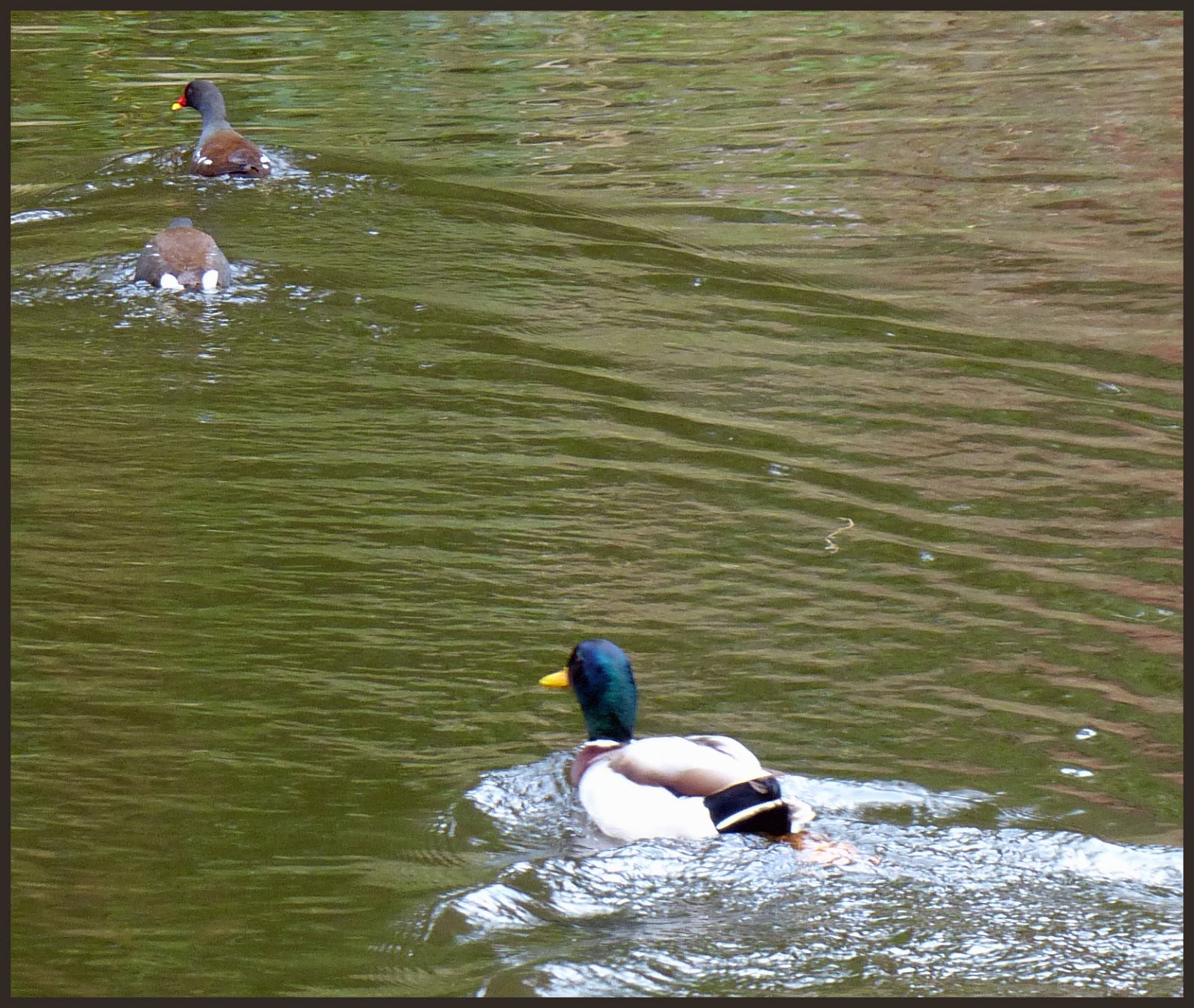
There were a few Mallard ducks and Moorhens on one of the main ponds.
This Cormorant had deserted the coast or waterfront in favour of easy pickings.
There were also quite a few Black-headed gulls.
The sunshine brought the Grey Squirrels out into the open,
foraging for their buried food supplies.
Suddenly we spotted a small flock of Redwing.
These winter migrants breed in northern regions of Europe and Asia,
but arrive in the UK in small flocks.
Speaking of winter migrants, we had read reports of Waxwings in our area,
but we failed to find them.
This white bibbed duck (above) may be a hybrid Mallard,
although when I thought I saw one last time,
hybrid expert Dave Appleton told me
that he felt the duck I had seen on that occasion
was
'simply a domestic variant of Mallard,
not a hybrid between a Mallard and any other species.
Domestic Mallards come in a bewildering variety
of sizes, shapes and plumages.'
not a hybrid between a Mallard and any other species.
Domestic Mallards come in a bewildering variety
of sizes, shapes and plumages.'
The Mallard drake above was doing a spot of preening ...
... before setting sail across the pond with his mate.
There was a photographer keeping a close vigil on this corner of the pond,
and if you follow the red arrow above, you will see why.
Every so often a rat would emerge from one hole or another ...
and the one in the photo below took to the water for a swim.
Members of the public have been asked to refrain
from feeding the ducks in this pond
because the scraps of bread and suchlike
prove particularly attractive to the rat population.

Postscript ...
Having checked out the photos on Dave's Domestic Mallard pages here, I'm pretty sure that the bibbed duck above is much the same as the one on his site from South Creake, Norfolk.
Labels:
Cormorants,
Ducks,
Grey Squirrel,
hybridisation,
Migration,
Moorhen,
parks,
rats,
Redwing,
Squirrels,
Suffolk,
Waxwings,
winter migrants
Friday, 29 November 2013
Seasonal Splash ~ Swans at WWT Welney
![]() |
| Whooper Swan, WWT Welney |
I had been looking for an opportunity to visit WWT Welney for the winter wild swan feed. It proved to be a memorable and wonderful experience, one that I would highly recommend.
You know you are getting closer to the wetlands around Welney and Hundred Foot Bank when the ornate masts (or towers) of Ely Cathedral, the Ship of the Fens, cross your horizon.
On arrival at WWT Welney, we were greeted by a couple of Mute Swans like the one above. You can see that this particular bird has been ringed. Many Mute Swans make Welney their year-round home. They have distinctive orange bills and are called 'mute' because, unlike other breeds, they do not make much noise, save for the whirring flap of their wings when they are airborne.
![]() |
| Touch-down! |
Enter the Whoopers! Whooper and Bewick's Swans flock to the site in their thousands (along with ducks) during the winter migration from Iceland, Siberia and the Arctic Tundra.
As the afternoon light began to dim, more and more swans gathered in preparation for the 15.30 hrs feed. This meal, apparently, is more like an afternoon snack. It keeps the birds satisfied until the 18.30 hrs floodlit swan feed.
East Anglia is renowned for its wide skies, distant horizons and for the quality of its light. This may have been a raw and indifferent November afternoon, but the light on the water was magical.
Some (but not all - see here) believe that the area began to take on its present guise back in 1630 when the Duke of Bedford scheduled an engineer from the Netherlands to implement a drainage scheme in the Fens. This action resulted in the emergence of two new rivers and the flood plain we know as the Ouse Washes. Welney, one of the areas that benefited from the draining scheme, is left to flood each winter, thereby providing the perfect habitat for its over-wintering wildfowl.
There was much wing-flapping along with numerous departures and arrivals ...
... and just occasionally a Swan Lake moment when an eerie hush pervaded, allowing the grace and elegance of the birds to be appreciated by all.
There were moments of preening and moments when the Pochards tried to tweak the swan feathers if the large birds came too close.
It was the swans that had drawn us over to Welney on this occasion, but naturally we were open to all comers. It was a joy to see good numbers of Lapwing (red conservation status).
The photo above intrigued me ... the Whooper's head reflection seems to have been cut in two by the ripples.
The photo above shows the Mute Swans mingling with the Whoopers. There were good numbers of Pochard dodging about in between.
More arrivals as feeding time draws near! These swans have left their sugar beet fields in the fens and are heading in for a snack of grain.
These swans are all Whoopers. Bewick's Swans also have yellow bills, but are smaller than the Whoopers. The yellow markings differ between the species. You can read about them here.
Time for a mingle ...
... and a chance to eye up the competition in the pecking order.
This drake Pochard seems to know there will be plenty for all.
And finally, the moment arrives. Food, glorious food!
When it comes to the crunch, you have to be in it to win it! It's a case of up tails all ...
- WWT Welney Winter Wild Swan Feed - do go!
- Words for Wide Skies - a poetry anthology on sale (while stocks last) in the WWT Welney shop. It contains my poem inspired by the hares at the reserve.
Labels:
Beautiful Birds,
Bewick's Swan,
Ely,
fens,
Lapwing,
Migration,
Mute Swan,
Nature Reserves,
Seasonal Splash,
Swans,
Whooper Swan,
WWT,
WWT Welney
Wednesday, 1 May 2013
Beautiful Birds: The Common Crane
We have just returned from a few days away on the east coast of England. I will post about Puffins soon, but I thought these Common Cranes deserved an initial mention since it was my first sighting of these birds in the wild.
We knew that the Cranes were about, but we really were not at all sure that they would put in an appearance. However, we had not been sitting quietly for very long when we heard a very distinctive sound. It was unmistakeable, and you can listen to a short (if somewhat muted) recording on the RSPB site here. We find Homer in the Iliad comparing the sonorous call to the noise made by advancing armies. We read that ...
"the Trojans advanced as a flight of wild fowl or cranes that scream overhead when rain and winter drive them over the flowing waters of Ocean."
We watched the birds in a mesmerised state, not sure whether to use the camera or binoculars.
It was fascinating to see the coordination between the wings and the feet. With the help of binoculars, we could just about make out the red patch above the eye.
The Common Crane is very large: in flight it reminded me of a Flamingo. The Crane was once a regular part of the East Anglian landscape, but ceased to breed here way back in about 1600. Place names like Cranfield and Cranmere reflect the presence of these birds in former days.
During our time away, we visited the extensive secondhand bookshop at Blickling Hall, where I bought a copy of Nature in Norfolk: a Heritage in Trust (Jarrold), a symposium volume published in 1976 to mark the 50th anniversary of the Norfolk Naturalists Trust. Eric Fowler's introduction includes a quotation by the seventeenth century diarist, John Evelyn, mentioning cranes' eggs from 'that country (especially the promontory of Norfolk.' Scientific knowledge was increasing rapidly, but concepts of 'conservation' were still two hundred years away.
You can read more about Cranes in the UK here at the Great Crane Project, supported by WWT, RSPB and Pensthorpe Conservation Trust. The Norfolk Wildlife Trust supports the Common Crane along with many other species in its patch. We joined the Trust while we were away, and greatly enjoyed the NWT reserves at Cley, Ranworth and Hickling.
So why was I keen to see the Common Crane in the wild? Well, it is always exciting to see a new bird, to tick off a 'lifer', but Cranes came to my attention thanks to the wonderful blogging work of Vickie Henderson in the USA. You can see some of Vickie's Sandhill Crane photos here. Samples of her artwork of the rare Whooping Crane can be seen and purchased here.
Oh, and ... if you go down on the marsh today, look out for a big surprise!
Monday, 11 March 2013
Beautiful Birds: A Cold Afternoon at Needham Market
![]() |
| A tense moment: Canada Goose meets Mute Swan |
![]() |
| A Black-headed Gull surveys the scene. |
![]() |
| I'm guessing the huge drake (back right) is a Mallard hybrid |
You can read my previous post about hybridisation here.
![]() |
| Time for a spot of ... |
![]() |
| ... spring-cleaning, aka preening. |
![]() |
| The gulls thought so, too. |
![]() |
| The one on the left is a juvenile, with paler head, legs and beak. |
![]() |
| A final fluff-up ... |
![]() |
... before joining the Mute Swan and other gulls on the water.![]() |
| The Moorhen preferred to scrabble for food on the bank. |
![]() |
| We saw a few distant Fieldfare on the way home. |
Subscribe to:
Posts (Atom)