Tuesday, 19 July 2016

Sand Wasps, Digger Wasps, the Ant-lion and the Bee-wolf

Suffolk boasts a number of sandy heathland and sand dune habitats. The photos below were taken at NT Sutton Hoo, above the river Deben near Woodbridge and at RSPB Minsmere on the Suffolk coast. The mounds at Sutton Hoo rise prominently above the skyline, but there are also a number of tiny mounds in the area that you could easily miss. These belong to a variety of burrowing insects including digger wasps.

The sandy soil around Minsmere and the adjoining heath above Dunwich is home to the Ant-lion and the Bee-wolf. Adult Ant-lions are not exactly spectacular: they look a bit like dull grey damselflies and are not often seen during the best hours of daylight, preferring the evening for their excursions on the wing. The larvae are the ones responsible for the name since they have soft bodies covered in bristles: they also have huge appetites for ants. They live in sandy pits, which they create and in which they sometimes play host to parasitic insects.

The Bee-wolf, on the other hand, is actually a solitary digger wasp. This insect preys on the worker Honey bee, but since the Bee-wolf needs a very particular habitat, I wonder how much of a threat it poses to the Honey bee population. It looks like a large wasp, but with rather short thick antennae.

*

My first photo (immediately below) was taken at Sutton Hoo in sandy soil. I do not have an exact ID for the insect to date, but I am pretty certain that it is a species of Digger Wasp ...


... for here it is doing what Digger Wasps do best.


The photo below shows ... a head in a hole. No prizes for guessing that!


The next photo was taken on the reserve at RSPB Minsmere along the sandy edge of the path that leads towards the sea from the Visitors' Centre.


Here we are back at NT Sutton Hoo again, where the brown insect - a weevil perhaps, possibly a larva of some sort - is climbing up the sandy wall of a large Digger Wasp/Sand Wasp hole. I am wondering if there is another insect slightly above it to the right in the hole within the hole. There was a lot of insect activity in the area.


 The following picture is of the same hole, and shows a wasp peering out of a crevice.
 

The hole below was about a couple of metres away from the large one above. This time you can see a different kind of insect, looking more like an ant; and yet it is in fact a solitary Red-banded Sand Wasp of the Ammophila family.


... and here it is ...


... digging away.


The photos that I took at Sutton Hoo were taken during a walk around the mounds. The photo below shows just how brown the long grass has become, despite the heavy rains in June. I find it sad to think that we are already about a month on from the longest day.


And finally, here is a photo of three friends who were quite happy to stand in our path until their pictures had been taken!


Sunday, 17 July 2016

Ladybird Alert - Striped Ladybird, a first for me


We took a walk on the magnificent heath at Dunwich on the Suffolk coast (just above Minsmere) this afternoon, and I remembered that I had still to post a photo of a ladybird I saw there on my last visit, about a month ago, back in June.

The insect was quite large, about the size you would expect for a Harlequin, but (unless I am completely mistaken) this was no Harlequin. It was a Striped Ladybird, a variety I do not recall having seen before. It feeds on brown aphids of the genus Cinara, which frequent pine trees, particularly Scots Pine.

This ladybird was crawling over a wooden bench, as you can see. I seem to recall that there were some pine trees in the vicinity, but I do not think that they were Scots Pine (which I have seen in Scotland, along the shore of places like Loch Maree).


Saturday, 16 July 2016

Holiday 3: A Day on Walney Island


I had read that there was a Cumbrian Wildlife Trust nature reserve at South Walney, so after we had visited the ruins of Furness Abbey, we drove through Barrow and over the bridge in the photo above to Walney Island (which is the near side in the picture). It was a rather chilly day in June, and my photos testify to the fact that the sun was not much in evidence.


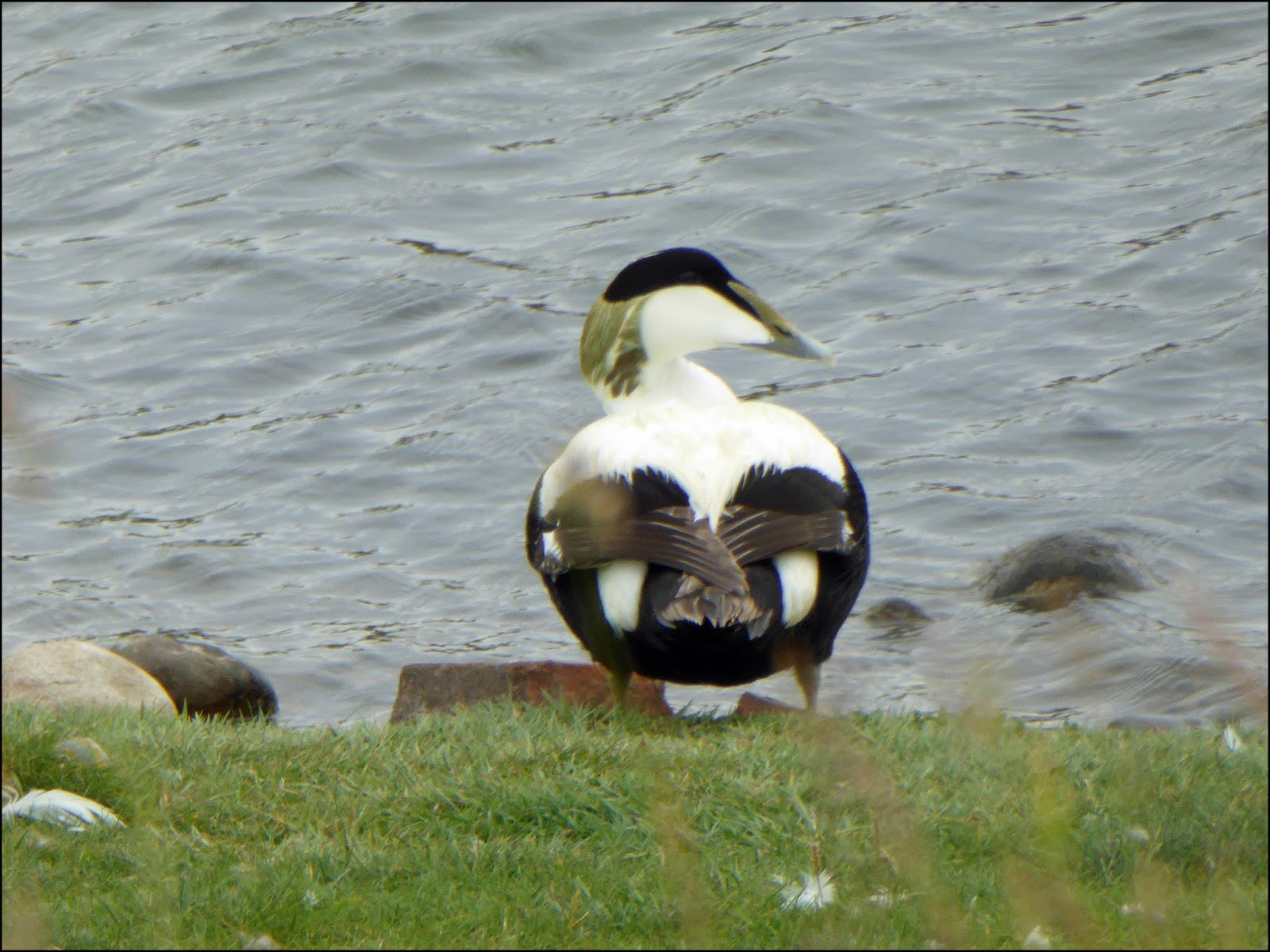
The island is not very large and we were soon on the reserve. I was thrilled to find Eider ducks in good numbers, including the pair in the photo above.


I gather that Walney Island pretty much marks the southern limit of Eider colonies on the west coast. Eiders are amber listed in terms of conservation, so the island is lucky to be able to boast 700 breeding pairs. The duck in the photo above is the female ...


... and this one is the male.


There are long expanses of shingle which provides a nesting area for various gulls, terns and other species such as the Ringed Plover. The Horned Poppy added a splash of sunshine to the scene.


Can you spot the Eider ducks nestling on the grass of the remains of the Walney Salt Works, which closed in 1909?


The lighthouse dominates the skyline.


Piel Castle lies across the water, and can be reached by boat. In 1487 Lambert Simnel landed on Piel Island. The castle dates from the 14th century.


The photo above shows the Eider colony on Walney Island.


In addition to long shingle beaches, there are large areas of saltmarsh.


The photo below helps to give a sense of scale and also a sense of 'the remote', which is something that strikes the visitor after the hustle and bustle of Barrow.


In a landscape that was predominantly grey, it was not only the Horned Poppy but also the tall spikes of Viper's Bugloss that added colour to the scene. We thoroughly enjoyed our visit, but all too soon we were crossing the bridge back to the mainland for a drive through the Lakes to our rented holiday property near Cockermouth.


Wednesday, 13 July 2016

Holiday 2: Amphibian Encounters around the Solway (north and south of the Scottish border)


Seen at NT Sutton Hoo last weekend


I know a good place for tadpoles here in Suffolk, but we do not often see frogs or toads in our local patch. Last weekend was an exception when we saw this little fellow, in the two photos above, poking out of what I presume was a drinking bowl for sheep at NT Sutton Hoo. The warty skin suggests a toad to me, but I may check by posting a photo on iSpot, particularly since the upper abdomen (probably the chest cavity) seems swollen.

On our recent holiday to the Solway estuary, we saw more toadlets and froglets in one hour than I have ever seen in my life (though we saw good numbers of toads crossing the road last year near Kilmartin).

This time the creatures were so tiny that we had to be incredibly careful not to step on them. It was a moving and fascinating experience, and one that poet Neil Rollinson wrote about during his residency with the Wordsworth Trust. The sad part (and having watched BBC Springwatch and Unsprung 2016, I use the 'sad' word with some trepidation!) is that far from all will reach maturity. I hope, however, that a good number will survive to boost the population in the lovely Eskrigg Nature Reserve near Lockerbie.

You can see in the three photos that follow that most were comparable to a short pine needle (or perhaps a 20p piece or needle from a yew tree) in body length.

Taken at Eskrigg

Taken at Eskrigg

Taken at Eskrigg

The next couple of photos show something of the landscape in the reserve - the pine forest with its moss and hummocky mounds ...

 ... and the watery areas.


The only adult frog (a Common Frog, I believe) that we saw during our first week away, while we were south of the Solway, was this one below, who was strolling across a rough track at night in the vicinity of the River Cocker. David got out of the car to take the photograph for me. The light lateral fold is clearly visible, and the striped barring on the hind legs is well defined.

Frog near the River Cocker, Cumbria on a wet night in late June 2016

On one of our expeditions, we found ourselves on the Furness peninsula. We had been told that there was a good place in the care of the National Trust for a waterside picnic; and although we actually moved on up the coast to eat, we were thrilled to discover a Natterjack Toad pool at our first port of call. Male Natterjack toads can sometimes be heard calling to the females on balmy summer evenings. It must be a special sound. It is terrific that the National Trust is working to conserve the Natterjack, which has a distinctive yellow stripe along its back.


The photo below shows the pool - and you can see that it is fenced off to give added protection to the spawn, tadpoles, toadlets and adult Natterjacks. There are only 60 known sites in the UK inhabited by these toads, which are protected by law in all stages of their development, and consequently should not be disturbed. Full marks to the National Trust and other bodies for protecting the Cumbrian population of these special amphibians. 


Friday, 8 July 2016

Holiday 1: Red Squirrel Quest ...


We have just returned from a holiday in Dumfries and Galloway. We had looked in vain for Red Squirrels in several places where they were known to live, but had failed to see more than a chewed or discarded pine cone.

We had perched in a Red Squirrel hide, ordered coffee in a Red Squirrel cafe and asked and asked for suggestions, but our quest continued.

We ended up at Eskrigg Reserve, a beautiful forest near Lockerbie. We sat patiently, watching a Great Spotted Woodpecker, a Jay, a Mute Swan, a Treecreeper ... but no sign of a squirrel.

We were beginning to think that we would have to move on when we came across a hut, and there, just outside, hanging from a nut feeder was ... a Red Squirrel.

We went on to see three more, and thoroughly enjoyed watching these magnificent animals as they interacted with one another, sat up on their haunches and ran up and down the pine trees.

I have reported our sightings on the Saving Scotland's Red Squirrels site. What a privilege to be able to watch - and log - these exquisite creatures.


Thursday, 7 July 2016

Tree Following for June and early July 2016


 Welcome to my Tree Following post for June and early July 2016. 


These tree posts form part of a wider project initiated by Lucy Corrander from the Loose and Leafy blog and continued by Pat at The Squirrelbasket

I am based in Suffolk, UK, where I have been keeping an eye on a Silver birch, B. pendula. I have added in a small Cherry sapling,
Prunus avium Sylvia, for my second tree.

You will find the other Tree Follower links by clicking through to the Mr Linky button here ... so do take the chance to have a look at the new posts!


***

Even in the bluest noonday of July,
There could not run the smallest breath of wind...

Robert Louis Stevenson


So here we are, past the longest day - and already the evenings are beginning to draw in ... just a little. The following is an update on my list of wild things seen in, on or around my two trees. 

Above and below: the Silver Birch in summer, with signs of ripening seeds

The tiny cherry tree has finished flowering. A lot of foliage has grown up round it, so I continue to wonder whether we should attempt to move it before the winter sets in. Some insect has been nibbling the leaves.

Ornamental cherry tree

I was away for part of this last month, which is probably why there are less sightings than I might have expected at this time of year. A number of my #gbb16 Bioblitz records from last month have been verified on iSpot and iRecord and added to my list below. 

I saw my first dragonfly in the garden of 2016 a few days ago, but it flew off before I could get close enough to attempt an ID. The cockchafer beetles - I always assumed they were bugs - have been flying busily around the silver birch on mild(er!) evenings, but the most exciting visitor this last month has been the hedgehog. The photo below actually shows one we saw last year as the camera failed to flash when David tried to take a picture of the 2016 hedgehog visitor last night.


The Silver Birch is full of sap, which is presumably what is attracting the Cockchafers. Apparently the larvae can damage the roots of trees, so perhaps we should not be so excited by their annual appearance! Here's one who came in through the french window and landed on the carpet.


Avian sightings seen at any time since I began the Tree Following project are shown in pink.

I have marked the 'wild things' seen during this last month in yellow.

  • TFb1   Great Spotted Woodpecker (a male and female)
  • TFb2   Great tit (several, often on feeder) 
  • TFb3   Long-tailed Tit (large family, including juveniles)
  • TFb4   Blackbird (several)
  • TFb5   Song Thrush   
  • TFb6   Blue tit (several frequently on feeder, including juveniles)
  • TFb7   Robin (the feisty Robin has put in frequent appearances)
  • TFb8   Magpie (several)
  • TFb9   Wood Pigeon (up to ten perching around the feeder area)
  • TFb10 Dunnock (two, and sadly a dead fledgling)  
  • TFb11 Starling (several noisy juveniles, one particularly pale)
  • TFb12 Carrion Crow 
  • TFb13 Goldfinch 
  • TFb14 Jay
  • TFb15  Green Woodpecker
  • TFb16  Wren 
  • TFb17  Bullfinch (no more sightings since last month's single visit from a male)
  • TFb18  Sparrowhawk (has been seen in the area, but has not been in our garden this month)
  • TFb19  Mallard
  • TFb20  House Sparrow (for the first time since we moved here, about five at once, just below the silver birch)
  • TFb21  Chaffinch
  • TFb22 Grey Heron (one flew over the Silver Birch yesterday). 
  • TFb23 Collared Dove (a pair)
  • TFb23 Coal tit

Mammal sightings include ...


  • TFm1 (?Wood) Mouse
  • TFm2 Bat ... first 2015 garden sighting 7 May 2015 [Apr/May 2015]
  • TFm3 Shrew
  • TFm4 Grey Squirrel  [Jan/Feb 2016] [Feb/Mar] [Mar/Apr]
  • TFm5 Stoat
  • TFm6 Hedgehog (seen last night, an adult, possibly a young adult)
 No new mammals this month.


Insect sightings include ...

  • TFi1 Small Tortoiseshell Butterfly [March 2014]
  • TFi2 Buff-tailed Bumblebee [March 2014] [Jan/Feb 2016] [Mar/Apr 2016]
  • TFi3 Brimstone Butterfly [April 2014]
  • TFi4 7-spot Ladybird [April 2014] [October 2014] [Apr/May 2015] [Jul/Aug 2015] [Sept/Oct 2015] [Mar/Apr 2016]
  • TFi5 Skipper Butterfly [July 2014]
  • TFi6 Meadow Brown Butterfly [July 2014] [Jul/Aug 2015]
  • TFi7 Large White Butterfly [July 2014]
  • TFi8 14-spot Yellow Ladybirds [July 2014]
  • TFi9 Small White Butterfly [May 2014] [Apr/May 2015] [Sept/Oct 2015 - caterpillars]
  • TFi10 Orange tip Butterfly [May 2014]
  • TFi11 Harlequin ladybird  [May 2014] [October 2014] [Sept/Oct 2015 - three on Acer negundo!]
  • TFi12 Garden Chafer (Phyllopertha horticola) [June 2014] [June/July 2016 - several after the silver birch sap on mild evenings]
  • TFi13 Ruby-tail Wasp [June 2014] [May/June 2015] [May/June 2016]
  • TFi14 Blackfly [June 2014
  • TFi15 Marmalade Hoverfly [July 2014] [Jul/Aug 2015]
  • TFi16 Shield bug [July 2014] [Apr/May 2015]
  • TFi17 Migrant Hawker dragonflies [July 2014]
  • TFi18 Unidentified Damselfly [August 2014]
  • TFi19 Comma butterfly [August 2014] [June/July 2016]
  • TFi20 Red Admiral butterfly [August 2014] [October 2014] [Jul/Aug 2015]
  • TFi21 Peacock butterfly [August 2014] [Jul/Aug 2015] [Nov/Dec 2015] - flew past window
  • TFi22 Green bottle flies [August 2014] [May/June 2015]
  • TFi23 Ants [August 2014] [Apr/May 2015]  [May/June 2015] [Jul/Aug 2015] [Sept/Oct 2015 Acer negundo] [Jun/July 2016]
  • TFi24 Squashbug aka Dock Bug, Coreus marginatus [August 2014]
  • TFi25 Birch Shieldbug (late instar?) [September 2014]
  • TFi26 Lacewing [October 2014] [Sept/Oct 2015]
  • TFi27 Cereal Leaf Beetle [Apr/May 2015]
  • TFi28 Unidentified Moth [Nov/Dec 2014] [Feb/Mar 2015] [Jul/Aug 2015] [Sept/Oct 2015]
    [Jan/Feb 2016] [June/July 2016]
  • TFi29 Rosemary Beetle [[Sept/Oct 2015] [May/June 2016 - four]
  • TFi30 Hawthorn Shieldbug [May/June 2015] 
  • TFi31 Forest Shieldbug (Pentatoma rufipes) [Sept/Oct 2015] 
  • TFi32 Early Bumblebee [Mar/Apr 2016] 
  • TFi33 Species of Miridae [Mar/Apr 2016]  
  • TFi34 Cranefly [May/June 2016] 
  • TFi35 Crossocerus, a genus of wasps belonging to the family Crabronidae [May/June 2016] 
  • TFi36 Wasp Beetle (Clytus arietis) [May/June 2016]
  • TFi37   Tree Bumblebee (Bombus (Pyrobombus) hypnorum) [May/June 2016] 
  • TFi38  Moth Least Black Arches (Nola confusalis) [May/June 2016] 

Molluscs


Arachnids


I saw a Comma yesterday near the Cherry Tree.

I wonder what the next few days will bring ...


#gbb16
MY PREVIOUS TREE FOLLOWING POSTS