Wednesday, 25 April 2018

Isle of Wight (2): Brading Roman Villa


I mentioned in my last post that I would be adding a few photos of our expeditions to a couple of the Roman villas on the island. The first villa we visited was Brading, and what a wonderful place it was.

A lot of information has been gathered about the Roman era on the Isle of Wight. The island was known as Vectis to the Romans. 

As we walked towards the entrance, my eye was diverted by this beautiful re-creation of a Roman garden. The board in the photo below shows the layout. It was early in the season (in fact we were told that the 'season', i.e. the holiday season, would not begin until Easter Saturday), but there were still bright tints and touches of colour, as you can probably see.


I couldn't help noticing the wild Violets, too. They seemed much larger than the ones we usually encounter here in Suffolk. Some were veering towards pink in tone. 


The staff at the villa are very wildlife-aware, and we walked around the building that houses the mosaics to see Medusa's wildlife meadow. I suspect the sign was made with school parties in mind, but I feel a wildlife garden should appeal to all.


Sadly, we were too early (since this was a long winter) for butterflies, but we did spot the rather impressive creature in the photo below! 


Much of the villa itself is under cover in a building that nestles beneath the heights of Brading Down, where we had a picnic lunch one day.


Once inside, we visited the cafe, which was very good: the chocolate tiffin was excellent!
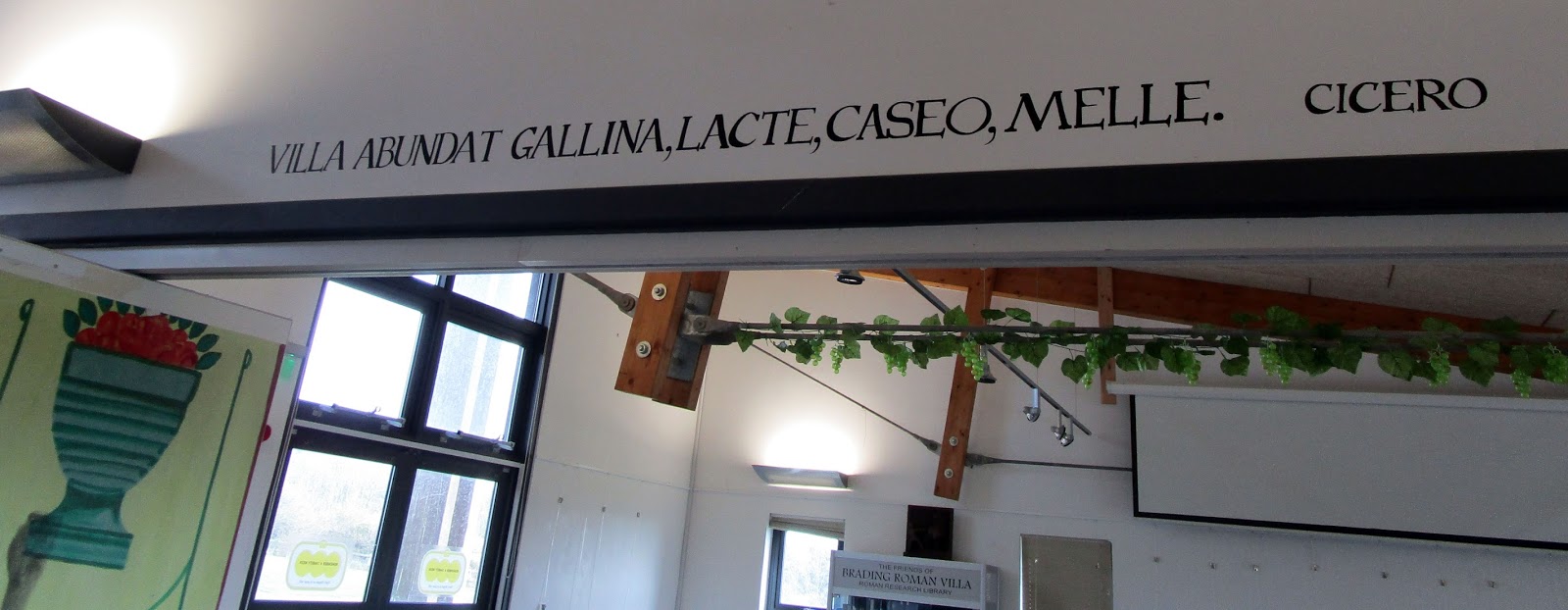

By this time we were itching to see the mosaics and other Roman remains. And what fantastic mosaics they were.


A good reconstruction can be very helpful; but, of course, not all reconstructions are good. I was particularly taken with the juxtaposition of the Roman tile-layer (below) and the modern excavator (two below). To see these men side by side, as they were in the display, seemed to me, in one of those rare moments of inspiration, to represent not only the era of Roman occupation on the island but also the arc of history and the sheer thrill of archaeology itself. This strange sense of distance and connection is why I was so intrigued by my first childhood visit to Lullingstone Roman villa in Kent, and why I went on to study (and teach) classical civilisation.   


When I was looking through my photos on my return and trying to remember the contexts, I came across this excellent blog about the Brading mosaics. We have Orpheus in the scene below, with a monkey and what may be the representation of a Chough (though it looks more like a Moorhen to me, but with red legs!).


Which bird do you think this was meant to be, I wonder?


Birds were not only represented in mosaic, but also in fresco, as you can see below.


Having mentioned the art of reconstruction, I want in passing to mention the skill of producing helpful labels. Presumably the use of the first person in the one below, just one of a number on site, is to make you feel welcomed into the world of Roman Britain by your (imaginary) Roman guide.


I particularly liked the fox in the mosaic!


And I can't resist adding in this photo of a real urban fox we saw some miles away in Ryde. It is a very poor quality shot, I'm afraid, thanks to the need to be quick, the poor light levels and the reflection from the windscreen, but it has a certain spark!


The Roman diet included shellfish of various kinds. We found some wonderful shells on the island, and I suspect many of the ones on display in the villa had been gathered (in Roman times) from local shorelines.


One of my best memories from that early trip to Lullingstone Roman villa was a tile with pawprints. A cat or dog had walked over it before the clay had set. The tile in the photo below from Brading has not only a pawprint (though it is not easy to see in the picture), but also a studded sandal mark and a human footprint. This kind of tile would have capped a floor of hypocaust.


And here are some remains of the underfloor hypocaust heating system at Brading.


I was going to add Newport Roman Villa into this post; but, on reflection, I think it can have a post of its own. So that will come next.


Monday, 23 April 2018

Isle of Wight (1): Osborne and Carisbrooke

'A wide expanse of shifting ocean,
A wide expanse of breezy down ...'

Mary Gordon Leith 


I mentioned in my last post that I had been away from my computer on the Isle of Wight and that I would share some pictures of our visit. We had a bitterly cold but calm crossing. We stayed out on deck, and David enjoyed looking at the forts in the Solent. The yachts from Cowes were out in force: you can see the island in the distance. I had spent a night on the island a long time ago, but had not previously had the chance to explore beyond Ryde and Newport.

OSBORNE

We drove straight to Osborne House, Queen Victoria's holiday home, with gardens stretching down to the sea. 


We passed this Victorian pillar box on our way to the cafe, where we were glad to warm up after the crossing with cups of steaming coffee.


You can just about make out the Solent. What lovely trees.


We thoroughly enjoyed seeing inside the house, and were delighted to find that we could picnic in the grounds. We perched on a bench near this stone sphinx, among daffodils and polyanthus. We noticed several holes in the soil: they were too large to have been made by mice so perhaps there were Red Squirrels in the vicinity ...


There were some wonderful decorative features: the frieze below adorned the inside of the house, with its Greek 'key' or 'meander' pattern, its palmettes and other motifs. 


The grotto outside was also very classical in appearance, with its shells and colour scheme.


I think we were both surprised at the number of corvids on the island. This rook was patrolling the lawn.


What wonderful blue skies in the photo below!


This last week has seemed very much like early summer; but despite the wonderful banks of primroses, our time on the island barely felt like spring.


CARISBROOKE CASTLE


Looking out over the walls


The Princess Beatrice garden from above


My thanks to David (Gill) for the two photographs above. We spent a wonderful afternoon exploring the castle. Princess Beatrice, Queen Victoria's youngest daughter, has this lovely garden named after her today, but way back in the 13th century, Isabella de Fortibus created an early garden here at Carisbrooke.

Back in 1817 John Keats remarked on the Jackdaws, and I am glad to report that in 2018 there were a few glossy Jackdaws in residence. The pair below, taken with the full extent of my zoom, were literally perched in the masonry. I suspect the next generation of these birds will soon be on the way.


Kings of the castle


We have really noticed the first flush of green growth on the trees this last week, but you can see in the photo that the branches were still bare. What impressive castle walls.

We concluded our visit to Carisbrooke Castle by sitting outside with a pot of Earl Grey tea and slices of cake. We returned later in the week for a brief visit, and I particularly enjoyed seeing some of the artifacts in the museum.

My next post will step back in time to the Roman era when the Isle of Wight was known as Vectis.
  

NT Wicken Fen - Butterflies

Speckled Wood, Wicken Fen Butterfly Trail, 21 April 2018

Well, here at long last is a photo from me!

I have been away on my travels to the Isle of Wight (of which more in a future post), and have been catching up with deadlines since my return. But on Saturday the sun shone and we were lured over to a favourite haunt, NT Wicken Fen near Ely.


I only wish I had been able to take more butterfly photos as, to our delight, we saw the following species:

1] Peacock
2] Orange Tip
3] Brimstone
4] Comma
5] Small Tortoiseshell
6] (Almost certainly a) Holly Blue

The Comma rested with closed wings for a while, but nearly all the butterflies were on the move and very tricky to photograph. I shall post some old photos of these species at the end for those of you who live in places where the species are different.

But first, here is the Comma in a picture taken yesterday (and you can see the white comma):


The biggest surprise was the number of Brimstones on the wing, probably more at one time and in one place than I have seen in my whole life before. It was thrilling to rest on a bench in the Butterfly Trail and just enjoy the flutter of bright yellow and deep cream wings as the insects moved around the foliage.


Butterflies were the predominant creatures on our walk, but they were not the only kind of wildlife by any means. We saw a Muntjac deer, a couple of newts, a Seven-spot Ladybird and lots of water snails. There were two of these ?worms (or worm casts) in the water: I have not been able to ID them yet. And we heard our first 2018 Cuckoo.


I imagine this is a fungus, perhaps of the puffball variety.


I have posted pictures of this ruin before, assuming it was a pumping station or building linked to drainage and water levels: this time there was a sign, proving that my hunch had been entirely incorrect...


The photo below reminds me that after such a long harsh winter, it will soon be dragonfly season ...


The photo below shows a section of my favourite boardwalk, 
with the windpump to the left ...


... and the visitors' centre to the right.


The views of flat fenland seemed wider than ever 
because the reeds were still fairly short, 
so we could see for miles. 


Live and let live? Or is the spider sizing up the ladybird?


Burgeoning spring ... at long last.


It took us a bit of time to get our eye in, but we eventually noticed some movement and linked it to  what I take to be a Caddisfly larva. The peaty water was dark, and seemed especially so in the bright sunshine, so I have ringed the creature in yellow.


There was some movement and this photo was taken a minute or so later.

------------

The butterfly photos below
are OLD PHOTOS,
but they show the butterflies I failed to catch on camera on Saturday.

1] Peacock


2] Orange Tip


3] Brimstone


5] Small Tortoiseshell


6] (Almost certainly a) Holly Blue


And, as mentioned, we also saw the Speckled Wood (picture at top of this post) and the Comma (also pictured earlier in this post, with closed wings; and shown below with open wings in an old photo). 


How lovely to feel that we have well and truly entered the butterfly season. 
Can you help Butterfly Conservation with their first sightings list for 2018?