Thursday, 10 September 2015

Pine Hawk-moth eggs at NT Sutton Hoo


After recent days of grey cloud I was keen to make the most this afternoon's lovely weather. NT Sutton Hoo was looking at its best. The mounds are in the background and the Visitors' Centre is beyond. 


 The blue flowers on the right of the mound are Harebells (you can't tell from the photo!).


There was also a good sized patch of Scabious, however ...


... what excited me at the time, and even more afterwards when David checked his Twitter feed, were these small white eggs on one of the pine trees. The tree was just inside the central roped-off mound area, making it difficult to get close enough for my camera to allow me to take a good macro shot. But at least I have a record of what are (it seems) eggs of the Pine Hawk-moth, Sphinx pinastri.

I am giving this identification because a glance at Twitter revealed that Molly Carter - who tweets as ‏@CuratorMolly - had seen not only the eggs but also a magnificent caterpillar here at Sutton Hoo only a few days ago. You can take a look on her Twitter account by clicking here. You might also like to see this brilliant model!
 
Don't forget that it is Moth Night (which goes on until 12 September 2015). Next year's theme will be Hawk-moths.

One of the Sutton Hoo Kestrels this afternoon

When I was up at Sutton Hoo last time, the local Kestrels were making their presence felt. I was delighted to find that the pair were active again today.


Kestrel over the Sutton Hoo burial mounds

Autumn is beginning to have the upper hand, and we saw a lot of fungi around the site.

Is this a Parasol Mushroom?

As we turned to leave, we saw a Hornet (too quick for us to catch on camera, my fifth Hornet of the season) in a gorse bush along with this spider, who had no intention of going anywhere.


Wednesday, 9 September 2015

Early Autumn ... a mixed bag

Hoverfly Syrphus sp. (I think) on the last of my Californian Poppies

I spent ten or twelve minutes in our garden with my camera this afternoon, having a look around to see what was about. There was a dragonfly, but it was on the wing and never gave me the chance to see it properly. I could hear a few birds rustling in the bushes, but the only one to break cover was a female Blackbird. There were a number of insects, as you will see ...


Hoverfly Syrphus sp.
.
Marmalade Hoverfly Episyrphus balteatus (I think)

Early autumn berries on the Hawthorn

Blackberries arriving over the garden fence!


The photograph above intrigued me. There is a Small White (Pieris rapae) caterpillar on my Nasturtium leaf, but what is that white mark at the tip of of my orange arrow?

As far as I can see, caterpillars do not leave a trail of slime in the way that slugs and snails do. However, I have discovered from Reg Fry on the UKLeps website (you will need to search or scroll down once you have clicked the link) that White (Pierid) caterpillars spin a silkpad as part of the pupation process.

Intriguingly, it does not actually look to me as though the 'silk' in my photos is going to be used in this way. Do let me know if you have any thoughts.

I wish my photographs were clearer, but I was leaning over an unruly clump of wild honeysuckle, and had no wish to topple over! 


Close-up of ?silk


The photo above shows a couple of Nasturtium plants that have largely survived the onslaught of the caterpillars thus far. However, as you can see the leaves have been eroded by Leaf Miners (you will need to scroll down once you have clicked the link). I blogged about these two years ago in July. My Nasturtiums have been much later this year.

What interests me, though, is whether any of the parasitic wasps that have frequented this part of our garden around my insect hotel have been laying eggs in the Miner larvae. This thought may not be for the squeamish!


Above: something more straight forward - a Daddy Longlegs or Cranefly. I expect these will soon be making their way into our homes. 


And finally, a Shieldbug nymph (I think it is the Common Shieldbug nymph, 4th instar, but, as ever, please let me know if this is not correct).

I shall try out my ten to twelve minute observation exercise again. Who knows what I may have missed this afternoon!

Tuesday, 8 September 2015

Drinker Moth at NT Wicken Fen


I seem to be working backwards through my photos at the moment. We noticed this beautiful female Drinker Moth (Euthrix potatoria, aka Philudoria potatoria) on 25 July at the approach to the NT Wicken Fen Butterfly Trail. The moth is one of 9,175 species recorded at this nature reserve. Adult males are darker orange-brown in colour.   

The Drinker is a night-flying moth. It is usually found in damp places. I believe the species is named after its hairy caterpillars which (supposedly) seek out dew drops on reeds or stalks of grass. A Cuckoo will eat these caterpillars, but other birds apparently leave them alone.


And before I complete this post with a photo of the Wicken windpump, I just want to draw your attention to Moth Night (see Twitter: #‎MothNight‬), which lasts for three nights in some strange way, and begins on 10 September 2015. This year's Moth Night theme is 'Migration'. 

The iconic Wicken Fen wind pump

Monday, 7 September 2015

Tree Following - August to September 2015


Welcome to my Tree Following post for August and early September.

These tree posts form part of a wider project run by Lucy Corrander from the Loose and Leafy blog. I am based in Suffolk, UK, where I am following an Acer negundo (aka a Box-leaf Maple). I am also continuing to keep an eye on my Silver Birch, B. pendula.

You will find the other Tree Follower links on the Loose and Leafy blog ... so do take the chance to have a look around!

August has been a strange month for us, with day after day of grey sky and a fair amount of rain. I think there must have been sunny interludes as I can remember trying to keep the wasps at bay, but the evenings have seemed dark and autumnal.

Strangely with the seasonal changes going on all around, my two trees have not changed as much as I might have expected.

There were a few brown leaves last month: there are still a few brown leaves. The nearby Downy Birch has definitely got more brown leaves, and a number of yellow ones, too. 

There were toadstools along what seem to be the root lines of my Silver Birch: there are still toadstools.

The Acer negundo was displaying its seed keys. These are still green and they continue to hang in the same manner. Come to think of it, the dispersal of Silver Birch seeds appears to have slowed. This may or may not actually be the case: it may simply be that the lack of light has stopped me from noticing the dispersal.

Acer negundo keys

What of the wildlife? I watched a very small fly alight on the Acer negundo, but failed to see it once it had landed. Otherwise this tree has been something of a barren area in terms of insects and small creatures. I would love to know why.

The Silver Birch, on the other hand, has continued to attract a large family of Long-tailed tits. They chitter-chatter away and are a delight to watch. There are plenty of Bluetits, too, of all ages. The Great tits head up the pecking order when the Magpies are elsewhere. I have seen the Grey Squirrel on a couple of occasions, and there are two Wood Pigeons who like to vie for the best perch on the fence next to the trunk. Sadly we have not seen the hedgehog again.

Silver Birch

Silver birch, September 2015 (see here for Sept. 2014)

Butterflies have been few and far between. I suspect the Whites were largely attracted by my nasturtiums. There have only been a couple of Red Admirals, and they have made the white Buddleia their destination of choice (a second was spotted some days after my Buddleia post here).

There have been Lacewings on the window at night and one or two moths. Whether the Silver Birch has anything to do with their presence is hard to say.


My least favourite visitors this summer have been the Hornets. One flew in to the house through an open upstairs window and was incredibly difficult to get out again! No stings reported, I am relieved to add.

I expect we will notice more radical changes next month when I will post my updated list of species seen around my two trees. I am not an autumn person, though I have to confess that I do enjoy the rich colours that appear before the frosts set in.

 
MY PREVIOUS TREE FOLLOWING POSTS

Saturday, 5 September 2015

Anyone for ... Cricket?


We found this handsome creature walking about on our bathroom ceiling on 6 August. I forgot to post the photo at the time, so it is a case of better late than never!

I am no expert when it comes to orthoptera, but I think this is a male Bush Cricket.

Wednesday, 2 September 2015

Constable Country - RSPB Flatford Wildlife Garden

Flatford Mill, painted by John Constable
We always enjoy a visit to Flatford, with its Constable connotations. The RSPB Wildlife Garden is a particular draw, especially when there are usually butterflies on the wing.

Saturday was a 'reasonable' afternoon by the standards of the summer. We entered the garden and were a bit surprised to see so many autumnal seedheads in August! 

I don't think we managed to spot one butterfly, but the volunteer staff member was very helpful and pointed out some other insects that we might well have missed.

The selection below shows these creatures and also a couple of mini-beasts that we spotted for ourselves.


Camouflaged Shieldbug instar nymph on sage

Not an insect this time, but an as yet unidentified arachnid!

The closest we came to a butterfly! A Mint Moth (thank you, RR, for confirming ID!)

A Willow Emerald damselfly

There were quite a few Bumblebees around


Sunday, 30 August 2015

Scottish Jellyfish Sightings 2015


According to the Marine Conservation Society, our smacks of jellyfish 'should not be ignored.'

There have been reports of high numbers this summer off the UK. However, you might also want to read this Guardian article by Steve Backshall.

I saw the jellyfish in this post when I was in Scotland at the end of June 2015 and have logged my sightings with the MSC. 

Cyanea lamarcki (Blue jellyfish), Campbeltown Harbour, Kintyre, Scotland (June 2015)

Cyanea lamarcki (Blue jellyfish), Campbeltown Harbour, Kintyre, Scotland (June 2015)

Aurelia aurita Moon jellyfish Campbeltown Harbour, Kintyre, Scotland (June 2015)

Thursday, 27 August 2015

Kestrel at NT Sutton Hoo

After the Sutton Hoo ship-burial helmet

I was up at NT Sutton Hoo this afternoon ...


... and spotted a Kestrel near the boundary with the farmer's field.


It was flying and perching ...


... flying and perching as it quartered its territory.

Presumably a female on account of head colour?

After a while I saw it take off towards the river Deben, above Woodbridge.


I sat down near the burial mounds to admire the Harebells.


It was a warm, and slightly humid, 23 degrees centigrade ...


... but an hour later when I was safely home, there was a cloudburst, followed by one of the most impressive double-rainbows I have seen.

Double rainbow, showing Alexander's band

Monday, 24 August 2015

More Moths . . .


I posted a piece last week about moths. I mentioned the Hummingbird Hawk-moth (I shall follow the UK Moths site spelling), and how I had seen a number in Greece but hardly any in the UK. Serendipidously we were sheltering from the rain this last weekend in the grounds of Helmingham Hall when what should catch my attention but ... a Hummingbird Hawk-moth, nectaring on a Buddleia bush. I apologise for the quality of the photograph: these insects rarely stay still, but they are wonderful to watch.


David was just leaving for work this morning when he noticed the moth in the photo above on the Buddleia adjacent to our drive. I think it may be a Straw Dot (Rivula sericealis). 


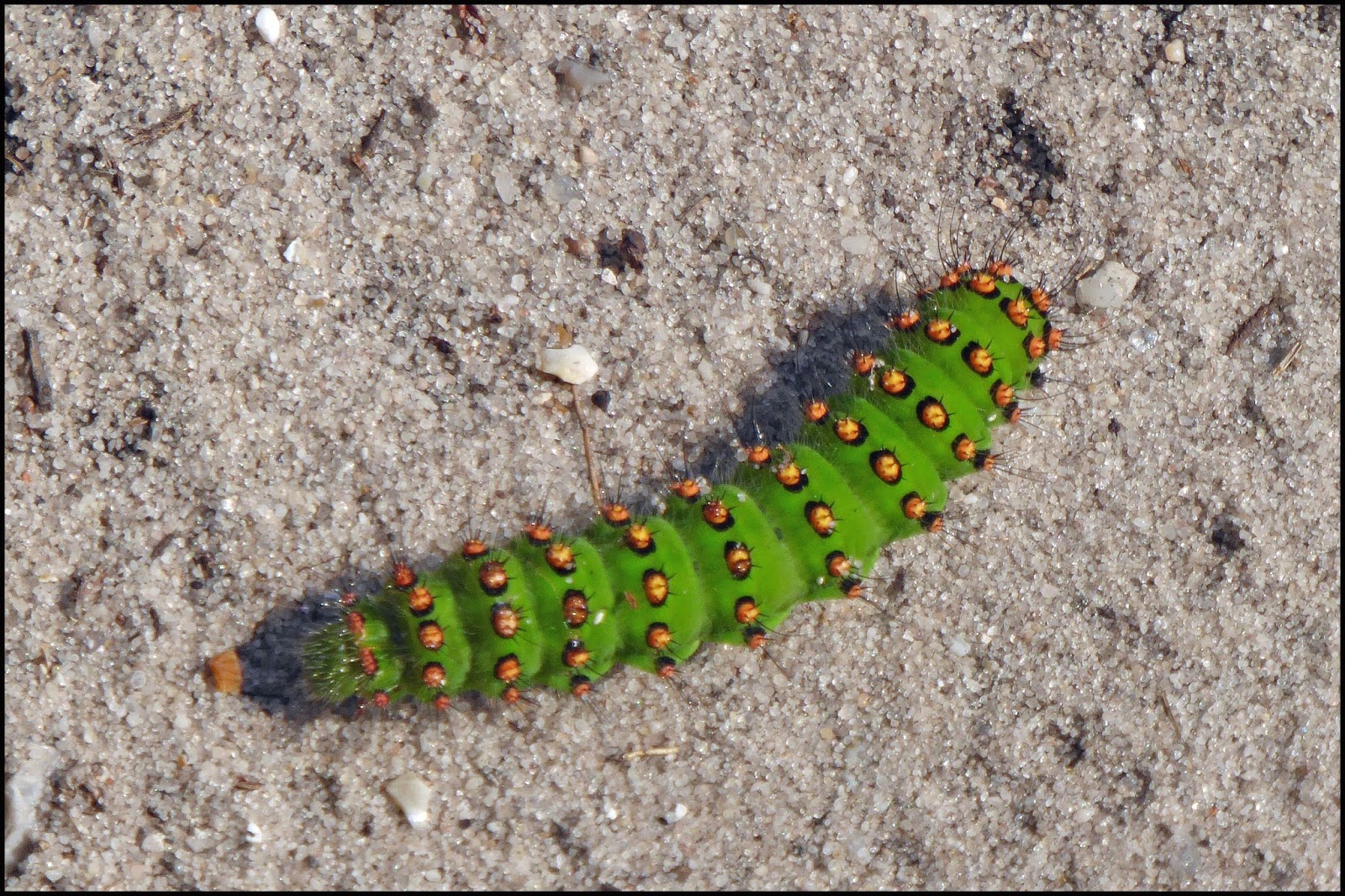
And finally, a handsome caterpillar!

I have been meaning to post this photo for some time. We came across the caterpillar earlier this summer on a sandy track on NT Dunwich Heath. It is an Emperor Moth larva (Saturnia pavonia), possibly 5th instar - and I would love to see the adult. The males fly about during the day.

Does anyone know whether the 'pavonia' bit of the name refers to the peacock-like eyes on the adult's wings?