Saturday, 20 February 2021

An Early Spring Morning in the Garden


We spent an hour in the garden this morning, enjoying some early spring sunshine and birdsong. These first two photographs, which were also the first two I uploaded, were actually taken on 12 February when the Fieldfares were still in our trees. All the other pictures were taken today.

We always enjoy seeing Goldfinches. This one was in the Silver Birch, which some of you may remember from the Tree Following meme.
 

This 'woody' corner of the old decking seems to suit these small Cyclamen. They don't seem to spread much, but are always a joy to see. But it was the miniature Iris reticulata in bloom that particularly caught my eye this morning. 

As you may know, we have been keeping an eye on four Wasp spider egg sacs over the winter. What you see in the photo below is, we can only think, the remains of one of them. The grassy area in which all four were last seen was under about 20cm of snow for almost a week earlier this month. All our snow has melted, but the long grass is bent over in swathes. 

Back in the summer, we were visited not only by Wasp spiders, but also by a couple of Common Lizards who, to our great excitement, were sighted on our patch for the first time. These 'firsts' may be totally unrelated, but it was nevertheless intriguing to read on @Tone_Killick's Twitter page for 15 December 2020 that it is extremely rare in the UK, there being probably only one instance, to find a photograph of a spider with vertebrate prey. It just made me wonder whether the spiders on our land were after the lizards, and not the other way round, as I might have supposed.

As for the egg sacs, well, time alone will tell whether the colony of Wasp spiders increases here or whether the wind and cold weather have killed off the overwintering eggs. 


On a more cheerful note, it was good to find two different kinds of ladybird making the most of the sunshine. The 7-spot emerged from a large pile of twigs, and what seems to be (the much smaller) Pine ladybird (Exochomus qadripustulatus), with its rim around the elytra, was perching on a leaf.

 
There were a couple of (?Nursery web) spiders running about on the relative warmth of the old tray. 

It was a delight to find two Daisies in the grass.

Here's a close-up of our first Iris . . .

. . . and photos of our first Crocuses.


This is our new feeding pole, which although empty in this picture, has already attracted Long-tailed tits, Great tits, a Robin, a Pigeon, Blue tits and Starlings. There is plenty of food for all comers, and yet the Blue tits, in particular, insist on dive-bombing their fellow Blue tits and also the Long-tailed tits. 

We have never had an Aconite in the garden before. There is just the one, in a very scruffy old pot, so I am intrigued whether perhaps we planted a few bulbs last autumn.

And finally, do let me know your thoughts on the (pretty shy) bird above. I thought it was a Sparrow, until I took the photo below, which is certainly one. The two bills don't look the same shape to me, but I am really pleased to find a House Sparrow in our garden. There was a little colony down the road, but it dispersed last summer when one of the houses had building work which interfered with a particular hedge. 

The last House Sparrow record for our garden is June 2020. These once-common birds are now categorised as Red in terms of conservation on the RSPB site. I hope we will see more of them in the days to come.


Friday, 12 February 2021

Fieldfares and Redwings

We have definitely had more snow than in our previous years in Suffolk. And, to our delight, the snow brought a huge mixed flock of Fieldfares (a garden first for us) and Redwings (just a few). All these photos were taken through the window of our home. Sadly the light quality was very poor when I photographed the Redwing, two photos below.


With a profusion of catkins behind


Seeing these wonderful birds so close at hand made me wonder whether there will be an influx, or even an irruption, of Waxwings. However, the Waxwing Twitter account, @WaxwingsUK , suggests to me that this is probably unlikely. 

Sunday, 7 February 2021

Snow on snow . . .

I have not ventured out beyond my patio door, but here are some of the avian visitors who came to our garden today. I gather there are Redwings and Fieldfare in the vicinity, but I have yet to see any this year. As for the snow, well, it is probably the most we have had since we moved in to our current house about nine years ago!


Friday, 5 February 2021

Early Signs of Spring


I thought I would post a few photographs from my time in the garden this morning. Despite a downpour yesterday, there is hardly any water in the old tray at present, but these spiders were making the most of the sunshine.

Way ahead of St David's Day, we were thrilled to see these buds. 


Our soil doesn't seem particularly suited to Snowdrops, but it is always a joy to peer under the Hydrangea and see these small white harbingers of spring.


I also noticed two Hellebore buds. 


And finally, these catkins beyond our garden fence were turning gold in the sunlight.  

Tuesday, 2 February 2021

RSPB Big Garden Birdwatch, 2021


A bird watch has to begin somewhere, and mine began with the small but distinctive features of this beautiful Blue tit, almost hidden in a woody patch beneath one of our coconut feeders. The three images below show that other sightings were to follow.


As you can see, I finally succeeded in uploading my Big Garden Birdwatch Results for 2021 on to the RSPB site. There are not really any surprises on my list, although, typically, Long-tailed tits and Wood Pigeons have been around in much greater numbers since my counting hour. 

Ours is a medium-sized suburban garden. It is in close proximity to a Local Nature Reserve. We have a mix of trees, shrubs and the somewhat battered stalks of last year's long grass. Our sandy soil contains a fair amount of old builders' rubble. 

We usually put out fatballs with seeds or mealworms. We replenished our supply of these, adding a new canister of sunflower seeds, which attracted the Goldfinches. 

I wonder what birds you were able to count. Results can be uploaded, I believe, for the next few days (possibly until 19 February, but do check). Here are a few photos of our avian visitors, taken from behind double-glazing ...


female Blackbird

Long-tailed tit

Starling

Blue tit

Robin

Friday, 29 January 2021

Late January Garden, ahead of the RSPB Big Garden Birdwatch

RSPB Big Garden Birdwatch Update of 31 Jan. 2021: I have tried several times to upload my Big Garden Birdwatch results to the RSPB site, but apparently the volume of results has caused a glitch. According to messages on the RSPB England Facebook page, we are invited to keep trying to upload our data, and this can be done right up until 19 February.

I look forward to taking part in the RSPB Big Garden Birdwatch over the weekend. Long-tailed tits may not gain my highest score, but I expect they will be in the top three. We hardly ever saw these exquisite birds when we lived in South Wales: I wonder whether they have become much more prevalent in recent years. We placed a robin-sized nesting-box of brushwood and a small roosting pouch in the garden today. It will be interesting to see in the coming weeks whether we have any takers.

 
'Our' nettles had a very poor summer season last year, so the ones in the photo above, taken this morning, make we wonder if 2021 will be a better year for them. I would love butterflies to lay their eggs in this corner of the garden.

Sadly this Dockbug has come to grief. I noticed it in the old shallow tray of water we keep out for the birds. On a happier note, I watched a ladybird moving along a branch in the sunshine. I expect it should really be overwintering, but the unexpected warmth had probably lured it out. I also saw what looked like my first bee of 2021. I always look forward to the return of the insects. 

The specks of ice (or hail?) on this leaf caught my eye the other morning. I have greatly enjoyed seeing the icy wonders on BBC Winterwatch this year.


Friday, 22 January 2021

My First Snowdrop of the Year and Other Garden Observations


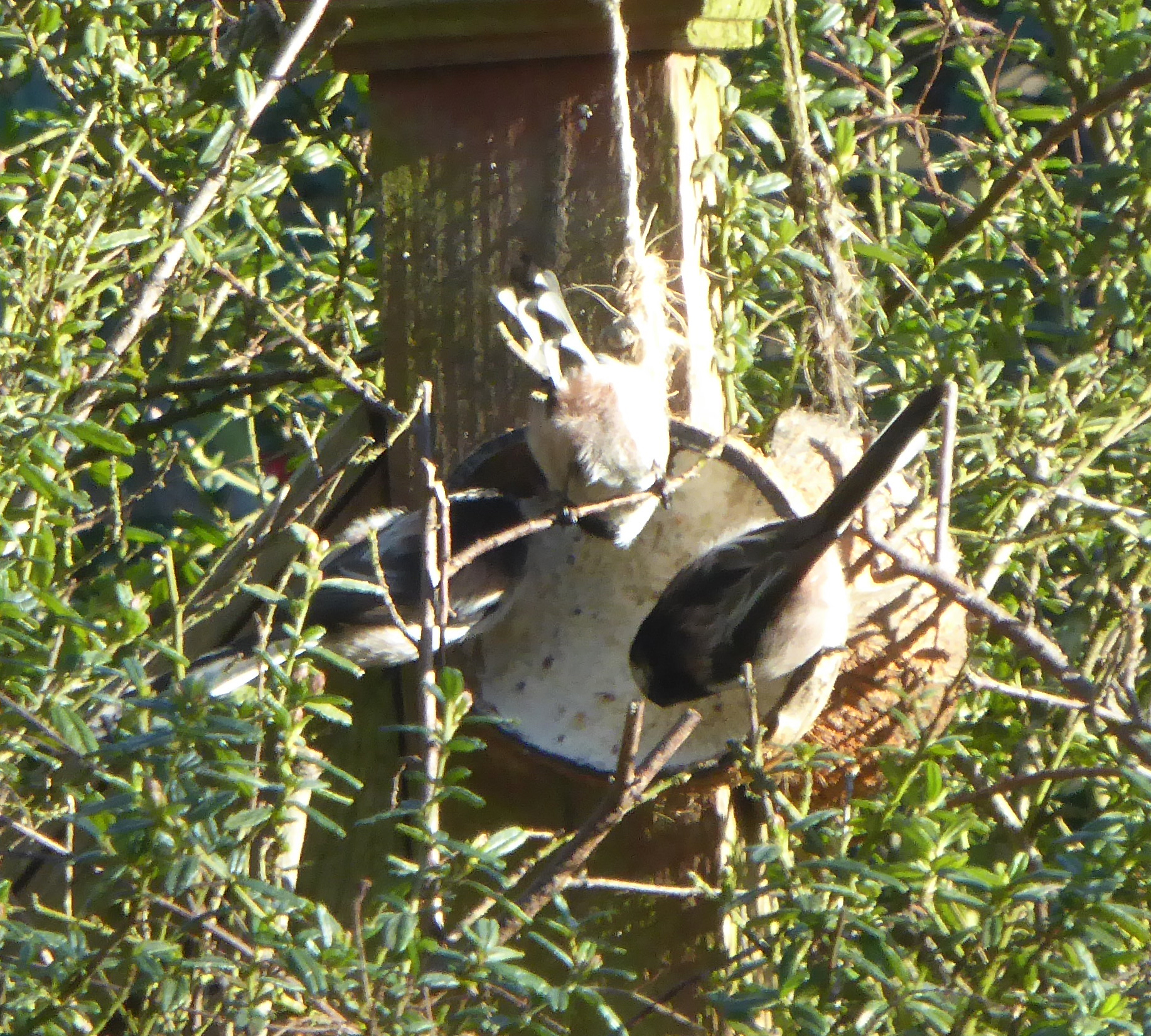
We had beautiful blue skies here in our part of Suffolk this morning, and it was a joy to watch the Long-tailed tits feeding from the fatballs. I love the way the top one clings on, projecting its bill forward. These birds are so acrobatic!


A number of folk have been posting about Snowdrops. I looked in the garden a few days ago and failed to see any signs, but today I came across two Snowdrops in flower, virtually hidden in a tangle of undergrowth. They brought a smile to my face!


David and I were out looking for the over-wintering Wasp-spider egg-sacs. We only managed to see one of the four that were in our mini-meadow (aka unmown lawn) last autumn. I hope the others have survived the frost. I wonder if you saw the Wasp-spider photograph on BBC Springwatch yesterday? 

We nearly missed this patch of Cyclamen in a shady corner... I wonder what we will find next.


And meanwhile, here is the Wasp-spider eggsac...


And just in case you have yet to see this striped spider, here is a link to one I saw last year...

Saturday, 16 January 2021

Snow . . .

We finally had more than a five-minute flurry of snow today. It looked beautiful for a while, but began to melt fairly swiftly. There is still some slush on the pavements, which will doubtless turn to ice if the temperatures freeze again, but most of the snow has vanished. The Blue tits, Long-tailed tits, Great tits, Robin and Blackbird have been very active around the coconut feeder. We also had a couple of gulls and Magpies battling it out for a tasty morsel.


I checked yesterday and at least one of the four Wasp spider eggsacs is still intact, though much of the long grass is now bent over. I couldn't see any signs of a Snowdrop, but I guess it's early yet. At least some of the bulbs have started to shoot. Will there be daffodils in flower for 1st March, I wonder?