Monday, 24 August 2015

More Moths . . .


I posted a piece last week about moths. I mentioned the Hummingbird Hawk-moth (I shall follow the UK Moths site spelling), and how I had seen a number in Greece but hardly any in the UK. Serendipidously we were sheltering from the rain this last weekend in the grounds of Helmingham Hall when what should catch my attention but ... a Hummingbird Hawk-moth, nectaring on a Buddleia bush. I apologise for the quality of the photograph: these insects rarely stay still, but they are wonderful to watch.


David was just leaving for work this morning when he noticed the moth in the photo above on the Buddleia adjacent to our drive. I think it may be a Straw Dot (Rivula sericealis). 


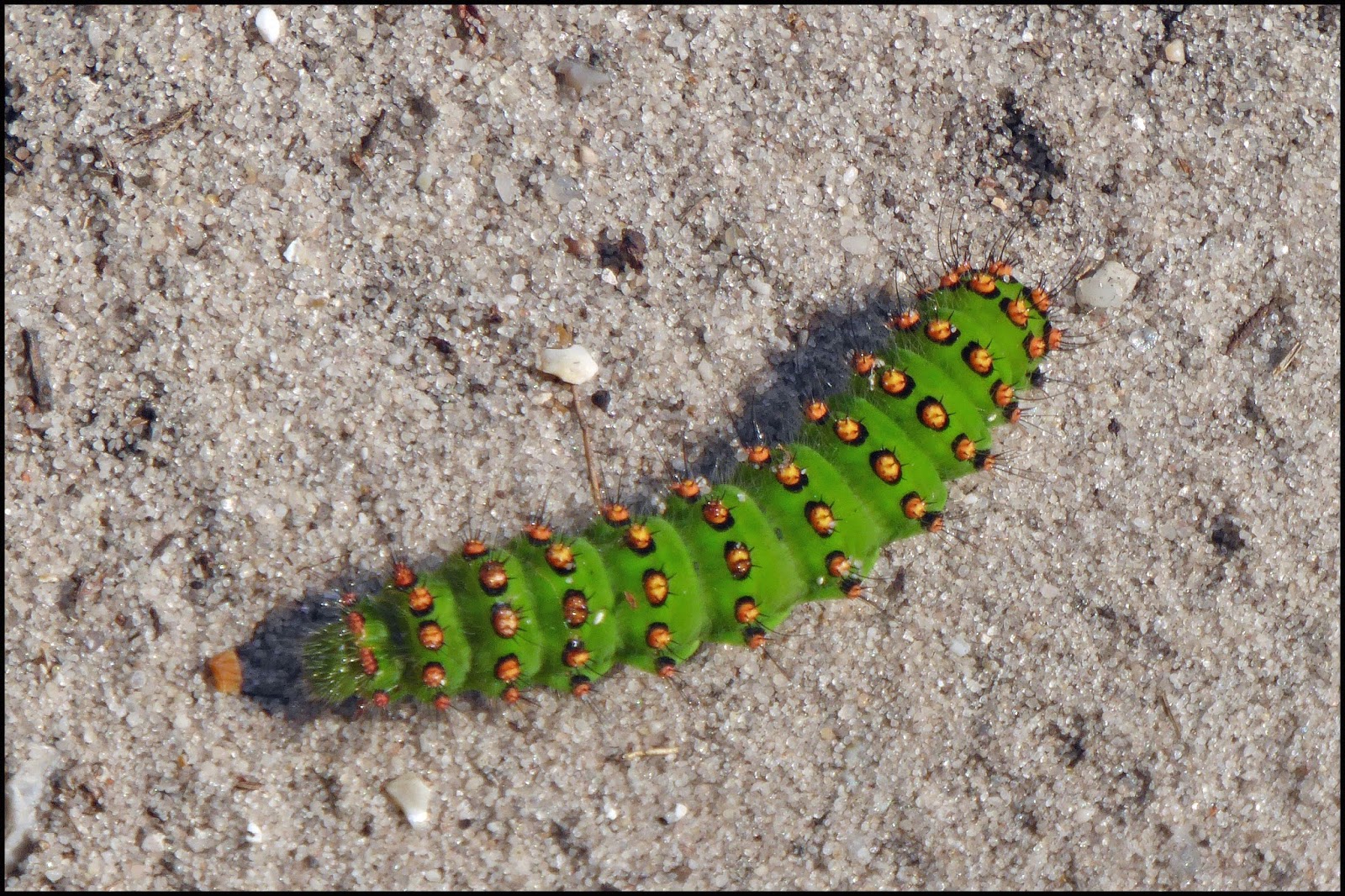
And finally, a handsome caterpillar!

I have been meaning to post this photo for some time. We came across the caterpillar earlier this summer on a sandy track on NT Dunwich Heath. It is an Emperor Moth larva (Saturnia pavonia), possibly 5th instar - and I would love to see the adult. The males fly about during the day.

Does anyone know whether the 'pavonia' bit of the name refers to the peacock-like eyes on the adult's wings?

Friday, 21 August 2015

Nasturtiums at Last!


I plant very few seeds. This year I planted Nasturtiums and Californian Poppies. The latter have done surprisingly well, but I have hardly seen a Nasturtium in flower until now. 


I suspect this is the reason! My plants are being devoured at a rapid rate by hungry caterpillars.

It would be interesting to know whether the leaf veins are intended to draw the larvae towards the centre of the plant.

The good news is that while I doubt there will be (m)any Nasturtium flowers left, at least there should be a very healthy brood of Large White Butterflies! 


Thursday, 20 August 2015

A Mixed Bag of Moths ...

I think this is Buff ermine (Spilosoma lutea)

It seems to be that time of year here in Suffolk when we begin to notice two particularly fluttery creatures - bats and moths. 

I have to confess that I was never very interested in moths. I liked butterflies and had a good butterfly guide from about the age of eleven. Most moths seemed a dull brown colour and did little to make me interested in them. In those days moths seemed to suggest the smell of naphthalene (now considered a possible health risk, especially to the young who might try to ingest mothballs). Some people have switched to red cedar discs as a deterrent, though the cedar may only work on hatching larvae.

I am still more of a butterfly person, but I am coming to appreciate moths as a result of seeing the wonderful photographs on your blogs. Many of you have moth traps, and while I don't use one of these, I really enjoy seeing the variety of shape, colour and particularly pattern that emerge. There is sometimes something rather kaleidoscopic about the markings on a moth.


We think this is the Straw Underwing (Thalpophila matura) ... thank you, RR!

The moth below appeared in our house on 30 June. It alighted on the mirror, as you can see.

Swallow-tailed Moth (Ourapteryx sambucaria)

Here in the UK there are three species of moth that can have a particularly negative effect on our homes. The Brown House Moth is attracted to natural fibres such as feathers, leather, sheepskin and wood. The White-shouldered House Moth prefers to lay its eggs in our food, and we all know about the Clothes Moth. Insects come in through our open windows and lay their eggs. Once the larvae hatch, the eating begins in earnest.

Moth eggs on glass

It is important to remember that most species of moths do not cause infestations in our homes. Many are exquisitely beautiful and play a key role in the food chain. I particularly like the bright red colours of the Cinnabar Moth, which flies at night and is therefore a tricky one to catch on camera (and also in the sunshine by day. My thanks to Simon Douglas Thompson for his correction here - see comments below).

The photo below was taken near Snape Maltings and shows a Cinnabar caterpillar.

Cinnabar Moth caterpillar in Suffolk

And just to end with a Humming-bird Hawk-moth that I saw near Pylos in the Peloponnese five years ago. These exquisite insects can also be found in the UK, although I have rarely seen them over here. 

Humming-bird hawk-moth (Macroglossum stellatarum)
 I read on the Butterfly Conservation site that there are two and a half thousand moth species in the UK compared with 59 species of butterfly; but, of course, there are also the migrants to spot.

Monday, 17 August 2015

Why so few butterflies on a White Buddleia?

I have been pondering this question for the last few days and weeks, ever since our most recent visit to RSPB Minsmere, when there were masses of butterflies (particularly Red Admiral and Peacock) on the Buddleia bushes by the entrance to the reserve. These bushes, as I recall, were all purple in colour.

Peacock butterfly, Buddleia, RSPB Minsmere

Red Admiral, Buddleia, RSPB MInsmere

Painted Lady, Buddleia, RSPB Minsmere

I am now beginning to reach an answer, although it may be more of a hunch than a scientific fact. If you know about these things, I should be delighted to learn more.

We inherited a large, white (and to date unidentified) Buddleia in our garden. The bush is healthy and full of blooms. The flower heads look beautiful for a day or so, but soon turn to a less attractive 'rust' as the flowers die. I have just started to dead-head the ones within reach.

Friday proved to be a red-letter day for the bush: a single Red Admiral landed on it and spent some minutes nectaring. I grabbed my camera to record this fairly unusual event ...

Red Admiral, home patch, 14 August 2105

Red Admiral, home patch, 14 August 2105

Red Admiral, home patch, 14 August 2105


Red Admiral, home patch, 14 August 2105

So why is this bush usually so neglected? There is even a dedicated nettle patch underneath it in the hope that butterflies might lay their eggs in this part of our garden. And are all white Buddleia bushes less attractive to butterflies?

I understand from Andrew Bullock in an article in the Daily Telegraph by Mary Keen that 'davidii forms ... are much more attractive to butterflies.' In my ignorance I had assumed that all Buddleia bushes in British gardens were davidii, but this is clearly not the case.

Monty Don, writing in the Daily Mail (, says that a considerable number of davidii hybrids do not have as much nectar as the species varieties, adding, however, that this is not the case for some of the white hybrids.

So my tentative conclusions to date are as follows:
  • the white Buddleia in our garden probably fails to offer much nectar.
  • it is probably not one of the davidii.
  • it is possible to buy varieties of white buddleia that are attractive to butterflies. Perhaps we should consider adding in one of these.
  • Given that the single Red Admiral alighted on the bush yesterday, I shall continue to keep it under close surveillance to see if other insects follow suit in the next few days. Perhaps the nectar levels are still peaking. 
I should be interested to learn whether any of you have a white variety in your garden that acts as a magnet for butterflies!

* * *

A previous post ... my words on the RSPB Minsmere leaflet

Thursday, 13 August 2015

2015 Hedgehog Sighting - at last!


We were out looking for Perseid showers last night, and although it was a bit cloudy and we failed to spot any, we had the unexpected pleasure of finding a young hedgehog rootling around in a flower bed.

I was only bemoaning the sad fact earlier this week that I had not seen a live hedgehog for over a year (when I saw one in the grounds of the Cathedral of the Isles on Great Cumbrae in Scotland).

And now I have seen one in 2015! Having just joined the Suffolk Wildlife Trust, I have logged the sighting on their site.

You can read more about hedgehogs in Suffolk here. 


Monday, 10 August 2015

WWT Welney - Butterfly Count, Ladybirds, Longhorn Beetles and Other Insects

We always enjoy a day at WWT Welney, whatever the season. We spent Saturday on this lovely Fenland reserve on the Ouse Washes near Ely.

It seemed a good place to do the Big Butterfly Count, as you can see from our list (and certificate) below.

Our butterfly list

There were some interesting insects about, including this huge Musk Beetle below (about 3mm long), who landed on our picnic chair! The Site Manager told us that it was Aromia moschata, a Eurasian species of Longhorn Beetle. The larvae of this insect live in the wood of pollarded Willow trees, and, as it happened, we were under the shade of just such a tree.

Aromia moschata

A little further into the reserve we came across a second Longhorn, this time Leptura quadrifasciata, usually known as Strangalia quadrifasciata. This is a 'longhorn beetle' of the family Cerambycidae. It frequents areas in which there are Alder, Oak and Willow trees. This beetle feeds on pollen and its larvae bore holes in wood.

Strangalia quadrifasciata
Ladybird pupa

There were a lot of beetles about, including ladybirds at various stages of development.

Harlequin ladybird larva, Harmonia axyridis

We saw a few Harlequins

There are three different species of Ladybird on this plant. We counted twenty 7-spots on this plant alone:


The dragonflies were magnificent, but most were on the wing and hard to photograph.


I think this one above is a female Ruddy Darter ...


... and here are a couple of males.


The dragonfly below is a male Southern Hawker, and perhaps one of my favourites.


There were plenty of Teasels, and the one below had a small spotless red beetle on one of its leaves. I have not identified it yet. Any suggestions gratefully received!


The wild flowers were wonderful, with a show of ragwort, ox-eye daisy, pink campion and sorrel. 


In addition to the butterflies we counted, we also saw numerous caterpillars. I think these may be Small Tortoiseshell.


The Bewick's Swans left the reserve months ago now, but we enjoyed seeing a family of Mute Swans and a couple of Whoopers, like this one below.


Mute Swan


We were just leaving the reserve when we noticed this partridge not in a pear tree, but on a post!

We stopped for a short wander around Ely, with its lovely cathedral, known as the Ship of the Fens, before heading home.

If you would like to log any UK sightings of Ladybirds or Butterflies you have seen, here are the websites:


Friday, 7 August 2015

Tree Following - July to August 2015


Welcome to my Tree Following post for July and early August.

These tree posts form part of a wider project run by Lucy Corrander from the Loose and Leafy blog. I am based in Suffolk, UK, where I am following an Acer negundo (aka a Box-leaf Maple). I am also continuing to keep an eye on my Silver Birch, B. pendula.

You will find the other Tree Follower links on the Loose and Leafy blog ... so do take the chance to catch up with happenings in the arboreal world!

The Acer negundo is growing at a rapid rate. It is largely the foliage, of course, at this time of year; but the tree seems to be spreading out in most directions. I have to confess that I am still trying to find a way to 'connect' with this tree. Perhaps this is the poet in me rather than the citizen-scientist, but it certainly helps when there is more than a clinical interest! I wish I could find more insect or avian life in, on or around this tree. The only thing to mention is that there were (possible) hedgehog droppings underneath it. I would love to have hedgehogs in the garden again: I have not seen a live one for over a year, and that was in the grounds of the Cathedral of the Isles on Great Cumbrae, off the Scottish coast!


Acer negundo, summer 2015

Acer negundo seed keys

I have no idea whether the following observation is of any significance in relation to either the Acer negundo or the Silver Birch, but since Sunday there has been a crescent trail of mushroom-like toadstools, almost linking the two trees. Is this a sign of early autumn (I hope not!). More investigation is required.

A trail of fungi, August 2015

The Silver Birch continues to fascinate and delight me. The sap has continued to rise (and fall, by which I mean drop), but I have not seen any more Cockchafers or Stag Beetles. The other birch, a Downy Birch just a few metres away, has dropped a lot of sticky sap on the cars. This has been a honeypot for wasps to the extent that I began to think that we must have a nest.

Silver Birch, summer 2015

It is not only sap that has been falling. We have watched the Silver Birch 'raining' its showers of seeds (and pollen, I think) in the wind. On one occasion I stood underneath the boughs with a sheet of paper.

These Silver Birch seeds landed on my sheet of paper

The coconut feeders on the Silver Birch have been much appreciated by family groups of Long-tailed tit (my favourites), Blue tit and Great tit. There have been times when all three have come at once.


Apologies for photo taken through glass! 

I was having coffee one day when a streak of silver caught my eye. It was a juvenile Grey Squirrel. It scampered up the bark and leaped on to the coconut. It clung on there, despite swivelling round and round, for about fifteen minutes. Having been disappointed on our recent Scottish holiday that we only saw one Red Squirrel, I am not sure how pleased I should be about the arrival of this Grey one ... but it was a joy to watch.


I didn't have my camera to hand, so a here's a Squirrel pic from earlier in the year!
There have been so many Woodpeckers out and about in Suffolk recently, but, alas, I have not seen (or heard) the ones that frequented our garden earlier this year. The Wood Pigeons are out in force, and the Blackbirds come and go.


We have had some wonderful Marmalade Hoverflies, but their presence may have more to do with the Gazanias. I should like to think my new des res insect hotels have played a part! On the strength of these sightings, I have joined the Hoverfly group on Facebook. We saw one Dragonfly, but it was too quick for us to identify. There have been no Damselfly sightings to report around either tree ... as yet. Large White butterflies are frequent visitors at the moment. 

This is the fifth sunny day in a row, and I, for one, am doing my best to cling on to summer. There are a few brown leaves on the Silver Birch, but you have to search for them. A colony of Winged Ants took centre stage two weeks ago, but their presence was part of a national irruption that happens each summer. There have been several 7-spot Ladybirds around the Silver Birch: I have just voted for this insect in the Royal Society of Biology (UK) insect poll. If you are UK-based, you might care to cast a vote, too. You can read about the selected insects here (and I love their allocated epithets!).

As you may know, I always enjoy keeping an eye out for similar trees on my travels. Last week we were at NT Dunwich Heath, where the Silver Birches were attracting a particular butterfly. I believe it is a Grayling (and a first sighting for me, although there were several about that day). These butterflies frequent coasts and heathland and are often - or usually - seen at ground level on sandy soils. Perhaps these butterlies were taking advantage of the sap. Graylings hide their forewings behind their hindwings when they are stationary. It is often possible to make out the 'eye-spot' wing marking when a butterfly first comes to rest: you can see this spot in my photo below. The species is listed under the Biodiversity Action Plan (BAP).


Grayling on Silver Birch at NT Dunwich Heath

Next month we will begin to think about the season of mists, but for now I hope the summer suns continue to glow. Oh, and don't forget to see if there are any Perseid meteor showers above your trees in the days to come.


Silver Birch Sighting Update


Avian sightings (on, in and around the Silver Birch, seen at any time since I began Lucy's Tree Following project over a year ago) are shown in pink.

I have marked the 'wild things' seen during this last month in yellow.

To date, the only birds seen on the Acer negundo are TFb13 Goldfinch and  TFb19  Chaffinch .   

  • TFb1   Great Spotted Woodpecker 
  • TFb2   Great tit (several, often on feeder) 
  • TFb3   Long-tailed Tit (large family, including juveniles)
  • TFb4   Blackbird
  • TFb5   Song Thrush   
  • TFb6   Blue tit (several frequently on feeder)
  • TFb7   Robin (frequent appearances)
  • TFb8   Magpie (about three frequently around below the feeder)
  • TFb9   Wood Pigeon (up to ten perching around the feeder area)
  • TFb10 Dunnock (two frequently below feeder)  
  • TFb11 Starling
  • TFb12 Carrion Crow (one every so often)  
  • TFb13 Goldfinch (a small charm)
  • TFb14 Jay
  • TFb15  Green Woodpecker
  • TFb16  Wren 
  • TFb17  Bullfinch (a pair)
  • TFb18  Sparrowhawk
  • TFb19  Mallard
  • TFb20  House Sparrow
  • TFb19  Chaffinch

Mammal sightings include ...

  • TFm1 (?Wood) Mouse
  • TFm2 Bat ... first 2015 garden sighting 7 May 2015 [Apr/May 2015]
  • TFm3 Shrew
  • TFm4 Grey Squirrel
 
STOP PRESS

TFm5 Stoat !!! (As I looked out through the window yesterday morning, 5 August 2015, towards the Downy Birch at the front, I noticed a creature outside the front door. I waited and to my astonishment it ran back and forth twice more before heading into some undergrowth. At first I thought it might be a rat, but it did not have a rat's tail and was quite a different shape and colour to the rats I have seen in the past. I wondered if its short tail had perhaps been severed partway along, but it is possible that this was just the point at which the normal fur turned into the black tip. Of course, if the juvenile was still very young, its tail may have been very short. It looked incredibly like these kits here in the top photo. We live in a suburban area, but we back on to a nature reserve. I am guessing it was a youngster, who had perhaps taken a wrong turning after a fright. I have seen stoats before, but never SO close to home!)


Insect sightings include ...

  • TFi1 Small Tortoiseshell Butterfly [March 2014]
  • TFi2 Buff-tailed Bumblebee [March 2014] 
  • TFi3 Brimstone Butterfly [April 2014]
  • TFi4 7-spot Ladybird [April 2014] [October 2014] [Apr/May 2015] [Jul/Aug 2015]
  • TFi5 Skipper Butterfly [July 2014]
  • TFi6 Meadow Brown Butterfly [July 2014] [Jul/Aug 2015]
  • TFi7 Large White Butterfly [July 2014]
  • TFi8 14-spot Yellow Ladybirds [July 2014]
  • TFi9 Small White Butterfly [May 2014] [Apr/May 2015]
  • TFi10 Orange tip Butterfly [May 2014]
  • TFi11 Harlequin ladybird [May 2014]
  • TFi12 Garden Chafer (Phyllopertha horticola) [June 2014] 
  • TFi13 Ruby-tail Wasp [June 2014] [May/June 2015]
  • TFi14 Blackfly [June 2014] 
  • TFi15 Marmalade Hoverfly [July 2014] [Jul/Aug 2015]
  • TFi16 Shield bug [July 2014] [Apr/May 2015]
  • TFi17 Migrant Hawker dragonflies [July 2014]
  • TFi18 Unidentified Damselfly [August 2014]
  • TFi19 Comma butterfly [August 2014]
  • TFi20 Red Admiral butterfly [August 2014] [October 2014] [Jul/Aug 2015]
  • TFi21 Peacock butterfly [August 2014] [Jul/Aug 2015]
  • TFi22 Green bottle flies [August 2014] [May/June 2015]
  • TFi23 Ants [August 2014] [Apr/May 2015]  [May/June 2015] [Jul/Aug 2015]
  • TFi24 Squashbug aka Dock Bug, Coreus marginatus [August 2014]
  • TFi25 Birch Shieldbug (late instar?) [September 2014]
  • TFi26 Lacewing [October 2014] (about fifteen) 
  • TFi27 Harlequin Ladybird [October 2014] 
  • TFi28 Moths (though not so many in December) [Nov/Dec 2014] [Feb/Mar 2015] [Jul/Aug 2015]
  • TFi29 Cereal Leaf Beetle [Apr/May 2015]
  • TFi30 Hawthorn Shieldbug [May/June 2015] 

Arachnids

MY PREVIOUS TREE FOLLOWING POSTS


Previous post ... my words on the RSPB Minsmere leaflet

Monday, 3 August 2015

My Words on the Latest RSPB Minsmere Leaflet ...

It came as quite a surprise today to discover that my words had been included on a new visitor leaflet at RSPB Minsmere. Some months ago I responded to a mini Facebook challenge from the RSPB to describe in a few words what it was that made me think of the site as such a special place.

This is what appeared on my Facebook wall this afternoon:

RSPB Suffolk 'We asked for snappy quotes right here on Facebook - and yours was the one we chose!'

You can see the online brochure here, but if you would like one that is entirely the right way up, well, you might just have to pay a visit to the reserve!


We have seen a number of 'firsts' at Minsmere over the years; perhaps notably the Bittern, a bird I never managed to see (or hear) during my Norfolk childhood.