Thursday, 11 July 2013

Beautiful Birds: Hobby on the Wing (Minsmere again!)


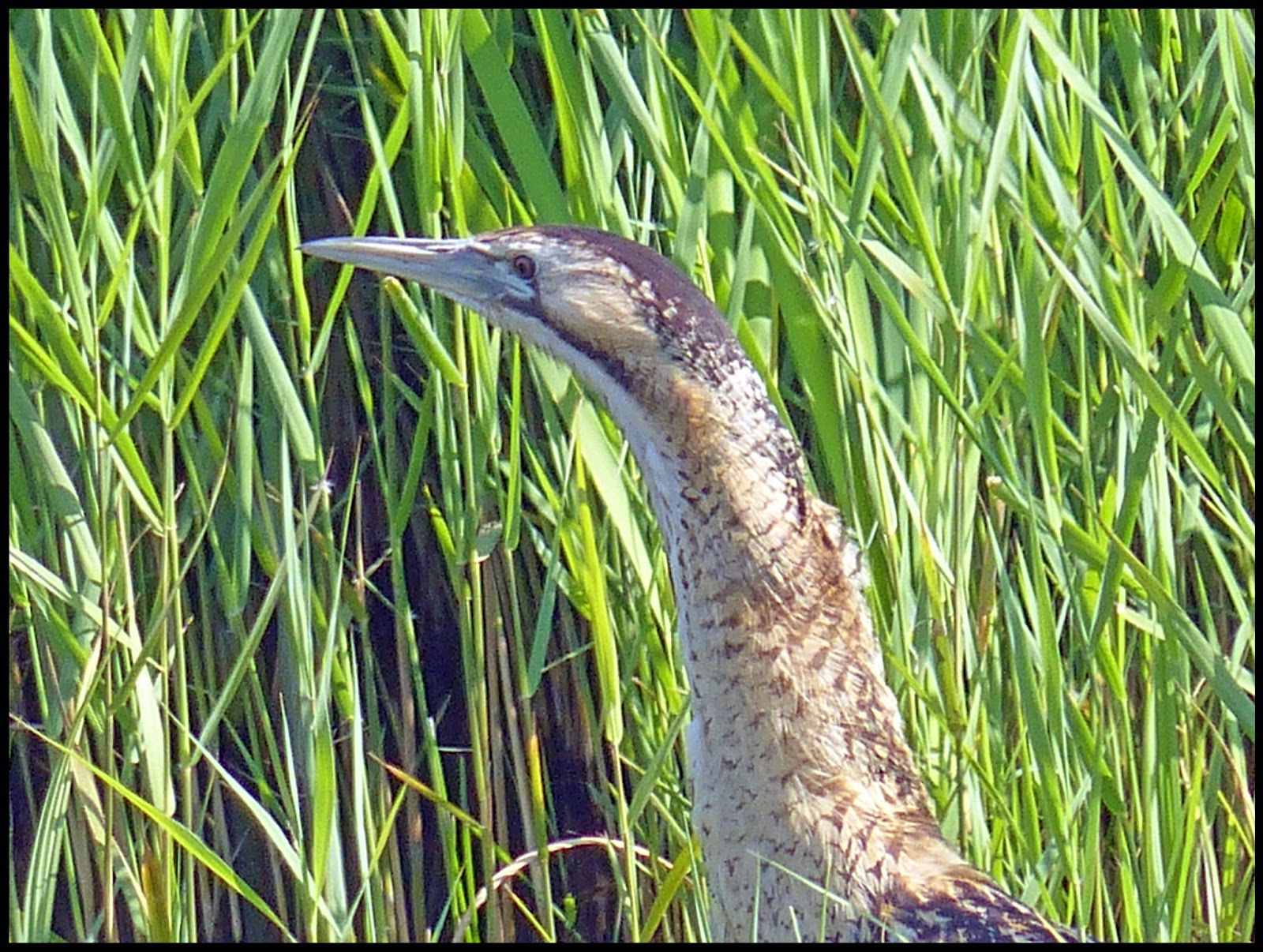
While we were watching the Bittern at the weekend, a Hobby flew right up to the hide, taking us all by surprise. There were a number of dragonflies zooming about, which was probably the reason!


Much to my surprise, the Hobby has been awarded Green conservation status. I say surprise because this is a bird that I have only recently started to see ...


You will find some far better photos of a Hobby at Minsmere here ...

Wednesday, 10 July 2013

Beautiful Birds: Bittern at Minsmere


I love to watch birds per se, whether they are the Blue-tits and Robins in my garden or whether they are the showy Little Egrets or Avocets in the wetlands beyond, but I always feel a thrill when I add a new 'lifer' to my list. Last weekend it was the turn of the Bittern. 


I have mentioned the RSPB 'Conservation' board game on this blog before. We used to play it as a family back in the 1970s. The Bittern was one of the endangered species to feature, and I doubt back then that I thought I would ever have an opportunity of seeing one of these rare birds. 


Since moving back to East Anglia, we have had close encounters in the form of hearing the distinctive Bittern boom, but until last weekend, we had never seen the bird with the deep voice! 


The bird was doing a spot of fishing at Minsmere, where it is listed as a Star Species. The Bittern is described as a 'thickset heron' on the RSPB site, and, not surprisingly, it has red conservation status.

Did you know that (according to the Norfolk Wildlife Trust) Bitterns were called 'butterbumps' in Norfolk? 

Tuesday, 9 July 2013

Odonata: Norfolk Hawker (a first sighting for me)


I am planning to post a few more Scottish photos, but we saw this female dragonfly at the weekend at Carlton Marshes near Lowestoft, and I wanted to post the photos while I remembered!

It was very well camouflaged, but we knew that there had been recent Norfolk Hawker (Aesha isosceles) sightings so we were keeping a sharp eye open.

You can imagine our delight when we realised that our watchfulness had been rewarded. The Norfolk Hawker has been described by Paul Green (The Little Guide to Dragonflies and Damselflies of Minsmere Nature Reserve) as an 'extremely rare insect confined to just a few sites in Norfolk and Suffolk', although I gather the dragonfly is also known on the continent. It is listed on the Red Data List and a licence is required if handling is to take place. This dragonfly is a UK-BAP Priority Species.

It is, as you can see, a large brown creature, with arresting green eyes. The yellow triangle on segment two (S2) is also a distinguishing feature. You can make out the amber wing-spots. We read in Britain's Dragonflies by Dave Smallshire and Andy Swash that 'any brown hawker with clear wings seen in East Anglia in early summer is sure to be this species'.    


Monday, 8 July 2013

Mustelidae: Otters in Scotland


I love to watch otters in the wild. They are very difficult creatures to spot, so we felt particularly pleased to have three sightings during our recent fortnight in Scotland. Two clues help me in my initial spotting, the first being that telltale V in the water as an otter swims, and the second, well, you have probably guessed, that 'ring of bright water' that was borrowed as a phrase by Gavin Maxwell from 'The Marriage of Psyche', the poem by Kathleen Raine.


We often use the car as a hide. It means that the otter is less likely to notice a human scent or to hear a strange noise. It also means that we can keep dry, though we had to keep switching on the windscreen wipers during the time we watched the otter above in the Assynt area.
 
That ring of bright water, emanating from the steel-grey loch ...

Two of my three otter sightings were of otters in the water. The third sighting, on Skye, began with an otter swimming near the shore, in and out of the kelp. To our great excitement, the creature climbed out of the water on to a long low rock, allowing us to see its whole form before it dived back and disappeared into its mysterious watery world.


We have re-visited old haunts on our recent holidays. We have also enjoyed new places along the way, but we have discovered that tried and tested destinations often yield good sightings. It takes patience, of course, and there is always the unpredictable element of timing: you just have to be in the right place at the right time!


Swimming close to the shore

Wednesday, 3 July 2013

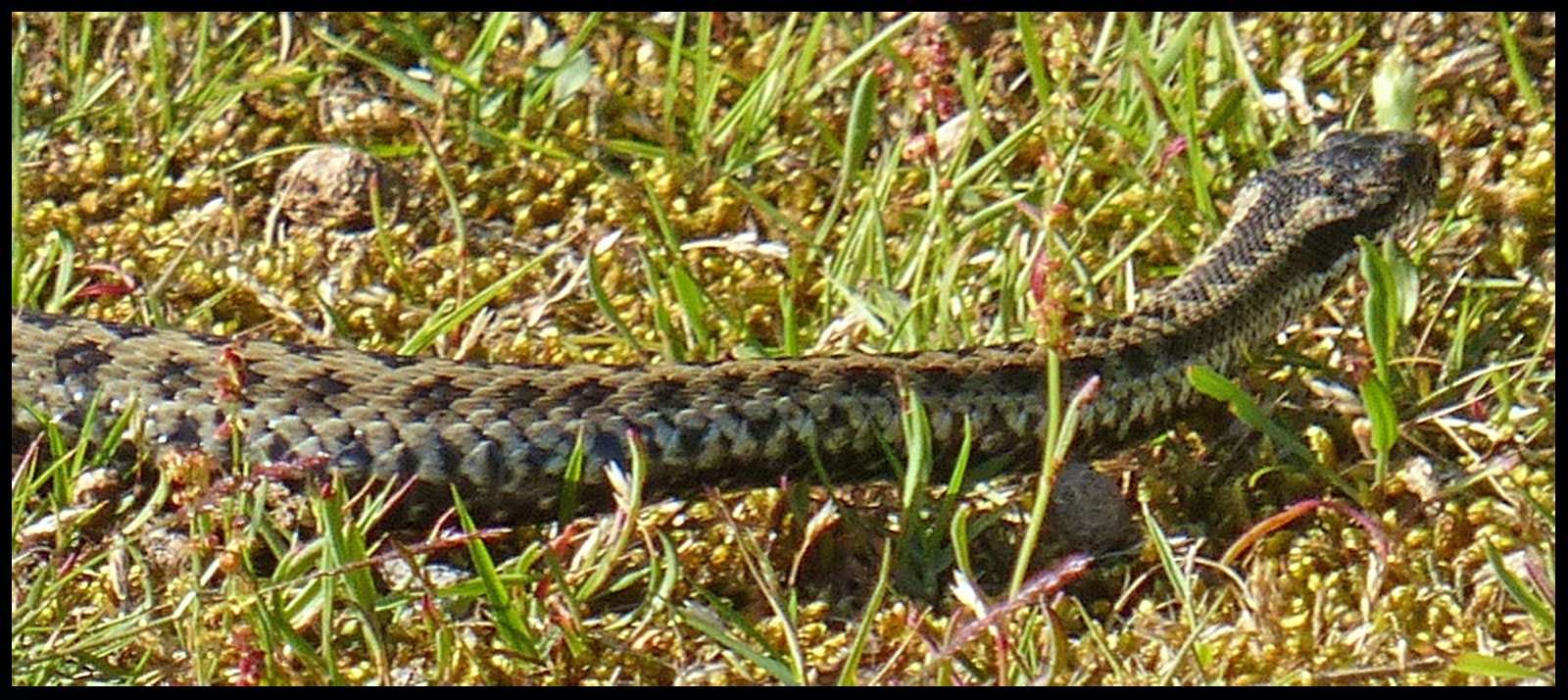
Herpetofauna: Adder at Minsmere

I had been wondering how long it would be before I encountered one of the Adders that frequent RSPB Minsmere, and thanks to the warm sunny conditions last weekend, I was able to take these photographs. My instinctive reaction was to jump, and then to warn David to keep a sensible distance away. At that point we watched the snake together. I got out my camera and took these shots, using my zoom lens, before the reptile slithered off into the shade of the undergrowth. 

Adders are a protected species under the 1981 Wildlife and Countryside Act. They are protected from being taken from the wild, from being killed and from being sold. These snakes do not bite unless startled or provoked. About 100 people receive an adder bite in the UK each year. Immediate medical attention must be sought in the case of such an eventuality.  

I have recorded the sighting here on the 'Add an Adder' section of The Amphibian & Reptile Conservation Trust, for the purposes of monitoring and conservation. 


Forked tongue (and red iris)


A veritable snake in the grass . . .

Saturday, 8 June 2013

Butterflies and Moths: A Caterpillar with Red Spots on Mersea Island


We crossed over The Strood, the small causeway bridge separating Mersea Island from the Essex mainland. There are certain tides in the year when you cannot cross for a few hours, but as you can see, we had no difficulty today.


I was quite excited by this caterpillar. The two red spots suggested to me that it would be potentially harmful, so I only allowed myself to get 'up close and personal' via my zoom lens.


The caterpillar turns out to be the larva of a Brown-tailed Moth. I have only seen this species once before, and that was on the Spurn Head peninsula. You can read the health warning here. You can read about these caterpillars in Suffolk here.

On Spurn, we had seen the tents, but here I could only find the one individual in my photos. It will turn into a black chrysalis later this month, before emerging as a brown-bodied white-winged moth in July.   

We enjoyed a quick wander through Cudmore Country Park ...


... taking in the views ...


 ... and looking right across to Bradwell and Othona. My zoom was on maximum, and the image was very fuzzy, but I quite like the effect. The building above is St Peter's Chapel. It was constructed in 654 by St Cedd from the masonry of a nearby Roman fortification that formed part of the Saxon Shore. The ruined chapel was used as a lighthouse in Tudor times. You can read more here.


The photo above shows the footpath on Mersea Island to the foot ferry to Brightlingsea. We saw Lapwing and Swallows from this path - and Skylarks as we walked through the footpath in the grassy areas of the country park. 
The clergyman, Sabine Baring Gould, who penned the words to the hymn 'Onward Christian Soldiers', was the incumbent (1870-1881) at East Mersea's church, dedicated to St Edmund King and Martyr. He wrote Mehalah, a Gothick novel of violence and tragedy, about the island. The tale is certainly atmospheric (rather like parts of The Moonstone by Wilkie Collins). Mehalah is a very strange read!

Friday, 7 June 2013

Home Patch: Ruby-tailed Wasp

It is always interesting to see new things in the garden. I have been watching my Ladybird house, and while - alas - I have not seen any Ladybirds, I have noticed some flying insects who keep alighting on the wooden post, just below the house. More often than not, these insects have invariably flapped their wings and flown off in the time it has taken me to adjust the zoom on my camera. I am wondering whether at least one of them, a cuckoo wasp, is linked to another insect's nest in the Ladybird house.

Yesterday, however, I saw an insect (no photo, I'm afraid from that sighting, despite an attempt) of an insect I recognised instantly from a visit to Minsmere last August ... a Ruby-tailed Wasp. These insects with their metallic rose-red abdomens and their emerald green head and thorax have been described as  'perhaps one of the most beautiful British insects'. The photos I tried to take at Minsmere last year have been re-posted below, underneath my recent pictures.  


The insect in the photos immediately above and below was sighted this morning. It shone with iridescence, but the areas of colour were not defined, unlike those of the Ruby-tailed Wasps I have seen.


The insect below also visited the same post below the Ladybird house this morning. I would guess that a creature with those white markings would be relatively easy to identify ... but an ID has eluded me thus far. I have found somewhat similar-looking insects on websites from the USA ('black and white' wasps etc.), but nothing from the UK.

Later: taking a second look, I just wonder whether the four white 'moons' could simply be reflections due to the iridescent nature of the elytra. What do you think?
If you can help with identification, do leave a comment or email me (email on Profile page). All these insects have wings, and when they land, they don't stay still for long!

You can read my previous post about the Ruby-tailed Wasp here ... and the identification help I received from 'What's that Bug?', which is here.

Ruby-tailed Wasp


Thursday, 6 June 2013

Nature Reserve Notes: Looking for Reptiles at RSPB Minsmere


We had been told that there were Adders about at RSPB Minsmere, so we were keeping an eye out for reptiles over the last Bank Holiday weekend. David was particularly sharp-eyed, and spotted a scaled creature camouflaged by the dry leaves. The photo above has been cropped considerably to make the reptile more visible!

It tuned out to be ...


... a magnificent Common Lizard. Definitely another exciting seasonal first (26 May 2013) ... though we never got to see an Adder!

Wednesday, 5 June 2013

Beautiful Birds: Green Woodpecker


First there was just a head, with a beady eye ...


... then there was a yaffle and a scuffle, and one of two Green Woodpeckers landed on the grass in front of some pine trees at Minsmere.


This was my first sighting of this species since 25 February

Tuesday, 4 June 2013

Butterflies and Moths: Drinker Moth Caterpillar and Small Copper Butterfly

A Drinker Moth caterpillar

(Euthrix potatoria)

Minsmere, 2 June 2013


I know the caterpillar above is far from hidden, but do take a look at this extraordinary article on caterpillar camouflage.


We saw our first Small Copper butterflies at Minsmere on 26 May 2013.


Monday, 3 June 2013

Eye-catching Insects: Cardinal Beetle

Pyrochroa serraticornis

This was a very active Common or Red-headed Cardinal Beetle, as you can tell from the tremor in its antennae! It was scuttling along in shadowy sunshine at Minsmere on 2 June 2013. A seasonal first for me!

Carlton Marshes: My First 2013 Damselfly and Dragonfly

We saw our first Damselfly (just the one) and Dragonflies of the year at Carlton Marshes on Bank Holiday Monday, 27 May. This seems very late in the season for first sightings, but perhaps not surprising after the cold winter. 


A female Broad-bodied Chaser (Libellula depressa)