Wednesday, 26 September 2012

Art and Landscape (1): 'John Constable' in Ipswich


There has been much excitement over the last couple of days on the Ipswich Waterfront outside UCS (by the Langlands and Bell Question? installation). The 'John Constable', a reconstructed Stour Lighter has taken up a temporary berth in 'dry dock' to enable members of the public to encounter this barge at close range, before it moves on to Sudbury tomorrow. The Lighter forms a key element of the 'Managing a Masterpiece' project.

You may be wondering what this has to do with 'Wild and Wonderful' nature ... John Constable was a relatively local artist: East Bergholt, Constable's birthplace, is only about 12 miles away. Constable painted the rural scenes of his day, scenes such as the 'Hay Wain', 'The Cornfield' and 'Flatford Mill'. I have included a photo by David Gill (see below) of the mill area as it is now. Constable enjoyed incorporating natural phenomena in his creative work. He painted rainbows over Salisbury Cathedral and over the River Stour. He even painted a double rainbow. He liked to paint storm clouds, large trees and running water. A Constable painting of 'The Lock' recently fetched over £22 million. 


Today's activity, however, was not about selling. It was a time to admire the craftsmanship that has gone into the building of the 'John Constable'. The Lighter will eventually have a new life on the River Stour, allowing people to take a boat trip along those waterways that Constable knew so well.


Today was a time to celebrate, and those of us on the Waterfront were able to enjoy listening to boat songs and to tunes from an accordion and harmonica. 

David Gill (ITV news report on the boat - here)

The view below shows Flatford Mill as it looks today. John Constable's father owned a dry-dock, which was the setting for the building of these boats in the artist's day. His painting, 'Boat-building near Flatford Mill' depicts the scene. The small figure gives a sense of scale, and I must admit that it was the sizeable dimensions of the lighter that surprised me most.


The photo below shows the steps needed to climb aboard!


John Constable's approach was considered radical at the time, in terms of his distinctive brushstrokes, his bold application of colour and portrayal of emotion through the natural subjects that he encountered in Dedham Vale and beyond. We may find this hard to appreciate in these post-postmodern days of abstraction, but Constable's work was highly instrumental in pushing 19th century painting towards the contemporary approaches to art that we know today.


'The sky is the source of light in Nature and it governs everything.'
John Constable

Islands & Islets (10): An Inner Hebridean Odyssey ... Caterpillars

The churchyard at Trumpan, Waternish, Skye, where we saw ...

... a Knot Grass Caterpillar (earlier sighting here). 

We spotted this (?White/Buff Ermine or Clouded Buff) caterpillar near ...

... the wonderful Abbey on Iona.
Do let me know in the Comments section if you can help with the identification of the caterpillar on Iona! Thank you.

Monday, 24 September 2012

Islands and Islets (9): Damselfly on Inchmahome

Probably a Common Blue Damselfly. Inchmahome is often a good place for damsels, but we only saw this one!

The Island Priory on Inchmahome in the Lake of Menteith (Scotland's only 'lake'!)

Waiting for the ferry back to the mainland ...

Friday, 21 September 2012

Islands and Islets (8): An Inner Hebridean Odyssey - Wildlife on Mull and Iona


Iona - as you approach by sea (or leave)

Approaching Iona from Mull

We spent three nights on Mull and one day on Iona. The weather wasn't brilliant, although the sun came out for a few hours during the afternoon of our last day (which we spent on Iona, where the colours of the kelp, the silver sand and the pure azure water were amazing).


We did not see many vertebrates during this leg of our journey - though we enjoyed watching the bats (not sure what species) at Uisken Beach on the Ross of Mull and a few rabbits here and there. We also saw four red deer on the wonderful road between Duart and Pennyghael, a toad in Bunessan and a seal in the strait between Lochaline and Fishnish.


Waiting for the ferry ...

My (separate)  Bird list is a little longer, though due to the wild weather, we didn't come across half the birds we had hoped to see. Needless to say, we thoroughly enjoyed watching the following (in order of sightings) ...

  • Herring Gull - Uisken
  • Hooded Crows - ditto
  • Buzzards - not quite on every telegraph post!
  • Pied Wagtails - Castle Duart
  • Chaffinches - ditto
  • Gannets - off the cliffs, not far from Bunessan
  • Skylarks - Duart Castle
  • Grey Herons - Pennyghael, Tobermory and elsewhere
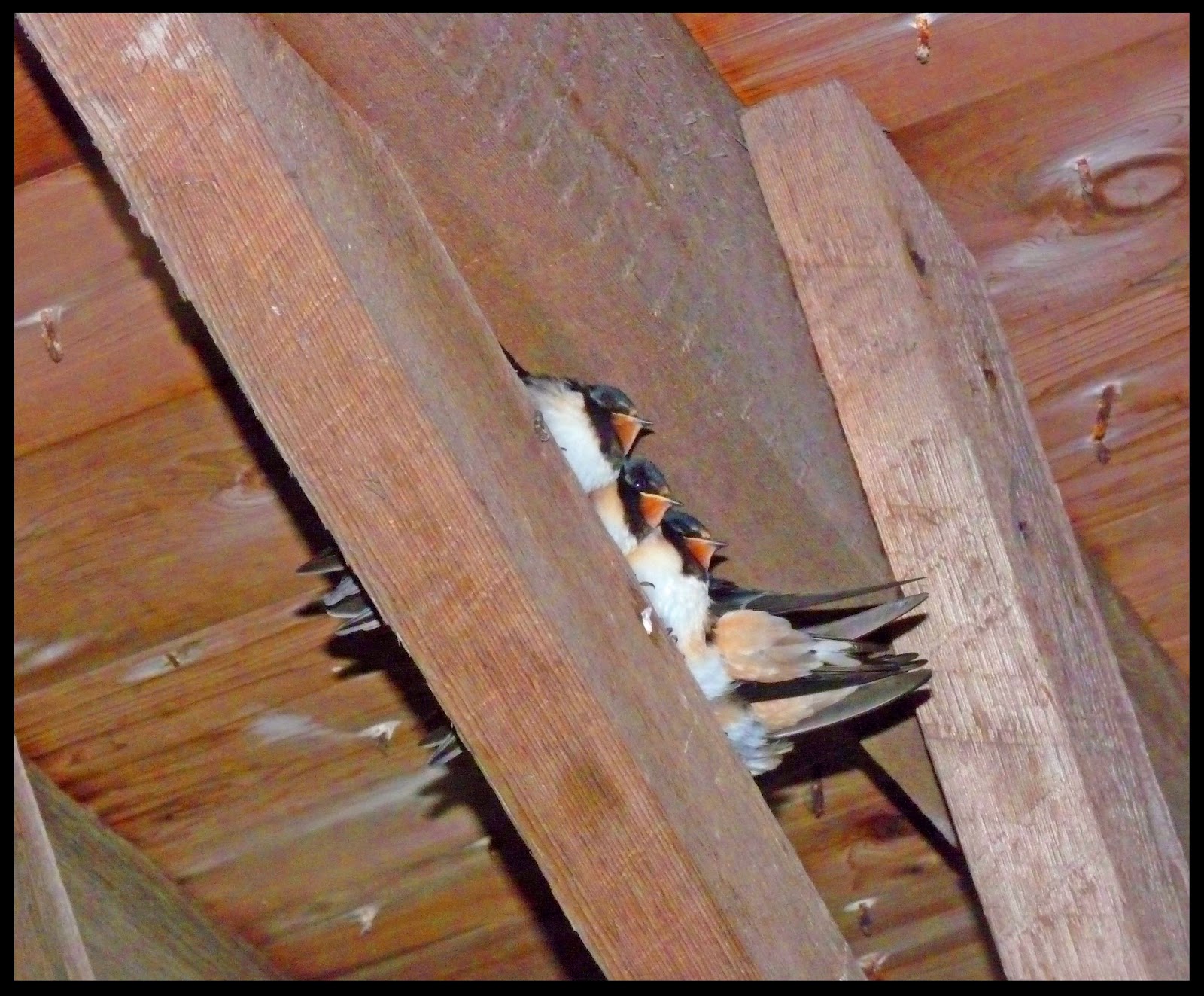
  • Swallows - (are these Swallows?) on Iona, taking shelter in the Abbey cloister rafters (photo below)
  • Cormorant - Pennyghael
  • Eiders - sea loch near Pennyghael
  • Oystercatchers - ditto
  • Curlew - ditto
  • Golden Eagles (2) - back road or 'scenic route' to Salen
  • Pheasant - Aros
  • (Query) White-tailed Eagle - a rather distant sighting in the Craignure/Duart area ... I see one has been spotted in this area from the Treshnish (B)log of wildlife here
  • ENORMOUS 'tidal wave' of Greylag at sunset rolling up the Sound of Iona
  • White doves on the Abbey (do these count as wild? - 'Columba', of course, means 'dove')
  • Song Thrush - Iona, near Abbey
  • House Sparrows (2) - ditto (enjoying the fresh soil of an archaeological dig - photo at end of post)
  • Robin - ditto
  • Blackbirds - Iona
  • Kestrels (2) - Ross of Mull
  • Mallard (8) - Loch Spelve, Mull 
  • Owls (2 unidentified) - Ross of Mull 

Taking shelter in the cloister in preparation for a LONG journey south

We loved the cloister, with its carvings by Chris Hall of Scottish birds and Holy Land plants

Do stone monkeys count as 'wild and wonderful'?

Almost time to touchdown ...

The Iona Community has the 'Wild Goose' as its symbol. Many associate the Community's worship with the liturgical compositions of John Bell. You can read about the background to the Community here in a book review by Dr Josh Sweden. The fascinating history of Iona, the island, is tied in with the MacDonald Lords of the Isles, and it was one of these, Reginald, who sent monks to found a Benedictine community in this out-of-the-way island that had been occupied by Columba. 


... and now it's time for a flypast
Looking out from Iona - I loved those volcanic tump-like rocks

We did not see many invertebrates during this leg of our journey. There was a wonderful striped caterpillar near St Oran's Chapel on Iona (photo for a future post), and plenty of craneflies in Bunessan on Mull. I also noted some bees and snails. There were a few sea anemones (these belong to the group of Cnidarians - like jellyfish) in the rock pools near the ferry on Iona.

The otters and cetaceans may have eluded me, but we saw many wonderful creatures nonetheless!

The archaeological dig ... has the dinosaur been excavated ... or was the Loch Ness Monster on holiday in the Hebrides?

Wednesday, 19 September 2012

Islands and Islets (7): An Inner Hebridean Odyssey - Wildlife Count

The beach at Ord, Sleat, Isle of Skye
While I was away I tried to make a list of (somewhere between all and most) of my wildlife sightings. I am no expert (as you will soon realise!), just a keen observer who likes to know what is about. I decided not to be too strict about numbers as I am so bad at calculating birds in a flock - so bad at calculating fullstop!

The first list here refers to the first leg of our journey to Skye (our most northerly destination), and includes sightings from Glasgow to the north of Trotternish ... I will only 'count' each species once.

Species of Bird
Mainland Scotland

31 August 2012

1]    Mallard - Loch Lomond
2]    Cormorant - Arrochar
3]    Carrion Crow - Rest-and-be-Thankful
4]    House Sparrow - Inveraray
5]    Pigeon (very black) - ditto
6]    Goldfinches - Glen Orchy
7]    Swifts - ditto
8]    Pied Wagtail - Glencoe
9]    Hooded Crow (2) - Glencoe and Onich
10]  Chaffinch - Onich
11]  Unidentified Owl - Glenfinnan

1 September 2012

12]  Sparrowhawk - Ardnamurchen
**]   Goldfinch - ditto
13]  Oystercatcher - ditto
**]   Cormorant - ditto
14]  Eiders (6) - ditto
15]  Grey Heron - ditto
16]  Greater Black-backed Gull - ditto
17]  (?Sky)larks (3) - ditto
18]  Gannet - near Mallaig
19]  White-tailed Eagle - ditto

Nature's paintbrush at work!

Species of Bird
Isle of Skye and Environs

1 September 2012

**]    Pied Wagtail - Broadford
20]   Herring Gull - ditto

2 September 2012

21]   Golden Eagle - Cuillin area
**]    Eiders - Dunvegan area

3 September 2012

22]  Buzzard - Cuillin area
23]  ?Dabchick - Trotternish
**]   Hooded Crows (6) - ditto
**]   Gannets (4) - viewed from Staffin area
**]   Pied Wagtails (6) - ditto

4 September 2012

24]  Starlings - Broadford area
**]   Pigeons - ditto
25]  Goosander?? - photo to follow - Loch Carron area (just off Skye, but trip from Skye)
26]  Rock Pipit - Loch Duich area (just off Skye, but trip from Skye)
**]   Pied Wagtail in first winter plumage - Loch Duich area (just off Skye, but trip from Skye)
27]  Robin - ditto
28]  Goldfinches (6) - ditto
**]   Rock Pipit - Armadale

5 September 2012

**]  Carrion Crows (2) - Portree
**]  Hooded Crows (3) - ditto
**]  Pied Wagtails (2) - Broadford area
29] Wheatears (4) - Waternish area
**]  Carrion Crow - ditto
30] Ringed Plovers (31) - Cuillin area
**]  Oystercatchers (2) - ditto

6 September 2012

**] Swifts (5) - Staffin
**]  Cormorant - ditto
**]  Buzzard - Bernisdale
**]  Grey Heron - Edinbane
**]  Pied Wagtail - Neist Point
**]  Gannets (5) - ditto
**]  Cormorant - ditto
31] Fulmars (2) - ditto
32] Greylag Geese (small flock) - Glendale area

7 September 2012

**] Ring Plover (3) - Sleat area
**] Herring Gull - Broadford area

8 September 2012

**] Grey Heron - Broadford area


Total of 32 (largely identified) species of bird for this leg of the journey (Glasgow to Trotternish)


Other Vertebrates
Mainland Scotland

31 August 2012

1]  Common Toad (query due to dark night!) - Glenfinnan
2]  Bats (5) - (species not identified) - ditto

1 September 2012

3]  Common Seals (small colony) - Ardnamurchen, not far from Corran Ferry
4]  Red deer doe - Bay of the Flies area, Ardnamurchen

Other Vertebrates
Isle of Skye and Environs

1 September 2012

5] Rabbits (3) - Broadford and Elgol areas

2 September 2012 

6] Common Seals (colony) - Dunvegan
7] Grey Seal (1) - ditto

4 September 2012

**] Rabbits (2) - Broadford area

6 September 2012

**] Rabbit - Glendale

************


Invertebrates
Mainland Scotland

31 August 2012  

1] Midge - Loch Lomond
2] Black Beetle (still to be identified) - Glencoe

1 September 2012

3] Buff-tailed Bumblebee - Ardnamurchen
4] Hoverfly - ditto


Invertebrates
Isle of Skye and Environs


2 September 2012

5] Dragonfly, unidentified (flew off too fast!) - Dunvegan area

3 September 2012

**] Dragonfly, unidentified (flew off too fast!) - Staffin 
6]  Cranefly - Broadford area

5 September 2012

7] Caterpillar - Trumpan area
**] Dragonfly, unidentified (flew off too fast!) - ditto 

6 September 2012

8] Lion's Mane Jellyfish - Bracadale 

************

Flora etc.
Mainland Scotland, Isle of Skye and Environs 

1]    Ragwort - Loch Lomond area (widespread)
2]    Rose Bay Willowherb - ditto (widespread)
3]    Bell Heather - ditto (widespread)
4]    Ling - ditto
5]    Montbretia - ditto (widespread)
6]    Meadowsweet - Tarbet
7]    Buttercup - ditto
8]    Conolvulus - Arrochar
9]    Sorrel
10]  Thistle - Rest-and-be-Thankful
11]   Feverfew - ditto
12]   Lesser Scabious - ditto

Also: large brown unidentified toadstool at Inveraray and ?sphagnum moss. Ist lichen on trees spotted at Cladich on way to Kilchurn.  

13]  Figwort - Dunvegan, Skye
14]  Foxglove - ditto
15]  Yellow/Ladies' Bedstraw - ditto
16]  Clover - St Columba's Island, Skye
17]  Yarrow - ditto
18]  Groundsel - ditto
19]  Tormentil - Waternish
20]   English Stonecrop, Sedum anglicum - Sleat, Skye
21]  Water mint - ditto

These observations are obviously of more interest to me than to others, but I hope you may find something in this post that catches your eye! I shall be logging my wildlife sightings for Mull and Iona soon ...

Tuesday, 18 September 2012

Islands and Islets (6): An Inner Hebridean Odyssey - Mystery Bird of Ardnamurchen


We left Fort William after breakfast, and were soon aboard the Corran Ferry bound for the unspoilt peninsula of Ardnamurchen, en route to Skye. Due to adverse weather conditions, it proved to be a very long route to the island, but that's another story! The grey-blue bird of prey above was practically my first avian sighting of the day.


We stopped off briefly at this lovely beach to watch the seals on their skerries and the rafts (or perhaps streamlined 'canoes') of Eiders.


Here are two more hasty views of the bird before it flew off. What fine banding on the tail feathers!

I would be very grateful for an identification: I thought it might have been a Buzzard (too blue?) or a Peregrine (not dark enough round the 'cheek'?). I don't think it was a Merlin ...


You might like to see my previous 2012 Scottish posts, which are here (miscellany) and here (jellyfish).


Later: Thank you to Heather Williams for her comment below. Yes, I think Sparrowhawk may well fit the bill (no pun intended), especially on account of the bird's size and the white stripe above the eye. We have had one of these in the garden in Suffolk, so I suppose I didn't really have to travel so far for a sighting, but who would have missed the chance to see the swathes of Scottish heather and golden bracken at this time of year?  
* * * 

Postscript . . . off-topic (we didn't see any Badgers in Scotland), but of great concern . . . the plight of Badgers in the face of Bovine TB. I thought this press release from the RSPB (here) was well worth reading, and would commend it to you. For more on Badgers in blogs (as it happens, from my old home area in South Wales - no bias, naturally!), you might like to see 'My Life Outside' (Adam Tilt) for a very informative post, and Jeremy Inglis Photography, for more details of the petition.

Monday, 17 September 2012

Islands and Islets (5): An Inner Hebridean Odyssey - jellyfish afloat!

The jellyfish in question!

... viewed here from above

... and here as it floated in the shallows.

The remote beach, with two hardy swimmers ...

... and the jellyfish being re-floated by a wave

It is always exciting to walk along the tideline of a vast and (almost) empty beach, like this one at Glenbrittle on Skye, in the brooding shadowlands of the Cuillin mountains.

The jellyfish was on the tideline ten days ago, and was washed every so often by a 'ninth wave'.

I am not entirely sure about its identification (query Lion's Mane, which features in the Sherlock Holmes tale), so I will let you know when I hear from the Marine Conservation Survey, as I have logged this sighting - and you may like to log any sightings you encounter.

[ *** Update from the Marine Conservation Survey: confirmation that this is a Lion's Mane - and an upside down one at that! Thank you, Richard ***]

This was the only jellyfish we saw during our time in Scotland this year. You can read more about our time on Skye, Mull and Iona here. My previous Hebridean Medusozoan sightings (this time of Moon Jellyfish) are here.

I will soon be posting my holiday 2012 list of the wildlife we encountered. Meanwhile, you may be interested to read about ...
  • a BBC report about a recent Portuguese Man O' War sighting in Cornwall (these are not actually jellyfish) ...
  • Portuguese Man O' War in Ireland
  • Fresh water jellyfish in the USA (National Geographic)

Friday, 14 September 2012

Islands and Islets (4): An Inner Hebridean Odyssey

We have just returned from a holiday in West Scotland. We travelled from Glasgow to Skye, from Skye to Mull (via the Corran and Lochaline ferries) and finally from Mull to Iona (by the Fionnphort CalMac). The weather was definitely 'autumnal' most of the time, and there was one occasion on Skye when I found it hard to stand up on account of the force of the prevailing wind. We had horizontal rain - often followed by rainbows to cheer us on our way.

I hope to add a few specific wildlife details in the next couple of posts, but these are some general introductory views. My camera lens, needless to say, has never needed cleaning so much, and you may 'spot' the ubiquitous rain blobs here and there. I suspect the adverse weather conditions meant that we did not see as great a range of wildlife as we have on previous occasions. We had no *definite* sightings of cetaceans this time - and no otters, despite our short first visit to Mull.  
One of the highlights of our holiday on Skye (as always) was to visit the Dunvegan seals on the skerries in the loch from a small boat. The boatman has vast experience of these waters, and since we were only a 'party' of five, we were able to be almost 'nose-to-whisker' with these majestic and fascinating mammals. I was particularly interested to discover that the resident colony of Common Seals had embraced a single Grey/Atlantic Seal into the fold.


The photo above shows the wild and windswept shore at Staffin on Skye's Trotternish peninsula. We were the only souls on the beach, walking in the sunshine, while all around us a huge storm was brewing.
The seals above were on a skerry in Loch Carron. I always think of Plockton as a sheltered harbour, with its colourful fuchsia gardens and palm trees along the waterfront; but as soon as we were out on the loch, we hit a swell - and it was quite difficult to stand up, let alone hold the camera still! But the colours were superb, and don't really show up in this relatively small photo.


We left Skye and drove through Ardnamurchen to reach the island of Mull, with its iconic coloured houses at Tobermory (aka 'Balamory' by the under 5s). We had really hoped to catch a few special glimpses of wildlife on Mull, and indeed we did; but the blustery rainy weather may have caused some of the animals to 'hole up' away from the reach of cameras and scopes.
The small island of Iona was (almost) our final island destination. It is only 20 minutes by ferry from Mull, and we arrived in time for an excellent guided tour of the Abbey. The weather was mixed, but as you will guess from the water photo above, the sun finally shone for us, enabling us to appreciate the very beautiful shades of azure and ultramarine, which were offset by the intense amber of the sunlit kelp on the shoreline.
We thoroughly enjoyed exploring the Abbey, and watching the Wagtails and occasional fly-pasts of the Greylag geese.
I included this photo of Skye to remind myself (as much as anything) of the intensity of the blues in the sea lochs. We stopped here to take photos on our way to the Waternish peninsula ...
... where you can see the many lichens that grow on these stones at Trumpan Church - a sign of the pure air in this end-of-the-road part of the world.


It is still possible to hear the Corncrake in this exposed corner of Skye. We listened to the Hooded Crows and watched the wind blowing through the wool-lined fences.
I always enjoy a walk along the tidelines to see what has been washed ashore. I saw a (Lion's mane) jellyfish on the beach at Loch Brittle in Bracadale, which was also where I spotted the Sea Urchin above. Many years ago I used to be intrigued by the colourful urchin spines we found on our favourite Cornish beaches. I initiially thought that they were unusual spar-like minerals. They were the trigger for my poem, 'Sea Scribe', which has been included in my first chapbook collection, co-authored with John Dotson, 'The Holy Place'.
I have mentioned the many Wagtails. Well, we were also amazed by the number of Chaffinches. The one above looks a little overweight on account of his perch by the tea table at Dunvegan Castle on Skye, where we would recommend Earl Grey tea and locally-made lemon cupcakes!


The photo above was taken the day before yesterday at the small fresh-water island in Scotland's only lake - as opposed to loch, the Lake of Menteith. We took a couple of hours out, on our way to the airport, for a picnic lunch in the tranquil setting of Inchmahome. This small island is a nine minute boat ride from the shore, laid on by Historic Scotland, who care for the abbey. Inchmahome is usually a good place for Damselflies, with its nettles and blackberry bushes - but we only spotted one on this visit.


We may have seen a lot of rain, but this sheep, way up in the north of Skye, definitely had the right idea!