Wednesday, 18 April 2012

Home Patch (6): A Visiting Bee-Fly


We had a typical British 'April day', with showers, hail, a rainbow and eventually a short spell of hot sun. I was delighted to find that the Bee-fly (or one of its relations) I had seen on 27 March 2012 had returned to the garden. It was a good opportunity to take a few quick photos before the sun went in again. The Bee-fly darted about, beating its wings very fast and alighting every so often for a short spell on the Flowering Currant.

Since I last saw this creature in the garden I discovered that there is also a Dotted Bee-fly, so I was keen to take a special look at its wings. No dots ~ no matter!


These insects look so furry ... and I would prefer them to be bees rather than flies, but, of course, they are what they are - and for good reason. Other creatures are aware that bees can sting - and are therefore keen to keep their distance.


Can you make out the long proboscis, through which it sucks nectar? 


You can read more about the Bee-fly here. I did not know that the insect in its larval stage makes its home in the nests of Solitary Bees.  


You will find my earlier Bee-fly of the season here, but I would particularly encourage you to take a look at Rosie's beautiful photographs over at Leavesnbloom.

Monday, 16 April 2012

Home Patch (5): Blackbird Profile


This female Blackbird is becoming quite a regular. She appears to have a number of suitors, who make quite a noise when they land in the garden. I presume the female bird is already beginning to prepare a nest: you can see tufts of grass in her beak.


For those who live outside the UK, it is worth pointing out that it is only the male Blackbird who sports black plumage. The female is brown, and sometimes has dark speckles on her chest. What I believe is a little unusual about this female is that she has so much white. The bird is obviously not an albino for she most of her pigment is dark and she does not have pink eyes. I am guessing that she has a measure of leucism, particularly since many of her kind are known to have been affected by this genetic anomaly. You can read about Blackbirds and leucistic tendencies on the British Trust for Ornithology (BTO) website here.


I shall record this Blackbird on the BTO Abnormal Plumage Survey here ... and on the subject of recording wildlife, I would like to point out Juliet Wilson's informative post here.

Have you seen anything slightly unusual in your home patch recently? 

One of our male garden Blackbirds - in 'standard' Blackbird plumage

Saturday, 14 April 2012

Home Patch (4): Long-tailed Tit

Long-tailed tit on left: Blue tit on right

Not a good photo - and not taken in my home patch - BUT since we enjoyed a short visit from a single Long-tailed tit in our new garden on Saturday, I thought I would post this old photo for those who are not familiar with these delightful birds. We have also seen Blue tits and Great tits. My 'bird tally' for our new home patch runs as follows:


    Incidentally, I was surprised to see a single Long-tailed tit as I always think of these birds flying around in small flocks. Although often listed alongside other tits, the Long-tailed Tit is apparently not a true tit, but a member of the Aegithalidae family.

    I have also spotted an as yet unidentified bird of prey overhead (I know it wasn't a Red Kite, Kestrel or Buzzard!) - and a couple of geese.

    Thursday, 12 April 2012

    Ladybird Alert (8): More 7-Spots

    7-Spot Ladybird in my garden today

    Close-up of Ladybird above

    A different 7-Spot in my garden (and the 3rd one scuttled away before I could photograph it!)

    I have seen three more 7-Spot Ladybirds, which makes a pleasing change after my previous sighting of a Harlequin!

    I shall be logging these 7-Spots with the UK Ladybird Survey, and would encourage you to do the same if you have Ladybird encounters! If you have Harlequin ladybird encounters, you might care to log them here on the Harlequin Ladybird Survey site.

    You might also be interested in Project Noah (networked organisms and habitats), described as 'a tool to explore and document wildlife and a platform to harness the power of citizen scientists everywhere.' I have only just discovered this wildlife platform, but I believe it covers the world. My thanks to Andrea (see Comments below) for setting me on the trail to find it!

    Home Patch (3): Elusive Birds ... and Other Observations

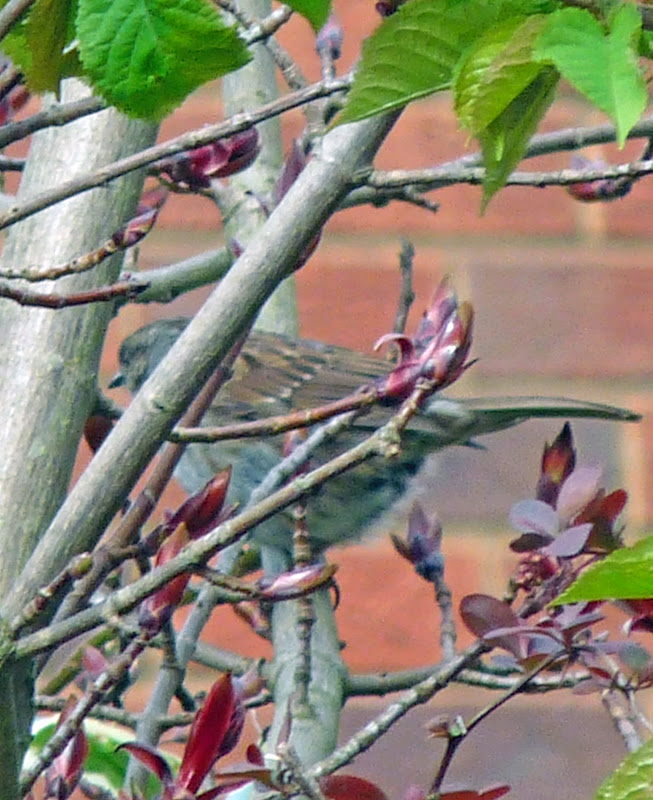
    The 'shy' bird was hiding in the budding branches this morning ...

    ... and I was delighted to catch it on camera, albeit from some distance.

    Is it a Dunnock (or here), I wonder?

    A Buff-tailed Bumble bee? Possibly a Queen ...

    ... was enjoying the flowering currant.

    Last night I spotted this moth through the window ... just a record shot!

    Here is the web, but where is the spider?

    There is something exquisite about a drop of water, something akin to 'a world in a grain of sand' ...

    These dew drops remind me of a feature on the secret life enclosed in a droplet in a recent WWT Waterlife magazine.

    The resident Robin seemed a bit tamer today, and allowed me to take two photos ...

    I wonder what my next sighting will be ...
    Those who have been reading my recent posts will know that we have recently moved to Suffolk, UK, and that I am exploring the wildlife in our new 'home patch'. I also noticed some (more) 7-spot Ladybirds: these will feature in the next post.

    Wednesday, 11 April 2012

    Home Patch (2) More Beautiful Birds


    I was delighted to add another bird to my 'new garden' list this morning - in the form of this fine Greenfinch. I have often seen these birds, but have never - to my knowledge - actually had one in my own patch ... until now. In the light of the RSPB report on the bird disease, Trichomonosis (which particularly affects Grenfinches), I am pleased to report that this garden visitor looked in good shape.

    I also spotted a trio of Bluetits, but it was raining so I shall try to take some better photographs of them at a later point.

    Garden list update:


    • Blackbird
    • Blue tit
    • Greenfinch 
    • Herring Gull
    • Jay
    • Magpie
    • Robin
    • Song Thrush

    I have also seen Sparrows, and am waiting to get a better look, but I think they may be Tree Sparrows.

    Tuesday, 10 April 2012

    Home Patch (1): Beautiful Birds

    Goldfinch

    Blackbird (male)

    Chaffinch

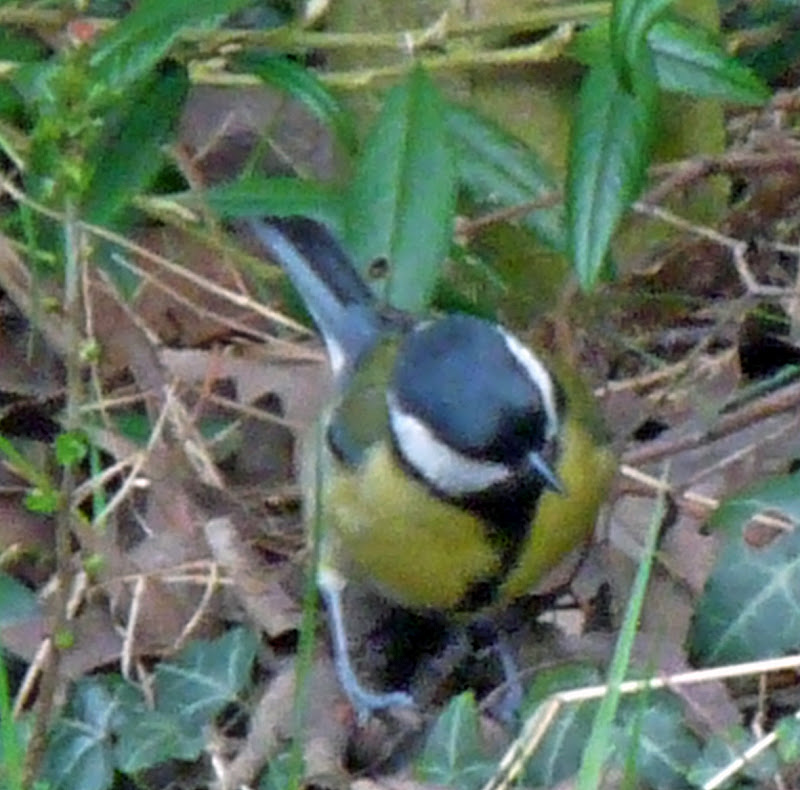
    Great Tit

    Wood Pigeon


    The birds in the photos above have all been spotted in our new garden in Suffolk, UK. The full list to date runs as follows:

    • Blackbird
    • Chaffinch
      • Goldfinch
      • Great Tit
      • Jay
      • Magpie
      • Robin
      • Song Thrush
      • Wood Pigeon
      I hope to add to this list in the days ahead. I have also seen Sparrows, and am waiting to get a better look, but I think they may be Tree Sparrows. Incidentally, I have three Sparrow Haiku in an International Kukai tomorrow ...

      Postscript: My thanks to Mary for leading me in the direction of her Goldfinch photographs from the USA. These birds are so different from ours ... though if 'my' pair return today, I will try to photograph their gold patches!

      Monday, 9 April 2012

      Ladybird Alert (7): Harlequin


      I 'spotted' my first Harlequin Ladybird (Harmonia axyridis) of the year on Saturday. It was crawling across a rug inside, and had perhaps been over-wintering indoors. Harlequins have 0-22 spots, and I reckon this one is near the upper limit, though some of the spots have become run-on blotches! It comes under the umbrella of succinea Ladybirds on account of its black on red colour-scheme. You can see the characteristic black 'M' or 'W' on the pronotum, but my photograph fails to show if the legs are reddish in colour. We know from this source that this ladybird was called Coccinella axyridis Pallas, way back in 1773.

      More information can be found here. If you find a Harlequin Ladybird in Britain, it would be good to report it to the Harlequin Ladybird Survey.

      Tuesday, 27 March 2012

      Eye-catching Insects (8): Bee-fly

      Bee-fly Bombylius major

      Not a good photo, I'm afraid, but a good enough record shot for me to discover that this is probably a Bee-fly or Bombylius major. The insect was darting about and hovering in my new garden. It hardly rested for a moment, so was quite hard to catch on camera. I have seen these creatures once before - in Yorkshire.

      You can read about these flies and how they mimic bees on the Natural History Museum site here. You will also see how the markings on the single pair of wings on the insect on my photo helped to confirm my identification.

      Postscript: 16 April ... I have just learned that there is a rare Dotted Bee-Fly! 

      Saturday, 24 March 2012

      Ladybird Alert (5): Seven-Spots welcome us to our new home

      It was interesting to see ...

      ... how many different plants they favoured in the garden.


      I must submit these to the UK Ladybird Survey ...

      Friday, 23 March 2012

      Beautiful Birds (43): Never Too Late for World Sparrow Day


      Sparrow on Liberty Island, USA, January 2012
      I am grateful to fellow poet, Alan Summers, for drawing our attention to World Sparrow Day ... and my apologies for running late, which is rather the story of my life at present due to an imminent house move!

      Alan has some excellent information on his blog, Area 17, so you might like to discover some new Sparrow facts for yourself. You can also visit the World Sparrow Day site, and see gallery photos of many different Sparrows. I had no idea that some were so colourful.

      We may be late, but why not post a Sparrow photo on your blog. If you do, please throw a link back to the WSD site. You might also care to leave me a link in the Comments section below ... and we can always aim to mark 2013 World Sparrow Day ON TIME.

      P.S. Did you know that the House Sparrow has a RED conservation designation?

      Wednesday, 14 March 2012

      Beautiful Birds (42): What a Lark

      There is usually a gaggle of geese on the foreshore, in the vicinity of ...
      The Orwell Bridge, where ...
      ... Canada Geese, in particular, gather to feed.
      There were Oystercatchers at the water's edge last Saturday ...
      ... and I'm wondering about the bird on the right. A Mallard, end on?
      I watched most of these birds through binoculars, and the zoom on my camera was somewhat challenged by the distance. I could also see Lapwing some way off, and when I got out of the car, I heard my first Skylark of 2012. I turned and was treated to the spectacle of the songster's display flight before it disappeared down into scrubby grass in a nearby field.

      You can read more about the Skylark here on the Southend RSPB pages. What is it about this bird that gives us all such a 'lift'? There is a quotation from Wilfred Gibson's poem, but I prefer Shelley's classic take on the subject, which you will find here. You might also enjoy the Skylark selection here. 


      First 2012 sighting:

      Monday, 12 March 2012

      Seasonal Splash (6): Spring Sunset at Snape


      Serenity . . .
      Just before the light went, we managed to see our first Avocets of 2012 at Snape. They were not at very close range, but you could just make out their distinctive white and black forms with the naked eye - and they looked much better through binoculars!

      We passed a toad crossing on our journey home, with a volunteer assisting these foolhardy creatures across the road. It brought back memories of toad-watching last Spring in South Wales. We have a toad tunnel in our local area, to allow the toads to cross from Landseer Park to Holywells Park in safety.

      Toads in South Wales: last year's photo re-visited

      Creatures of camouflage

      Thursday, 8 March 2012

      Beautiful Birds (41): Plus a Hoverfly ... Calendar Photos


      I was delighted to receive two contributor copies of the Swansea Vale Resource Centre calendar today. My wildlife photographs represent ...
      • April - Puffins and a Gannet
      • May - Mumbles Pier, with its Kittiwakes
      • July - the Hoverfly you see above
      The calendar was part of the COASTAL Project, 'Life through a Lens'.

      Monday, 5 March 2012

      Beautiful Birds (40): 2012 Species List Wordle

      Wordle of birds spotted in January and February 2012. I was in Philadelphia and New York in January for two weeks, so one or two of the birds were seen in the USA.