Monday, 17 September 2012

Islands and Islets (5): An Inner Hebridean Odyssey - jellyfish afloat!

The jellyfish in question!

... viewed here from above

... and here as it floated in the shallows.

The remote beach, with two hardy swimmers ...

... and the jellyfish being re-floated by a wave

It is always exciting to walk along the tideline of a vast and (almost) empty beach, like this one at Glenbrittle on Skye, in the brooding shadowlands of the Cuillin mountains.

The jellyfish was on the tideline ten days ago, and was washed every so often by a 'ninth wave'.

I am not entirely sure about its identification (query Lion's Mane, which features in the Sherlock Holmes tale), so I will let you know when I hear from the Marine Conservation Survey, as I have logged this sighting - and you may like to log any sightings you encounter.

[ *** Update from the Marine Conservation Survey: confirmation that this is a Lion's Mane - and an upside down one at that! Thank you, Richard ***]

This was the only jellyfish we saw during our time in Scotland this year. You can read more about our time on Skye, Mull and Iona here. My previous Hebridean Medusozoan sightings (this time of Moon Jellyfish) are here.

I will soon be posting my holiday 2012 list of the wildlife we encountered. Meanwhile, you may be interested to read about ...
  • a BBC report about a recent Portuguese Man O' War sighting in Cornwall (these are not actually jellyfish) ...
  • Portuguese Man O' War in Ireland
  • Fresh water jellyfish in the USA (National Geographic)

Friday, 14 September 2012

Islands and Islets (4): An Inner Hebridean Odyssey

We have just returned from a holiday in West Scotland. We travelled from Glasgow to Skye, from Skye to Mull (via the Corran and Lochaline ferries) and finally from Mull to Iona (by the Fionnphort CalMac). The weather was definitely 'autumnal' most of the time, and there was one occasion on Skye when I found it hard to stand up on account of the force of the prevailing wind. We had horizontal rain - often followed by rainbows to cheer us on our way.

I hope to add a few specific wildlife details in the next couple of posts, but these are some general introductory views. My camera lens, needless to say, has never needed cleaning so much, and you may 'spot' the ubiquitous rain blobs here and there. I suspect the adverse weather conditions meant that we did not see as great a range of wildlife as we have on previous occasions. We had no *definite* sightings of cetaceans this time - and no otters, despite our short first visit to Mull.  
One of the highlights of our holiday on Skye (as always) was to visit the Dunvegan seals on the skerries in the loch from a small boat. The boatman has vast experience of these waters, and since we were only a 'party' of five, we were able to be almost 'nose-to-whisker' with these majestic and fascinating mammals. I was particularly interested to discover that the resident colony of Common Seals had embraced a single Grey/Atlantic Seal into the fold.


The photo above shows the wild and windswept shore at Staffin on Skye's Trotternish peninsula. We were the only souls on the beach, walking in the sunshine, while all around us a huge storm was brewing.
The seals above were on a skerry in Loch Carron. I always think of Plockton as a sheltered harbour, with its colourful fuchsia gardens and palm trees along the waterfront; but as soon as we were out on the loch, we hit a swell - and it was quite difficult to stand up, let alone hold the camera still! But the colours were superb, and don't really show up in this relatively small photo.


We left Skye and drove through Ardnamurchen to reach the island of Mull, with its iconic coloured houses at Tobermory (aka 'Balamory' by the under 5s). We had really hoped to catch a few special glimpses of wildlife on Mull, and indeed we did; but the blustery rainy weather may have caused some of the animals to 'hole up' away from the reach of cameras and scopes.
The small island of Iona was (almost) our final island destination. It is only 20 minutes by ferry from Mull, and we arrived in time for an excellent guided tour of the Abbey. The weather was mixed, but as you will guess from the water photo above, the sun finally shone for us, enabling us to appreciate the very beautiful shades of azure and ultramarine, which were offset by the intense amber of the sunlit kelp on the shoreline.
We thoroughly enjoyed exploring the Abbey, and watching the Wagtails and occasional fly-pasts of the Greylag geese.
I included this photo of Skye to remind myself (as much as anything) of the intensity of the blues in the sea lochs. We stopped here to take photos on our way to the Waternish peninsula ...
... where you can see the many lichens that grow on these stones at Trumpan Church - a sign of the pure air in this end-of-the-road part of the world.


It is still possible to hear the Corncrake in this exposed corner of Skye. We listened to the Hooded Crows and watched the wind blowing through the wool-lined fences.
I always enjoy a walk along the tidelines to see what has been washed ashore. I saw a (Lion's mane) jellyfish on the beach at Loch Brittle in Bracadale, which was also where I spotted the Sea Urchin above. Many years ago I used to be intrigued by the colourful urchin spines we found on our favourite Cornish beaches. I initiially thought that they were unusual spar-like minerals. They were the trigger for my poem, 'Sea Scribe', which has been included in my first chapbook collection, co-authored with John Dotson, 'The Holy Place'.
I have mentioned the many Wagtails. Well, we were also amazed by the number of Chaffinches. The one above looks a little overweight on account of his perch by the tea table at Dunvegan Castle on Skye, where we would recommend Earl Grey tea and locally-made lemon cupcakes!


The photo above was taken the day before yesterday at the small fresh-water island in Scotland's only lake - as opposed to loch, the Lake of Menteith. We took a couple of hours out, on our way to the airport, for a picnic lunch in the tranquil setting of Inchmahome. This small island is a nine minute boat ride from the shore, laid on by Historic Scotland, who care for the abbey. Inchmahome is usually a good place for Damselflies, with its nettles and blackberry bushes - but we only spotted one on this visit.


We may have seen a lot of rain, but this sheep, way up in the north of Skye, definitely had the right idea!

Tuesday, 14 August 2012

Nature Reserves (4): Ruby-tailed Wasp at Minsmere


I noticed this unusual insect at Minsmere last Saturday. As you can see from the next photo, it was very active and intent on vanishing down the crack, so I had to grab my camera quickly ... and consequently I should apologise for the poor quality of these photos. But at least I have two record shots.

I searched the web and Google Images, but without success. Daniel from What's that Bug came to my rescue, and you can read about this insect here. For an impressive photo, you might like to click here.

According to the Gateshead Birders site, the not dissimilar Chrysis ignita lays its eggs in the nests of mason bees, and is therefore a climber of walls. 
Rosy-tailed Wasp (Hedychridium roseum)

Friday, 10 August 2012

Odonata (11): Minsmere - Brown Hawker

Brown Hawker - I think!


My thanks to David for his photos above of this splendid dragonfly, which alighted in a gorse bush during our visit to Minsmere on 21 July.

My close-up (but shaky as I was trying to keep clear of the gorse spikes!)

Thursday, 9 August 2012

Home Patch (29): Harlequin

f. succinea (Harlequin ladybird)
This seems to be one of the 100+ colour pattern varieties of the Harlequin Ladybird. I found it in the garden this morning, and you may recall that I found a harlequin pupa some weeks ago. The ladybird above was not very large (for a Harlequin), and its elytra had taken a bit of a knock at some stage. It is the first ladybird I have seen for some days.

I am just about to log it on the Harlequin Ladybird survey here.

Home Patch (28): First Dragonfly!

This is the first dragonfly I have seen in our garden since we moved here a few months ago. I hope it will be the first of many, particularly since we have a mill stream nature reserve close by. I am guessing it may be a Migrant Hawker (well, a Hawker of some description), but would be delighted if anyone could confirm or contradict this assumption for me. I have just found details of a local (Suffolk) Dragonfly group here


Home Patch (27): Hawkmoth Caterpillar for Elevenses

I was having a cup of coffee by the window when what appeared at first glance to be a wriggling leaf turned out on closer inspection to be a bright green caterpillar, being attacked by a Great tit. I apologise for the quality of the photos (which serve as record shots): the Photinia was very dark and the light in the garden, shadowy.

The small bird went to great lengths over the space of ten minutes to make an inroad into the large, lively and almost luminous caterpillar. 
I eventually swapped my camera for my binoculars, and was able to see much more clearly. The caterpillar had a distinctive horn.
I know very little about moths as I have said before. My guess is that the green caterpillar would have turned into a Poplar Hawk-moth, Laothoe populi. In some parts of the world it seems that Hawk-moths are known as Sphinx moths or Hornworms: I would prefer to call this caterpillar the Green Unicorn! You might be interested to read Archie Ritter's piece on the subject of these lepidoptera here.


The Great tit finally won the day, so one less moth for our garden ...
... but we did have a beautiful Red Admiral on the Buddleia.


P.S. My post on the Hummingbird Hawk-moth ... is here.

Home Patch (26): Visiting Cricket

This cricket must have hopped in to our house during the night. Grasshoppers do not have such long antennae. Crickets rub their wings together when they stridulate while grasshoppers 'sing' by rubbing their legs against their wings. Both species belong to the group known as Orthoptera ('ortho' = rigid and/or straight and 'ptera' = wing in Greek).

Monday, 6 August 2012

Nature Reserves (3): Dunwich Heath and Minsmere

We failed to notice any particularly unusual birds, but we were able to notch up 21 Gatekeeper butterflies at Minsmere during the allocated 15 minutes for the Big Butterfly Count. They were out in the intermittent sunshine, enjoying the brambles.

I also saw a single Red Admiral ...

... and this unidentified Dragonfly. It was very active and finally settled high up a tree. I was leaning back as far as possible and using my zoom ... hence the wobble and poor quality photo! I think it is a hawker of some kind.


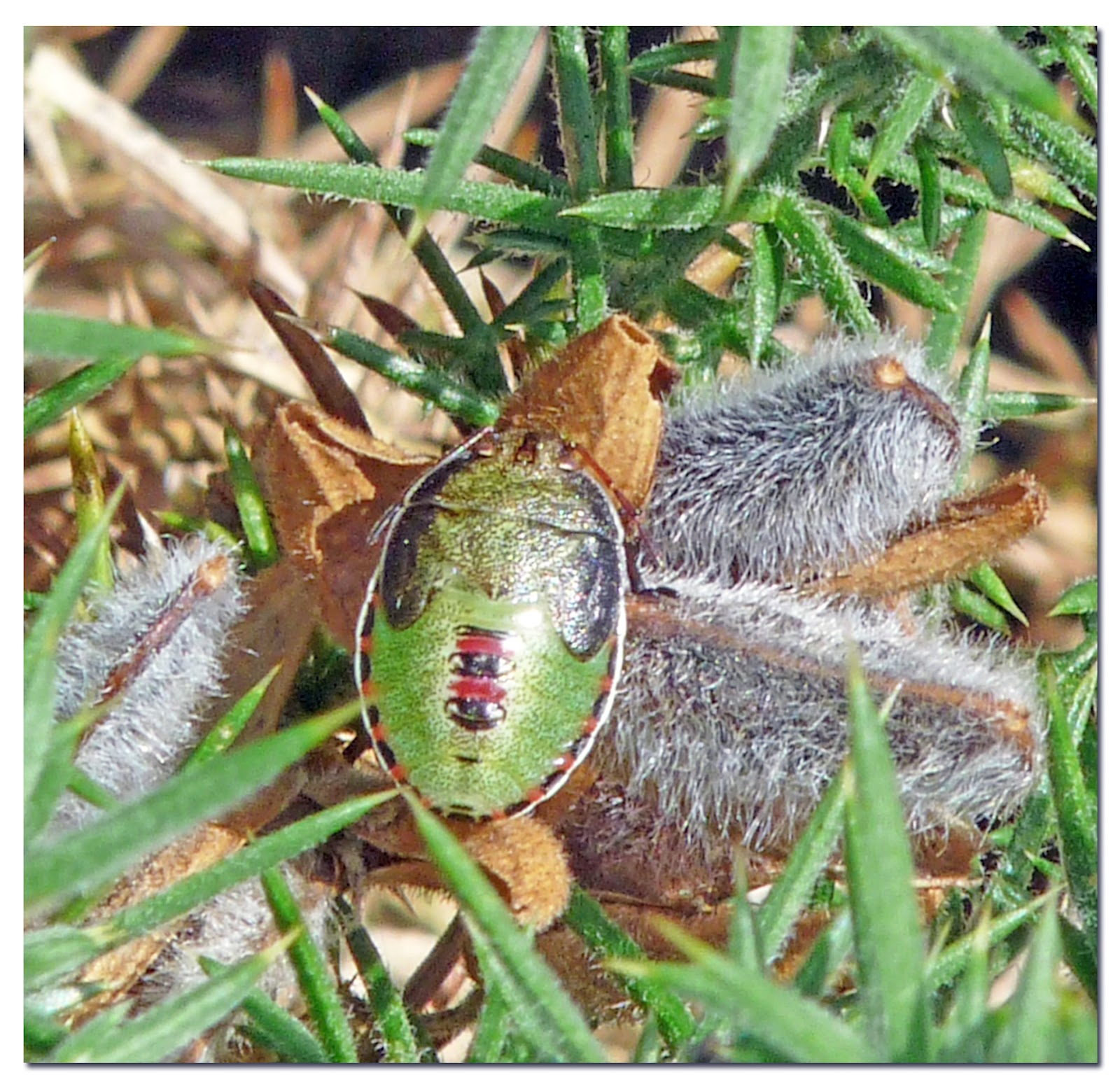
Our most unusual sighting of the afternoon at Dunwich Heath (National Trust), and indeed a first for me, was this Gorse Shieldbug nymph. I believe it is related to the Stinkbug family. Incidentally you might be interested to see a Red-legged Shieldbug in the Cabinet of Curiosities here. You might also like this British bug guide to hemiptera.

(Piezodorus lituratus)

I think the last bug I saw in nymph form was in Pylos ... here

We also noticed a few lively Cinnabar Moth caterpillars on the ragwort ...


... and what seemed to be a Brown-tail Moth tent on the heath ...

Previously noticed here at Spurn Point
And finally, a photo to help you find your bearings if you are not familiar with these two superb Suffolk wildlife sites ...

Monday, 30 July 2012

Home Patch (25): Marmalade Fly and Leaf Miner

Episyrphus balteatus (Marmalade Fly)
I gather this is a common Hoverfly in the UK. The twin stripes (one large, one small) make identification relatively straight forward. This tiny insect was sucking nectar in a white Pelargonium in the garden this morning. I gather it eats aphids ... there are a lot of Blackfly on the nearby nasturtiums!

Grown from seed ... Nasturtium, adding a splash of colour ... and home for Blackfly ...

... and the Leaf Miner! (Click here and scroll down just a little ... amazing photos of Leaf Miner)

Friday, 27 July 2012

Butterflies and Moths (13): Meadow Brown in Home Patch


There were few butterflies about in the garden, but this Meadow Brown stayed still just long enough for a couple of photographs. It was the first time I had seen this species around our home and it made me realise that I should do an updated tally of my Home Patch recordings soon.

There has been little sunshine today, but now it's looking just a little brighter, so perhaps a few more butterflies will take wing.