Showing posts with label Brown Argus. Show all posts

Thursday, 1 August 2024

2024 Garden Butterfly Sightings Up Until 1 August


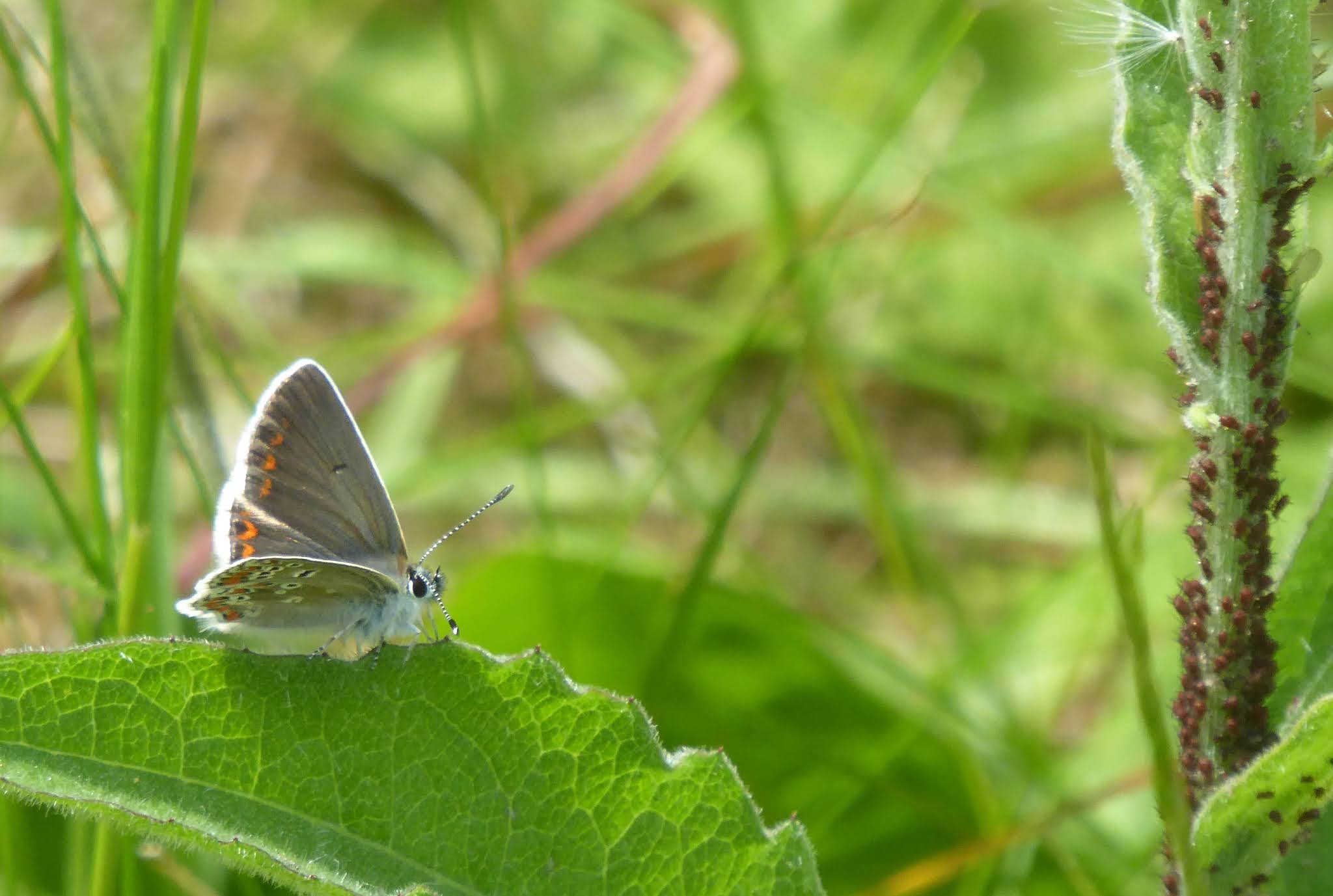
This dainty Brown Argus is the most recent butterfly to appear in our garden this year. It represents the 15th species spotted within our boundary. The chart below shows my records for the Garden Butterfly Survey. Naturally, some days produce more sightings than others depending on factors such as time in the garden, weather and butterfly cycles. 

The garden had a large white Buddleia when we moved in over twelve years ago. It also had a range of trees and bushes. We have allowed the grass to grow long and have added a butterfly house, a large trough of Nasturtiums (I never know if these are primarily for the Large White caterpillars to eat or for us to enjoy!), Verbena bonariensis and some herbs. We also have three mini-ponds and a water bowl for the hedgehog, so water is always available.

The list will enlarge with a double-click. 

The first column is for the scientific species name, followed by the common English name. Next comes the family name, e.g. Pieridae refers to the white (and 'white-ish') butterflies. The number column gives the total of butterflies seen between the dates of the first 2024 sighting on the left (column 5) and the most recent on the right. If my calculations are correct, the chart shows a total of 195 butterfly records since the late start of the 2024 butterfly season.  

I would hope to see a Small Heath and a Common Blue by the end of the season. Watch this space!


Friday, 8 July 2022

Update: Butterflies in the Garden


Latest First Garden Sighting of 2022, seen this evening at 19.30 hrs

I shall return to my holiday sightings soon (this was my Swallowtail post, in case you missed it); but I am interrupting the sequence to add my latest garden sightings, along with the latest addition, as shown above. 

Once again I am taking part in the Butterfly Conservation 'Garden Butterfly Survey'. The chart below shows my 2022 records from the beginning of the year up until yesterday. 


Some of you will know that we signed a Suffolk Wildlife Trust pledge, saying 'no to the mow'. I think the long grass of our suburban micro-meadow is beginning to pay dividends. I hope the Buddleias, several of them self-seeded, make a positive difference, too.

Total: 17 species ... and counting.


Monday, 7 June 2021

#30DaysWild, Day 7, 7 June 2021 ... First Brown Argus of the Season


It was lunch time and I was about to go inside when something with a glossy sheen about it caught the corner of my eye. My first guess was a Hairstreak, but then I saw the wings open to the familiar chocolate-brown of the Brown Argus (or, on occasions, the female Common Blue). The not-particularly-prominent mark in the centre of the forewing makes me favour the Brown Argus, though I think it is dubious whether the diagnostic 4th spot on the outer wing is in fact present in the photo below. Despite the proximity of the Blackfly in the photo above, Brown Argus larva feed off vegetation such as Rock Rose and particular varieties of Cranesbill and Stoksbill.

We had these butterflies in our homepatch for the first time last year, so we are glad they have returned, now that the unmown grassland of a garden has gone without a mow for well over a year. 

It was only when I uploaded the photograph that I noticed the bonus insect, which could be a female Thick-legged Flower Beetle. 

And just a quick update on butterfly species seen in the garden to date in 2021:

  1. Peacock
  2. Brimstone
  3. Holly Blue
  4. Orange Tip
  5. Small White
  6. Large White
  7. Green Hairstreak
  8. Brown Argus.


Sunday, 20 September 2020

Landguard: Blue Butterflies on a Blustery Afternoon

I see we are fast moving towards the autumn equinox, and perhaps this had something to do with the force of the waves on Saturday afternoon. I know other places have experienced dreadful storms and floods. The beach at Landguard shelves steeply as you may be able to tell from the photo.


As ever, I enjoyed seeing what was on the sand around my feet. I need to get my pebble book out and gen up on my stones. I spent my teenage years in East Anglia and used to know my carnelian from my quartz!


As you can see, this far end of the beach was once again pretty unpopulated. There were three windsurfers quite a way out, braving the breakers.


We spotted a bird on the groyne, this time clearly a Turnstone.


You can see the wing markings in the photo below. I nearly missed its take-off!


Up on the reserve we managed to find several Common Blue butterflies in the sheltered spots. 


Most had hunkered down to avoid the wind.


There were also a couple of tiny Brown Argus.


I think this butterfly had seen better days. 


Another Common Blue...


... and another, this time on the Tamarisk.


I wonder how many more we will see this season. For any who may not know it, here's a link to Robert Frost's beautiful 'Blue-Butterfly Day' poem, though as you will see, it doesn't exactly fit with our UK season right now!


Wednesday, 16 September 2020

Landguard Nature Reserve again... and a new Moth

We returned to the Landguard Nature Reserve yesterday afternoon and were delighted to see a new moth, which we think is probably a Treble-bar. I am waiting for the folk on iSpot to come to my aid over the ID.


We noticed this bird hopping about on its orange legs on one of the groynes. It seems to be a Turnstone (well, two of us think this is what it is), but perhaps its plumage is in an in-between stage. 

It was wonderful to be back on the water's edge...


...though there was a bit of sea fret over Felixstowe beyond the person in the distance.


Wonderful pebbles!


Turning inland a little, I noticed this plant, which I think may be Black Nightshade.

Landguard holds a very strategic position, and there are a number of grim reminders of past conflict, like this WW2 bunker pill box.


Speaking of happier things, we were delighted to see Common Blue butterflies in reasonable numbers. They were mainly low down in the grass, which made photography a challenge!

This one is on a stem of what I assume is Rest harrow. 


We also saw a couple of Brown Argus butterflies. The spot on the wing is quite marked and the abdomen quite long so I think this is the right ID.

Outside the fenced-in areas on the reserve there were lots of signs of rabbit activity... and we finally got to see two of the burrow-makers!


Tuesday, 1 September 2020

Garden Butterflies in August and a Brown Argus to kickstart September


This post was due to record butterflies seen in August for my Garden Butterfly Survey for Butterfly Conservation, and indeed it will. But I couldn't resist starting with these photos of a Brown Argus who alighted on the long grass this afternoon and stayed in a small patch for quite a while.


We had seen a couple of this species earlier in the summer here in the garden for the first time, but that was a good many weeks ago. My photos are not brilliant, but you can probably make out the prominent dark spot in the centre of the forewings, one of the features that distinguishes this butterfly from the female Common Blue; the thin abdomen (indicative of a male) being another.


And now back to August. As usual in these monthly charts, the figure recorded represents the highest number of a species seen at one time, rather than the total number. 


Looking back over these charts, I am amazed at the Gatekeeper figures, but during the heatwave we sat out for good long spells and they just kept coming. Their season seems to be over now. Sadly we have had not seen any Small Tortoiseshells in the garden (perhaps as a result of our nettle patch which was failing to thrive). We rarely see Painted Ladies here, but thus far my count for this species is nil.

Readers of this blog will know that, with the exception of a single go at preparing a winding path for my lockdown exercise back in March, we have refrained from mowing this year. The photo below, taken three hours ago, shows part of the garden, including the grassy triangle in which we noticed the Brown Argus. 


I wonder what other butterflies will appear in September...

Monday, 3 August 2020

Purple Hairstreak in my Garden Butterfly Survey Records for July 2020


I am glad to report that, despite numerous overcast days, my Garden Butterfly Survey numbers for July were considerably up on my June figures. 

We have been particularly delighted to see a Purple Hairstreak and two Brown Argus (verified on iSpot) in the garden for the first time since we moved here to our Suffolk home some eight or nine years ago. The Purple Hairstreak, like the two Green Hairstreaks earlier in the year, did not stay long. The photo above was the only one I managed to take; but I'm pleased to have a record shot, especially as this was my first sighting ever of the species, despite looking (hard!) in the Wood of Cree in the Galloway Forest and around the oaks at Suffolk Wildlife Trust's Carlton Marshes in previous summers. 

Please bear in mind that for the Garden Butterfly Survey the largest number of a species seen on a given count is what shows up in the chart, rather than the total number of butterflies seen in the whole month. Our number of Small Whites, for example, seen and recorded in the garden through the month greatly exceeds 14, but we never saw more than 14 at a time. Likewise, we actually had two Brown Argus sightings, but these are recorded as '1' because we saw one of these butterflies on two occasions, rather than two at once.


In other garden news: we saw a Common Lizard in the garden for the first time. I wonder if there are more about or whether it was attracted by the ants or the long grass.

Saturday, 18 July 2020

Big Butterfly Count (and a new homepatch species)


I had a tip-off that these beautiful butterflies were on the wing in our area, but it came as a surprise when we found one in our garden yesterday. I have not seen many Brown Argus butterflies in my life, and the few I have spotted have all been in Cambridgeshire at NT Wicken Fen. We have only knowingly had one Common Blue, a male, in our garden so far this year, but I wondered at first if the new sighting could be a female. I checked this website and came to the conclusion that this was unlikely on account of the marked dark spot on the wing and the markings on the outer hindwing, but since four kind folk have now agreed with my Brown Argus ID, I think this is probably what it is (but do feel free to say otherwise - with explanation, please!). 

Yesterday marked the start of the Big Butterfly Count, organised by Butterfly Conservation. This citizen-science survey made the national BBC News here in England so I hope there will be a good response, particularly since many species are in decline. David and I did two fifteen minute counts this afternoon on a quiet lane bordered by fields and hedges, now that my 'government shielding' advice allows for time beyond the garden in the company of another adult.  

Meanwhile, I continue to count butterflies in the garden for the Garden Butterfly Survey

Oh, and on another note entirely, the BATS were back in the garden last night. It is only the second time we have seen them this year. I saw two, both too large for Pipistrelles, and David saw more at the front of the house. I wonder what they are...

Thursday, 9 August 2018

Big Butterfly Counts at NT Wicken Fen and Sutton Hoo


David and I have now submitted several Big Butterfly Count surveys: there is still time to do a survey this weekend, and longer still until the final submission date. 

Large and Small Whites have been showing in good numbers in our neck of the woods, but the 'red row' on the survey chart for Commas, Peacocks, Red Admirals and Painted Ladies has been consistently lacking in the counts we have undertaken so far. 

We were at NT Wicken Fen near Ely again last Saturday, and were told to keep an eye out for the Brown Argus. To the novice (me), these butterflies can look very similar to the female Common Blue, but from what I have read on what I consider to be reliable websites, I believe we certainly saw a few Brown Argus.


The fenman's cottage garden at the approach to Wicken Fen was in full bloom.


I think this may well be one of the Brown Argus sightings, though it helps when you can see both sides of the wing!


... And there were definitely a few Speckled Woods about. 


We only saw one Small Copper.


On our previous visit there were plenty of Gatekeepers, but this time it was the Meadow Browns that were showing in good numbers. 


That little 'smudge' in the wing design intrigues me. 


A number of beautiful Brimstones were sighted and duly marked down on the chart. 


The only 'red' I saw was this Red Admiral, high up above the boardwalk. We usually see a few Commas down on the Butterfly Walk, but there were none about on this occasion. 


There were signs to say that some of the sedge had been harvested. 


The last two photos were taken at NT Sutton Hoo on a small clump of Viper's Bugloss. The Silver Y below is, of course, a day-flying moth and not a butterfly, but it is one of the species featured in the Big Butterfly Count, so we were pleased to find it. And, incidentally, we saw our first one in the garden a few days ago, too (or to be more precise, on a windowsill).


If you have a spare 15 minutes, do take part in the Big Butterfly Count. Oh, and I haven't forgotten to post a selection of holiday photos: I have in fact been busy making myself a Photobox album with some of them ...