Showing posts with label Caterpillars. Show all posts

Friday, 26 July 2024

Elephant Hawk-moth, Another 'Garden First'


© David Gill 2024


Some years ago we were delighted to find an Elephant Hawk-moth caterpillar very close to our home. This afternoon we discovered an adult moth in our long grass, in close proximity to the anthill where we found the Slow worm only yesterday. Another entry for our home patch list of species.


My photo ... to give an impression of the long grass location

 
Larval stage, my photo taken close to home, 2021


Friday, 28 June 2024

Tiger (Moth) Time

Scarlet Tiger moth, Anglesey Abbey, Cambs.

We have been to the water mill at Anglesey Abbey on many occasions. We have often watched swans, dragonflies and damselflies. This time our eyes were averted by a fluttery flash of red: a Scarlet Tiger moth in flight. I have never seen these magnificent insects in the east of England before, and my Cornish sightings have been few and far between. 

I loaded a photo on to iSpot, and one of the other contributors to the site suggested I contact the County Moth Recorder for Cambridgeshire. I have now had the ID confirmed (not that I was really in any doubt on this occasion), but I have also learned that this species appears to be moving east and that the predominant moth on a relatively nearby fen was in fact the Scarlet Tiger. What a magnificent creature to find in National Insect Week!


Scarlet Tiger

Small Eggar (Eriogaster lanestris) larva, Anglesey Abbey

Our next sighting was less showy, but interesting nonetheless. The moth larva in the photo above floored me somewhat in terms of an ID. As you can see, it was on a pathway with pebble-sized stones, quite close to the Visitors' Centre. The photo fails to show the conifers that towered above the path. 

I had imagined that the 'blanket-stitch' edging would aid identification considerably, but I drew a blank. Once again the folk on iSpot came to my rescue, suggesting an ID of Small Eggar, a 'Nationally Scarce' category B species. I see it usually turns up in the west but that there have been sightings in Norfolk. 


Water mill on the lode at Anglesey Abbey


Monday, 6 May 2024

A Mixed Bag of Bank Holiday Sightings from our Garden and Local Nature Reserve

14-spot Ladybirds mating on a nettle in our garden this morning


A rolled-up oak leaf on the reserve ... which may suggest that the dangling caterpillar below

... is the larva of Oak Leaf Roller moth Tortrix viridana

... though it could be the larval stage of the Winter moth (Operophtera)


Back in the garden, the caterpillar of the Bagworm (moth)

... turning this way and that


Garden: a Nursery Web spider (left) and a spider exoskeleton (right)

The exoskeleton

A parasitised caterpillar with eggs, apparently (thanks to iSpot), and claspers showing

If I receive more information from the kind iSpot enthusiasts, I will update the page.

Wednesday, 28 October 2020

Common Crossbill on an Autumn Afternoon

We were not far from the car when a birder hailed us, telling us to look up as there was a small flock of Crossbills in a tall pine tree. The Common Crossbill is a bird I have long wanted to see so I cricked my neck and waited for a flicker of movement in the high branches.

It was not long before I spotted a male...  


 ...with his burnt-orange feathers.


I particularly wanted to capture the distinctive cross-over bill on my photo, and despite the distance and poor light, you can just about make it out in the photo above. 

The kind birder mentioned that there had been a flock, and while we only saw three in total ourselves, it was not long before I noticed the female with her green plumage. You can see her at the end of the lower arrow in the photo above. I always enjoy seeing a new species, and keep hoping the day will come when I happen to be in the same place as a Hoopoe, but a surprise encounter, like this one with the Crossbills, is always a particular joy. Our friend told us there were also Redpolls about but we failed to see them.

The area in question has mixed swathes of woodland, and in the deciduous areas, there were plenty of chestnuts on the ground ...

... and a good selection of fungi.

Most fronds of bracken have taken on that beautiful bronze hue of autumn.

We noticed one small moth larva on the sandy soil. Autumn is not my favourite season, but I do particularly like the display of red (see below), yellow, brown and orange.


P.S. Apologies if the spacing looks odd on your screen. Since Blogger updated its platform, I have found it hard to use the html option and hard to position pictures evenly within text.

Friday, 4 September 2020

My view of the Elephant Hawk-moth Larva


Having posted a few photos taken earlier in the week by David of an Elephant Hawk-moth larva he had seen en route to the nearest Post Office, I was absolutely delighted this afternoon to learn that there was a caterpillar in very close proximity to our home. As you can see it was busy eating its way through some Rosebay Willowherb leaves when I arrived.


I like the way its shape seems to mirror the grass seedhead just below it!


Not much left of the plant!

Wednesday, 17 June 2020

Day 17, #30DaysWildCreativity: Nourishing Things That Grow Nearby


The world had hardly changed

when I planted twenty-five seeds, each one a dry husk from which the vibrancy of life would spring. I waited, willing the first shoots to spike through the soil, hoping the slugs and snails would find other sources of nutrition. Within a month, green plants began to take shape, bearing stems that became umbrella handles underneath a ring of miniature leaves.

Some days raindrops pattered down from brooding skies. A few bounced off the seedlings: others landed on the leaves and became tiny snow-globes of life. As rainbows gave way to bursts of sunshine, the plants grew and began to develop a range of markings. This morning there were three distinct colour forms; vibrant green, deep kale green, and mottled green and cream.

Each stalk propels its leaf towards the light. Each leaf spreads in diameter, providing the perfect wet-weather shelter for a mouse. I pick a single stem and twiddle it round between index finger and thumb. I check for signs of butterfly eggs and blackfly, but there are none. I roll the small leaf and squeeze it, inhaling an earthy draft of pepper. I am reminded of piquant pasta suppers in last year’s heatwave. 

But no eggs could mean no larvae, which in turn could mean a dearth of white butterflies.


* * * 

This post was written in response to Dr Miriam Darlington's #30DaysWildCreativity meme for Day 17 of #30DaysWild. We were invited to look 'more closely at things growing nearby and see how nourishing they are'.  

Monday, 8 June 2020

#30DaysWild, Day 8: Knapweed Surprise


I seem to have been preoccupied with correspondence during the last 36 hours, so, with some reluctance, I will pass over Dr Miriam Darlington's tempting #30DaysWildCreativity meme offered today by her guest, Sarah Acton, though I would like to try it at some point. 

Instead I have opted for this morning's discovery which follows on perfectly from yesterday's post about the new Knapweed plant in our wild garden...

Look! Caterpillars at last! 

I am pretty excited, particularly since they were not there yesterday, and I'm not entirely sure I know whose larvae they are (I had wondered Angle Shades since the moth had been in the area, but I am not sure the pictures match). I am in the process of trying to find out, but do leave a comment if you can help. 

In yesterday's post I wrote about what insects the Knapweed might attract, little thinking that by this morning there would be at least four hungry mouths feeding on the plant. The weather has not been particularly bright or warm, but, as they say, what a difference a day makes...

-----------------------

UPDATE, August 2020

Having guessed these were moth larvae, I am now wondering if they might be Hoverfly larvae. The reason is the photo in the pop-up window labelled 'Hoverfly larvae' on this UK Safari page. Other suggestions from kind folk on iSpot are both types of Orthosia; O. gracilis (Powdered Quaker) and O. gothica (Hebrew Character) and

Tuesday, 5 June 2018

Dunwich Heath Again - Do You Recognise This Caterpillar?


There were few butterflies about on Dunwich Heath last Sunday afternoon but, most obligingly, this Small Copper perched for a while near our favourite seat. I have been wondering about the plant: do you think it is Heath Speedwell? It was definitely more pink than blue to my eyes, though there could be a touch of mauve in there somewhere. The area comprised dry sandy heathland, so the Pink Water Speedwell seems an unlikely alternative. 


While I was looking for butterflies in the heather, David noticed a tiny 'snake' (well, a caterpillar) in the grass by his feet. I have posted these pictures on iSpot, but do let me know if you recognise it. It couldn't be a Grayling larva, could it? I have seen the adult butterflies in this area.

It made me wonder why some lepidopteran larvae have sideways stripes (e.g. the Cinnabar moth with its black and orange bands and the Swallowtail butterfly with its segments of green, black and amber) while others (e.g. the Shoulder-striped Clover moth) have lengthways ones. The Striped Hawkmoth caterpillar seems to have lines going in both directions! These linear markings must be to do with camouflage and particular habitats.  


And speaking of camouflage, this moth below, blended in so beautifully with its sandy environment that I would have missed it all together if it had not fluttered its wings. Doesn't it blend perfectly with the bits of twig? After a while it flew along the side of the heather and gorse, and was equally well hidden. I'm guessing it is a Common Heath (too pale and indistinct for a Lattice Heath?), but again I have posted it on iSpot.


We ended our walk with a pot of Earl Grey in our favourite cafe in Dunwich. David had a slice of lemon curd cake and I chose the coffee and walnut. I'm afraid we were hungry and gobbled them up before I thought to take a photo!

For more on wing colour, pattern and iridescence you might find this article from Exeter University of interest. I am always fascinated by iridescence.

Thursday, 21 September 2017

Butterfly and Moth Larvae... My Photos

Those of you who have visited my blog recently will know that I have been collating my photos of butterflies and moths. Today I am turning my attention to their larvae, beginning with the larvae of MOTHS...

Emperor Moth (Saturnia pavonia) larva, I'm guessing 5th instar, Dunwich Heath, Suffolk,
 
Mullein moth larva, RSPB Wildlife Garden, Flatford, Suffolk, 2017

Above and below: Drinker moth (Euthrix potatoria) larva, Flatford, Suffolk, 2016


Buff Ermine (Spilosoma lutea) larva

Knot Grass (Acronicta rumicis) larva, St Columba's inland island (photo here),
Snizort River on Skye, 2010

Fox Moth (Macrthylacia rubi)
early instar larva on Raasay, Inner Hebrides, Sept. 2009

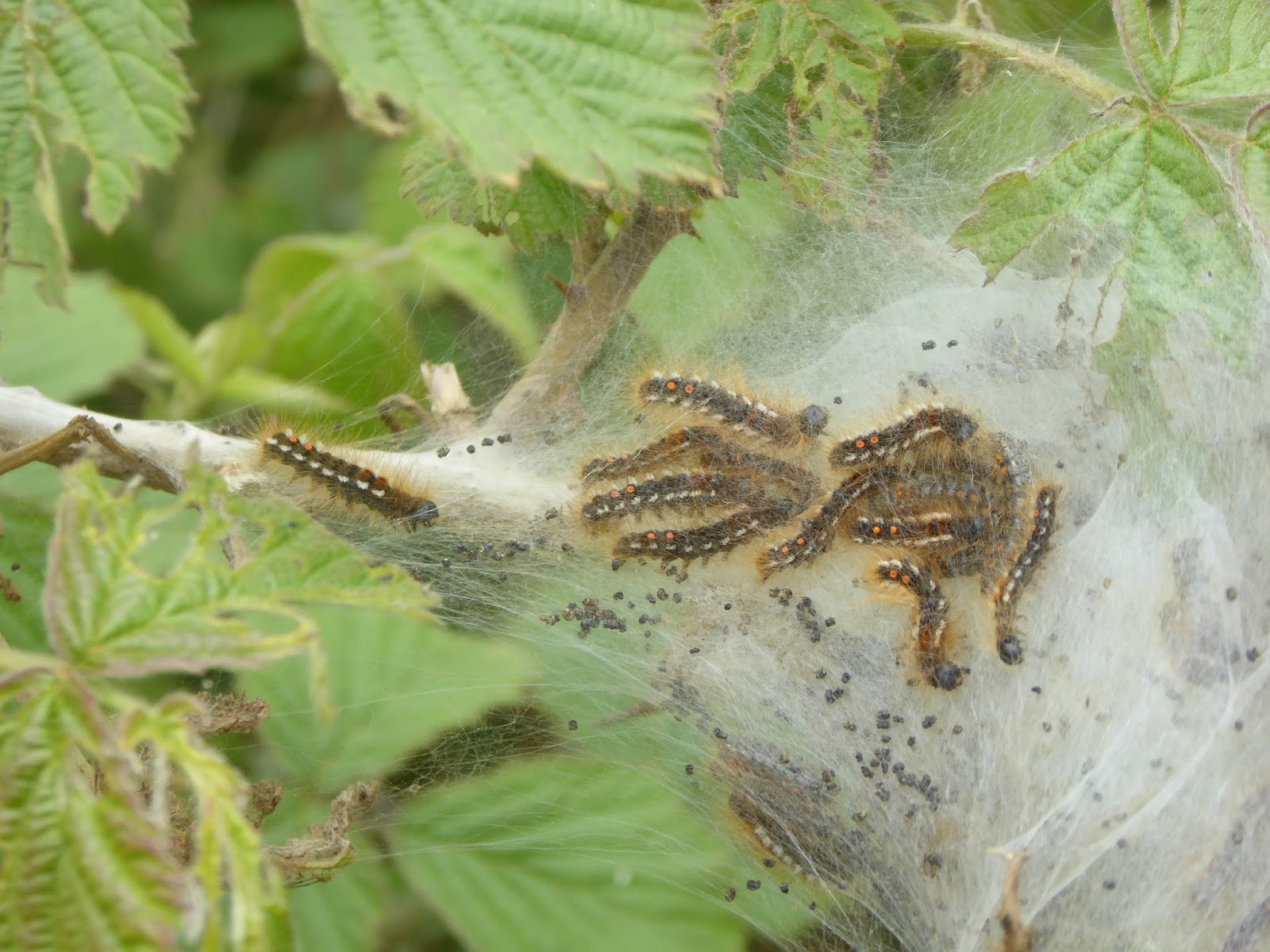
Tent of Brown-tail (Euproctis Chrysorrhoea) moth larvae, Spurn peninsula, April 2009
More Brown tail larvae, RSPB Holme Dunes, Norfolk, 2017

*

Moving on to the larvae of DAY-FLYING MOTHS

6-spot Burnet (Zygaena Filipendulae), Mwnt, Pembrokeshire

Cinnabar moth (Tyria jacobaeae) larva, Snape, Suffolk

Cinnabar moth larvae on (stripped) Ragwort, Snape, Suffolk

* * *

The larvae of BUTTERFLIES

Swallowtail (Papilio machaon britannicus) larva, Norfolk

Swallowtail, devouring Milk Parsley, Norfolk

Swallowtail larva, Norfolk

Swallowtail larva, Norfolk

Swallowtail on Milk Parsley umbels

I'm guessing this is a first instar Swallowtail larva, Norfolk

Small Tortoiseshell (Aglais urticae) larvae, WWT Welney, Norfolk, 2016

Peacock (Aglais io) larva, RSPB Minsmere, 2016

Large White (Pieris brassicae) larvae, RSPB Flatford Wildlife Garden, Suffolk

Large White larvae, NT Oxburgh Hall, Norfolk

This is not a very scientific post, I'm afraid, but I wanted to group my photos together. I hope it shows something of the diversity in terms of colour, hairiness and shape of a small selection of our UK lepidoptera larvae. As ever, if you spot an error, please feel free to drop a line in the Comments section...