Showing posts with label Blackbird. Show all posts

Monday, 24 January 2022

Trailcam Update and RSPB Big Garden Birdwatch Reminder


We hope to take part once again in the annual RSPB Big Garden Birdwatch, which runs from 28 to 30 January 2022. It is always interesting to see which of the 'regulars' deign to show up during our chosen hour, and if there are any surprises. Do consider taking part yourselves; this must be one of the largest and most popular citizen science projects around.

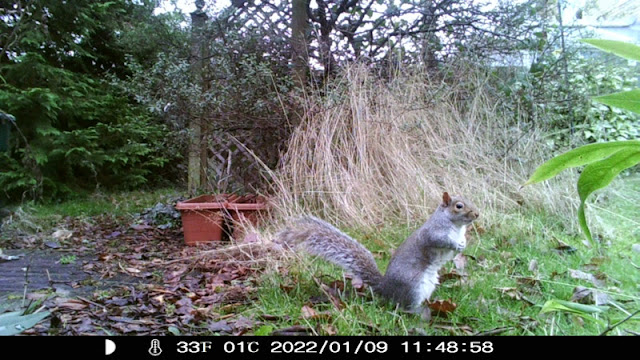
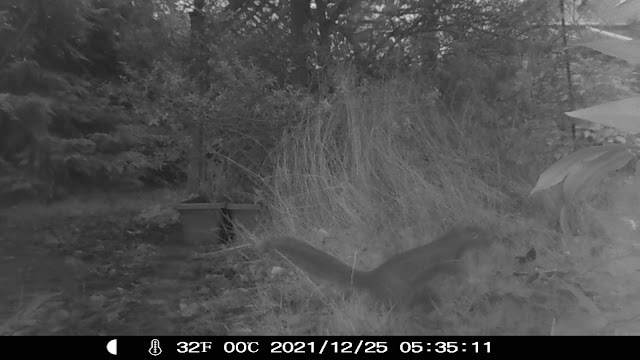
You might be wondering why I am posting a photograph of a Grey Squirrel. Well, it occurred to me that taking part in the Birdwatch is a bit like taking the photographs off our garden Trailcam ... you never quite know what you will find.  

Our Trailcam has picked up the following creatures to date:

  1. Blackbird
  2. Robin
  3. Blue tit
  4. Pigeon
  5. Magpie
  6. Great tit
  7. Grey Squirrel
  8. Mouse
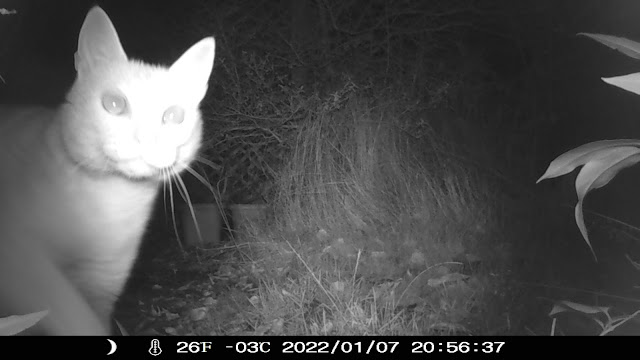
  9. Other people's domestic cats ... several

We keep hoping it will deliver a surprise, though I have to say that (despite the charm of 'Ray' the rodent on BBC Winterwatch), I am glad we have not ended up with frame upon frame of rats! In fact, rats have not appeared at all to date. Perhaps I should mention Ray's nemesis, the Tawny Owl; as it happens, I have just heard our resident bird calling, but I sense an appearance on the Trailcam is, at the very least, unlikely. 

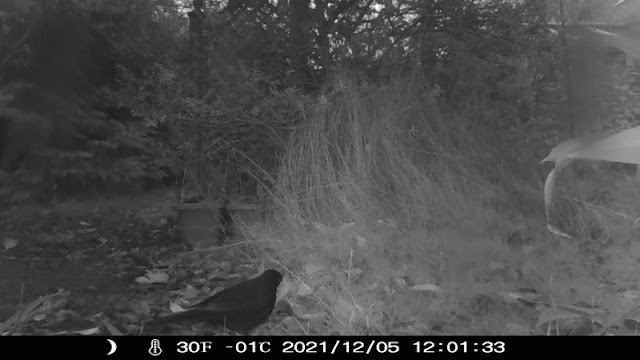
Here is a small selection of our recent photographs ...

I would love to know the real colour of the fur.


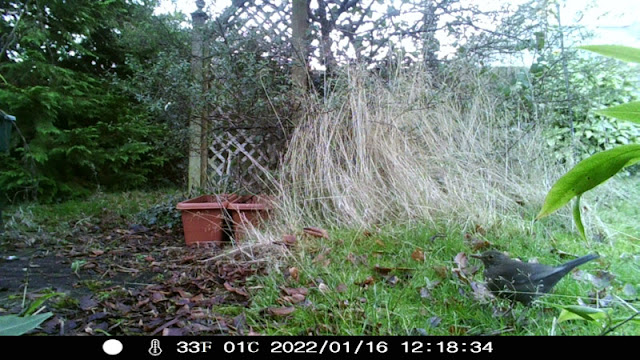
One of our faithful visitors, a female Blackbird


This one was burning the midnight oil ...

This was the early bird Grey Squirrel.


Sunday, 6 June 2021

#30DaysWild 6 June, Day 6: A Tale of (at least) Two Blackbirds


The two photos above from our TrailCam show 'Star', the partially-leucistic female Blackbird, caught on camera. She is nearly always the star of our garden show as there must be particularly juicy worms in this corner of the garden! The orange arrow in the top photo shows the distinguishing mark that led to her 'name'.  

The two photos below show her mate, 'Mr Star', taken on different days, but with a bill full of food on each occasion.
 

The Blackbirds seemed to be foraging nearly all the time, and we began to have a hunch that there was almost certainly a 'Star Junior'. We became a bit fearful for the fledgling when the camera showed photos of potential predators in the form of the visiting cat and magpie you see below.


The foragaing continued apace, which we took to be a good sign. The adult male Blackbird kept his distance, often standing sentinel on top of a fir tree, but Star would wander round the grassy paths and come within a metre of us if we were sitting on the patio.


It seems the frantic hunt for food continued on into the night. The photo above, taken at 03.16 hrs yesterday morning, seems to show a Blackbird bill looking up at something in the air.

We have at last been 'introduced' to Star Junior, a single sleek and healthy-looking semi-fledgling. We have watched mother and young hopping in tandem round the grassy paths. We have seen Star's offspring fly into a low branch and we have watched it 'flop', with feathers all spread out, on the decking. Each day, and almost each hour, brings more independence. I did not like to disturb the 'new arrival' by clicking my camera (which always 'pings' when switched on) while it was spreadeagled in the sunshine, but I hope soon to be able to post a photograph, providing the latest bird on the block stays around a little longer.
 

Wednesday, 2 June 2021

2nd June 2021: #30DaysWild, Day 2


I have three garden sightings to report so far today (and a fourth, though I was not the one to see it).

[1] My first Small Copper of the year, which you see above.

[2] A bee flying in and out of one of our insect houses, despite the ant invasion. I failed to photograph the bee, though you can see the ants making their presence felt in the photo below, taken a few days ago. I hope the bee will prove to be a Leaf-cutter, which is what we had last year. 

[3] The blackbirds were making loud (?alarm) calls last night at dusk. We failed to see evidence of a magpie, jay or cat ... but this morning Star the female was perching in front of a rotund and fluffy semi-fledgling. No wonder Star has been such an active hunter-gatherer recently. 

... and ...

[4] from David, the first 2021 sighting of a Red Damselfly in the garden.  


Hard to tell if there are signs yet of leaf or bee!


Ant invasion!

I wonder what you have been doing or finding for Day 2 of #30DaysWild ...


Saturday, 6 March 2021

Fun with the Trailcam


The Blackbirds seem to be the stars of our Trailcam show so far, at least during daylight hours. However, we think we may have caught a mouse on camera. I will post the photos below and you can decide for yourselves. The pictures are not very clear, I must admit, and it is quite possible that we have exercised rather too much imagination! 

Since the mouse is, or would be, so tiny and possibly fairly hard to spot at the best of times, I have done a little cropping on Photoshop and have also indicated not only the (query) position of the mouse, but also the (side and frontal) view of it that we think we may see. 

The camera shows that it was just below freezing when the camera clicked twice at 3.51 early this morning. It also definitely shows spots, which may or may not be eyes; and, of course, something must have triggered the camera in the first place while we were definitely indoors. It will be interesting to hear your views if you care to leave a comment! Alternatively you can cast a vote on my Twitter poll over the next 24 hours.


Sunday, 28 February 2021

First Go with TrailCam and a Mixed-Bag of Garden Sightings

The top photograph shows David installing our new TrailCam in the hope that we might be able to record a few night visitors over the coming weeks. We have never used one before, but spurred on by reports from a couple of friends who have recently set up these cameras, we thought we would buy a fairly basic model and see what happened. I have a good idea of the creatures who visit our garden by day from the Homepatch Species List I have been keeping for the last few years, but little idea of what happens after dark or when we are inside. 

The second photo shows a kind of tunnel between the ivy and the fir tree. We have often seen cats in that area, but two of the regular felines have now moved elsewhere with their families, and we rarely see a cat in the garden. 

36 hours on and we uploaded the film. There are no great revelations to date (and thankfully perhaps, not even a rat), but the camera had been triggered several times, mainly in the dark, once yesterday morning in thick fog, and a few times in the daylight. 

The Blackbird below is the first identifiable creature to be caught on camera. Watch this space!


We have checked the garden for more ladybirds, and have located more 7-spot and Pine varieties. We have also seen a couple of bees . . .


. . . and a hoverfly (below), complete with shadow.


The 7-spot below is definitely keeping company with what are probably spiders, though I haven't been able to count their legs with any accuracy. I had wondered if they were Dock bug nymphs as we get a lot of Dock bugs in this part of the garden, but I don't think they are a good enough match.


We have had wasps' nests in the garden the last couple of years (well, one in the shower vent, so perhaps more in house than garden), so it was no real surprise to see this insect inspecting last year's nest site, which, thankfully was definitely in the garden and not in the house. I am fascinated by most insects, but do not get on well with ticks or the Common Wasp. I shall post this picture on to iSpot.


It has been a joy to see our Crocus, Miniatire Iris and other bulbs opening in the sunshine. We have a good show, albeit a miniature one, of Tête-à-têtes, in readiness for St David's Day (though these may technically be more Narcissus than Daffodil ... I wonder if you know).


Back to our mix of ladybirds again ...


And finally for now, a rather gruesome photo of what seems to be some kind of (perhaps beetle or weevil) larva demolishing an earthworm. A tiny corner of roofing felt came adrift from the old shed and this is what was underneath it ... I am hoping the folk on iSpot can enlighten me as to what exactly is going on.
 

After some fairly dormant months in our home patch, it suddenly seems as though there is a lot of activity even if I am still awaiting my first butterfly sighting!

Sunday, 7 February 2021

Snow on snow . . .

I have not ventured out beyond my patio door, but here are some of the avian visitors who came to our garden today. I gather there are Redwings and Fieldfare in the vicinity, but I have yet to see any this year. As for the snow, well, it is probably the most we have had since we moved in to our current house about nine years ago!


Tuesday, 2 May 2017

Wildlife in the Ruins (or a grey Bank Holiday in the Thetford Area)


We had been waiting for some time for the 'right kind of day' on which to revisit the Thetford area. Bank Holiday Monday proved just such a day, with short sunny intervals, even shorter showers and a good deal of fair, if grey, weather.

Our first stop was the site of the Priory, founded 1103 or 4, and belonging to the Cluniac order of monks. The remains are in the care of English Heritage. We made our way to the magnificent Gate House, which dates from the 14th century, and were met by the three avian residents you can see in the photo above. I have been trying to ascertain whether the 'white pigeons' are simply that - white pigeons - or whether, perhaps, they are fantails. According to this thread on the RSPB site, they are descendants of the Rock Dove. Feral pigeons are descendants of what has long been known as the Rock Dove. Does this fact make these white pigeons 'feral' doves? I am not sure. But wait, there is an issue with the name 'Rock Dove': do take a look here in the pigeon and dove section of the IOC World Bird List site


Above: the pigeons in situ.

The magnificent flint-faced Gate House


 A close-up of the flint, and you can see where strands of ivy have been removed (or in this case, left). Thetford is not far from Grimes Graves, and is a good location for flint.


You can see that we were under rather a dark cloud at this point, but this photo gives a good impression of the extensive remains of the Priory.


You can read more about the Howard family here.


The photo above shows the Priory end of the site and the one below is from the spacious prior's lodging.


I went inside the walls of the prior's residence and noticed a corner of wildflowers growing out of the wall. I don't know whether this suggests that this corner is a damp one or whether, perhaps, it is a favourite haunt of wild birds who deposit seeds.


In any case, I was soon aware that there were two bright Blackbird eyes...


... staring down at me. The bird's bill was stuffed full of insects. I left him to his prize catch, not knowing whether male Blackbirds feed the female while she is nesting, though I never saw or heard a hint of another bird in this area. [After note: I have now been able to look up the habits of breeding Blackbirds, and it appears that while only the female sits on the nest, her mate will assist with food finding. Of course, I have no idea whether this particular bird was feeding himself or a family...].

* * *

By this time it was 1 o'clock, so we moved on to the next site - which was half a mile away, if that. The ruined Church of the Holy Sepulchre in Thetford is currently undergoing some restoration, as you can see from the photo below. The nave dates from the 12th century, and at some point after the nearby priory (see above) was dissolved in 1536, this particular church fell into use as a barn. I have only found three other UK churches with this dedication or foundation, including the Round Church in Cambridge.


According to the English heritage board, the rounded structure below is an added 19th century grotto, built as part of an ornamental garden feature. How unusual. You can read more about the church here on the Historic England site.


I looked about on the ground and noticed an empty snail shell. There was only one, so the adjacent flints may not have been in use as a regular anvil for a Song Thrush, but they would have served a useful purpose on this occasion at any rate. 


We were being watched from above, and it is possible that this bird had dropped the snail from a height. Song thrushes bang away at their 'anvils' on the ground whereas Carrion Crows and some other corvids prefer to drop a mollusc shell from a height.


It was time for a picnic lunch so we drove a few miles out of town on to the heath in the heart of the Brecks. The soil is sandy here and ideal for the families that were using the bike trails through the adjoining forest.


David and I found several caches of overwintering ladybirds, sadly all Harlequins. I shall add these to the UK Ladybird survey. But to end this section on a happier note, I am pleased to report that both my recent North Norfolk ladybird IDs have been assessed on iRecord and confirmed. One of the species was a (small) Kidney-spot and the other a (large) Eyed Ladybird - both UK species.

We moved on to Knettishall Heath after our picnic, a wildife area in the care of the Suffolk Wldlife Trust. This will be the focus of my next post, and it will include - you guessed - the sighting of another UK ladybird species. 

Over-wintering Harlequin Ladybirds (and in the two photos below)