Showing posts with label winter migrants. Show all posts

Saturday, 20 February 2021

An Early Spring Morning in the Garden


We spent an hour in the garden this morning, enjoying some early spring sunshine and birdsong. These first two photographs, which were also the first two I uploaded, were actually taken on 12 February when the Fieldfares were still in our trees. All the other pictures were taken today.

We always enjoy seeing Goldfinches. This one was in the Silver Birch, which some of you may remember from the Tree Following meme.
 

This 'woody' corner of the old decking seems to suit these small Cyclamen. They don't seem to spread much, but are always a joy to see. But it was the miniature Iris reticulata in bloom that particularly caught my eye this morning. 

As you may know, we have been keeping an eye on four Wasp spider egg sacs over the winter. What you see in the photo below is, we can only think, the remains of one of them. The grassy area in which all four were last seen was under about 20cm of snow for almost a week earlier this month. All our snow has melted, but the long grass is bent over in swathes. 

Back in the summer, we were visited not only by Wasp spiders, but also by a couple of Common Lizards who, to our great excitement, were sighted on our patch for the first time. These 'firsts' may be totally unrelated, but it was nevertheless intriguing to read on @Tone_Killick's Twitter page for 15 December 2020 that it is extremely rare in the UK, there being probably only one instance, to find a photograph of a spider with vertebrate prey. It just made me wonder whether the spiders on our land were after the lizards, and not the other way round, as I might have supposed.

As for the egg sacs, well, time alone will tell whether the colony of Wasp spiders increases here or whether the wind and cold weather have killed off the overwintering eggs. 


On a more cheerful note, it was good to find two different kinds of ladybird making the most of the sunshine. The 7-spot emerged from a large pile of twigs, and what seems to be (the much smaller) Pine ladybird (Exochomus qadripustulatus), with its rim around the elytra, was perching on a leaf.

 
There were a couple of (?Nursery web) spiders running about on the relative warmth of the old tray. 

It was a delight to find two Daisies in the grass.

Here's a close-up of our first Iris . . .

. . . and photos of our first Crocuses.


This is our new feeding pole, which although empty in this picture, has already attracted Long-tailed tits, Great tits, a Robin, a Pigeon, Blue tits and Starlings. There is plenty of food for all comers, and yet the Blue tits, in particular, insist on dive-bombing their fellow Blue tits and also the Long-tailed tits. 

We have never had an Aconite in the garden before. There is just the one, in a very scruffy old pot, so I am intrigued whether perhaps we planted a few bulbs last autumn.

And finally, do let me know your thoughts on the (pretty shy) bird above. I thought it was a Sparrow, until I took the photo below, which is certainly one. The two bills don't look the same shape to me, but I am really pleased to find a House Sparrow in our garden. There was a little colony down the road, but it dispersed last summer when one of the houses had building work which interfered with a particular hedge. 

The last House Sparrow record for our garden is June 2020. These once-common birds are now categorised as Red in terms of conservation on the RSPB site. I hope we will see more of them in the days to come.


Friday, 12 February 2021

Fieldfares and Redwings

We have definitely had more snow than in our previous years in Suffolk. And, to our delight, the snow brought a huge mixed flock of Fieldfares (a garden first for us) and Redwings (just a few). All these photos were taken through the window of our home. Sadly the light quality was very poor when I photographed the Redwing, two photos below.


With a profusion of catkins behind


Seeing these wonderful birds so close at hand made me wonder whether there will be an influx, or even an irruption, of Waxwings. However, the Waxwing Twitter account, @WaxwingsUK , suggests to me that this is probably unlikely. 

Thursday, 15 March 2018

Queen of the Spring


I have been on the look-out for early insects, and feeling the warmth of the sun through a glass panel yesterday afternoon, went outside just in case there were any Ladybirds emerging from the places they tend to over-winter. I guess it is still a bit early and cold, though I see I had come across a Brimstone and a Small Tortoiseshell butterfly by this time last year. However, making her way slowly up the door frame was this beautiful Queen Bumblebee. Queens, I have discovered, hibernate in the earth on their own. When they wake up they need to feed, and find a suitable nesting site. You can read about the Queen bee here on the Bumblebee Conservation Trust site.


I enlarged my photo on Photoshop to see the details. I also lightened it to help me see anything I might have missed. Those little golden speckles on the wing, presumably of pollen, caught my eye. Bees make particularly good pollinators because not only do they have specific pollen sacks, but small particles of pollen are carried on their bodies as a whole.

There are not many flowers in our garden yet. We have a few Polyanthus, a couple of small Iris, a lingering Snowdrop, yellow Viola (like small Pansies), a number of Daffodils and a couple of Daisies. It's a lovely to think that buds are beginning to burst - though I gather we may be due for more snow before the weekend is out, and 'just up the road' in Norfolk, there have been sightings of a magnificent female Snowy Owl.


Postscript

Looking at the daffodils in this photo makes me feel we should be trying to buy plants in more environmentally-friendly pots next time. What a challenge for garden centres to switch from polystyrene and plastic to recycled, recyclable or biodegradable plant containers. Has anyone come across an outlet that is committed to doing just that? 

Friday, 20 January 2017

A 'First' Garden Sighting - Redwing (I think...)


I looked out of my window this afternoon just before sunset and noticed an unusual bird on the branches of the Acer negundo, which rarely attracts avian life. 

Wondering if it could be a Redwing, I grabbed my camera and was able to take three record shots through the double glazing before it flew off. I apologise for the quality, but I think the photos show a solitary Redwing (unless you can advise me of some other ID) - a 'first' in my home patch; and, in fact, my first migratory Redwing of the year. There is a clear superciliary stripe and just a hint of the characteristic russet colour around the wing area on the photo above. You can see a few stray berries in the background which had perhaps lured the bird into our garden in the first place.   


I note from the RSPB website that Redwing have been given Red conservation status. I had never seen these birds before we moved to Suffolk five years ago. 


Monday, 19 January 2015

Redwings in the Park


It was a bitterly cold weekend, though the snow flurries were minimal. We visited Christchurch Park, where this Grey Squirrel was busy foraging at the edge of one of the grassy areas.

After our sighting of a Barn Owl last weekend, we thought it would be good to see if Mabel the Tawny Owl was 'at home' since I had read that she had been back in her favourite spot. There was, however, no sign of her on this occasion. I expect the afternoon was too cold for her to sit at the opening of her usual tree hole. 


This magnificent Song Thrush was hopping about, and we looked hard to see whether (s)he was ringed, but there was no ring in sight.

The Blackbird gives an idea of scale for the Redwing

Suddenly on this muted January afternoon, our eyes were alerted by movement in front of a female Blackbird. We thought at first that it might be a Brambling, a bird I would love to see, but it was a Redwing, another winter migrant. According to the RSPB site, it is 'the UK's smallest true thrush' and is on the Red List for conservation. There were, in fact, several Redwings hopping about in the dead leaves. I failed to find a good setting for my camera in the dim light, but at least I have a couple of record shots and another bird to add to my January list.


Monday, 10 February 2014

A Lull in the Weather ~ a Stroll in the Park


After a stormy night, the weather cleared a little on Sunday afternoon
so we visited one of our local parks.
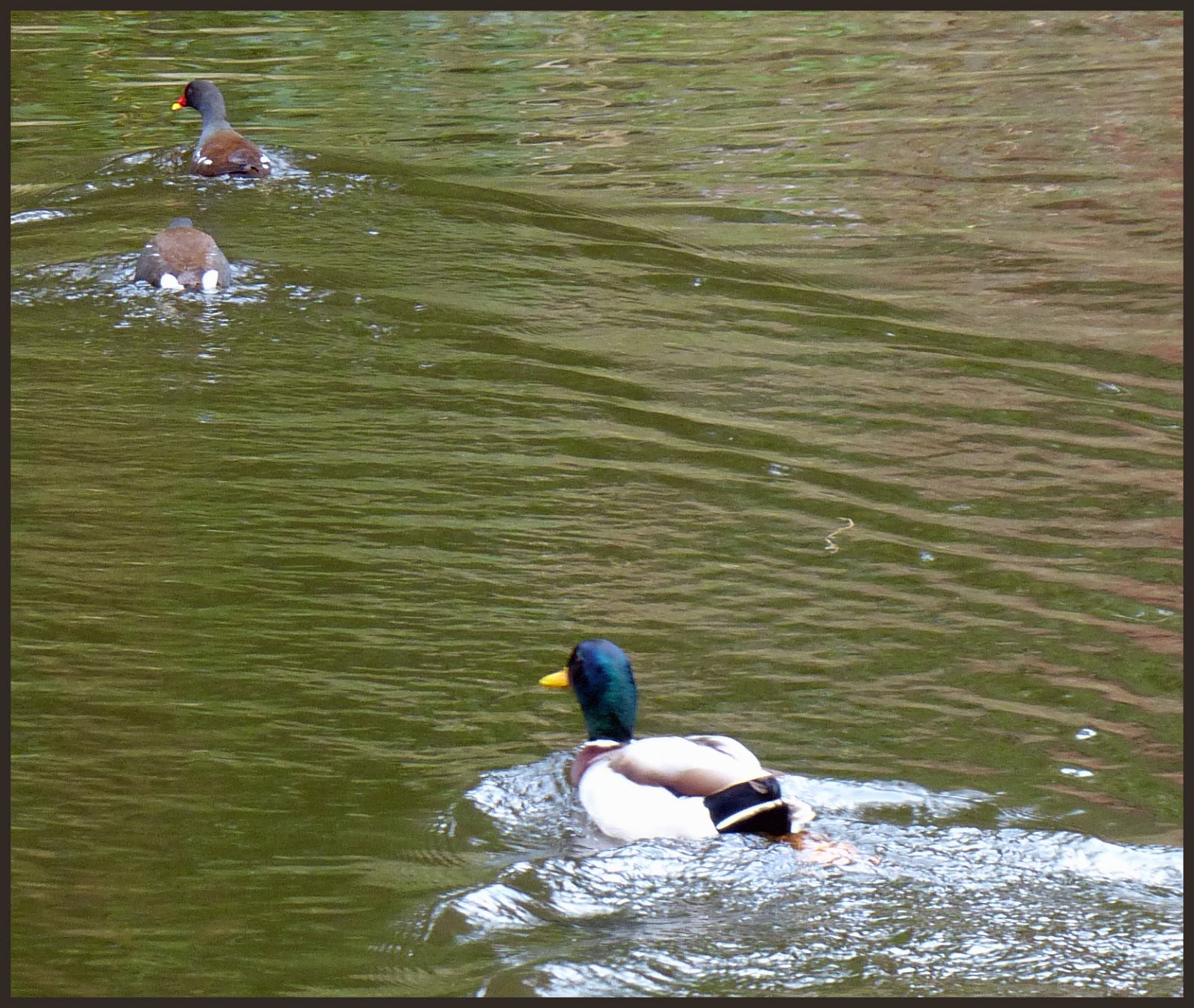
There were a few Mallard ducks and Moorhens on one of the main ponds.


This Cormorant had deserted the coast or waterfront in favour of easy pickings. 
There were also quite a few Black-headed gulls. 


The sunshine brought the Grey Squirrels out into the open,
foraging for their buried food supplies.


Suddenly we spotted a small flock of Redwing


These winter migrants breed in northern regions of Europe and Asia,
but arrive in the UK in small flocks.

Speaking of winter migrants, we had read reports of Waxwings in our area,
but we failed to find them.


This white bibbed duck (above) may be a hybrid Mallard,
although when I thought I saw one last time, 
hybrid expert Dave Appleton told me
that he felt the duck I had seen on that occasion 
was 'simply a domestic variant of Mallard,
not a hybrid between a Mallard and any other species.
Domestic Mallards come in a bewildering variety
 of sizes, shapes and plumages.' 

So many thanks to Dave,
whose 'hybrid duck' photos can be viewed here


The Mallard drake above was doing a spot of preening ...


... before setting sail across the pond with his mate.


There was a photographer keeping a close vigil on this corner of the pond,
and if you follow the red arrow above, you will see why.


Every so often a rat would emerge from one hole or another ...
and the one in the photo below took to the water for a swim. 

Members of the public have been asked to refrain
from feeding the ducks in this pond
because the scraps of bread and suchlike
prove particularly attractive to the rat population.


Postscript ...

Having checked out the photos on Dave's Domestic Mallard pages here, I'm pretty sure that the bibbed duck above is much the same as the one on his site from South Creake, Norfolk.