Showing posts with label Bees. Show all posts

Thursday, 16 June 2022

Garden Sightings


We were so pleased to see that this beautiful Hummingbird Hawkmoth had found a clump of self-seeded Valerian in our wild garden. It is only the second we have seen here since we moved in a decade ago. And speaking of moving in ...

I am so thrilled to see a bee investigating our new (for 2022) bee house. Our old bee houses have been taken over by ants.


Friday, 11 March 2022

New Lodger of the Insect Kind


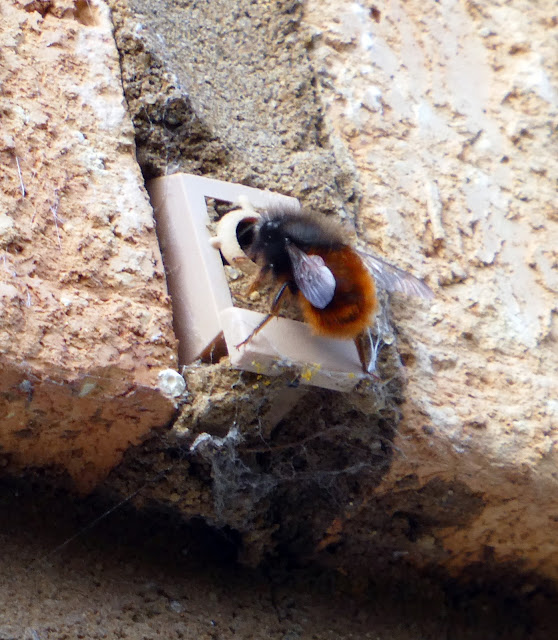
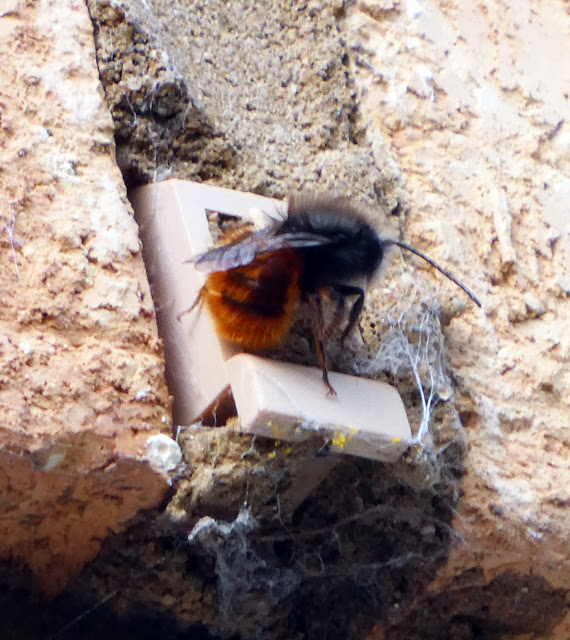
Look who decided to force entry into our home this morning ...

It proved a bit of a squeeze ...

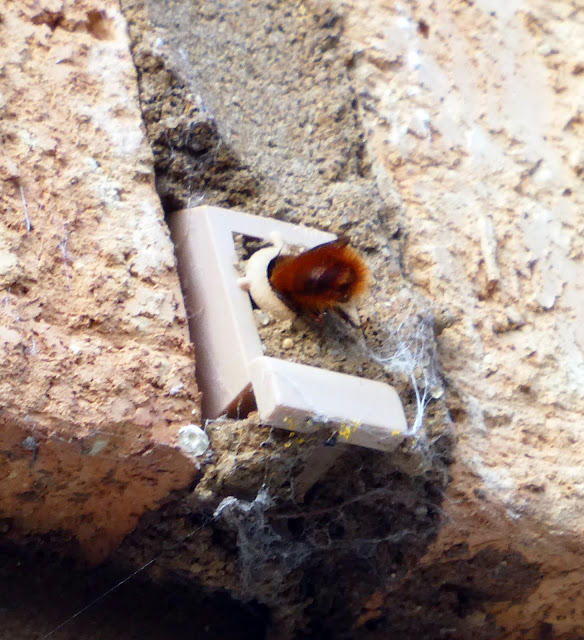
Gently does it!

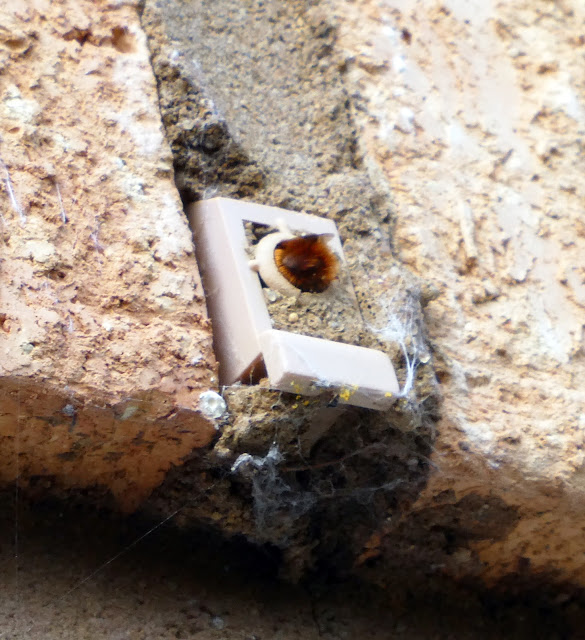
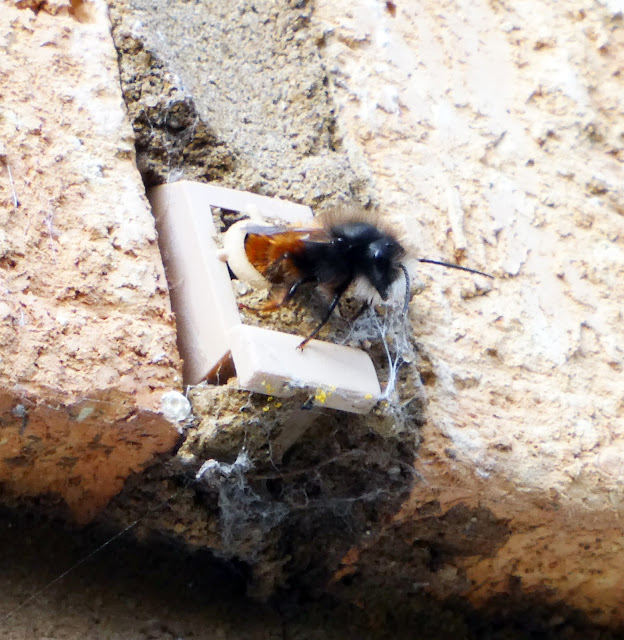
Perhaps that was a bit ambitious ...

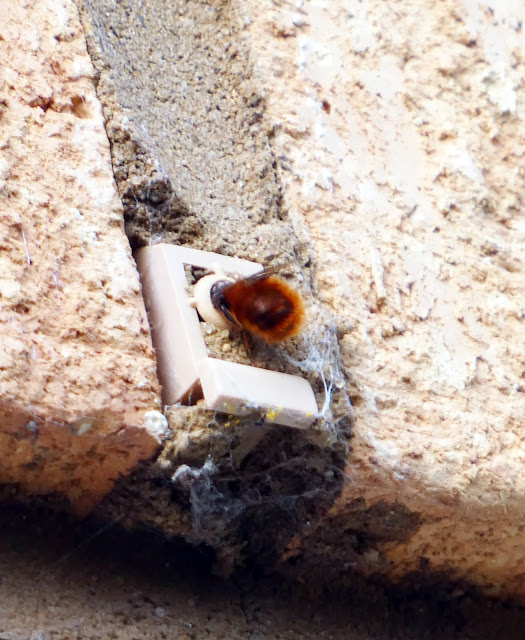
Perhaps there is an easier way in ...

... or out!
 

I have not yet identified this delightful little bee, but am guessing it is an early masonry bee. Do tell me if you recognise the species. I shall post a photo on iSpot. 

 * * *

Postscript: I posted on iSpot, and it seems the bee is a male Red Mason Bee (Osmia (Osmia) rufa), with its long hairs and 13 segments on its antennae (yes, a kind person on iSpot counted these!).  

Monday, 10 May 2021

Nomad Bee (?) on Dandelion


We have various insects landing on the Dandelions at the moment. This seems to be a new one for my garden list. I am not exactly sure what kind of ?bee it is, but judging by a thread on the Suffolk Wildlife Facebook group, it seems to be a Nomad bee, perhaps akin to Nomada goodeniana, though I fear the antennae are not sufficiently orange in hue for this particular variety. Those two yellow spots made me stop and take a second look. I shall post the photo on iSpot.  


P.S. Thanks to the kind (and knowledgeable) folk on iSpot, it seems this is a Nomada/Nomad bee, possibly a female marshamella.

Wednesday, 24 March 2021

First Butterfly Sighting and Other Insects in the Garden


At long last, the day finally arrived! I saw my first butterfly of the year, a smart male Brimstone, gracing our garden yesterday. 

But there were other sights to catch my attention as I took a careful look around this morning. One of these was the bee you see in the photo above and in the photo below. 


I watched as the bee squeezed herself in and out of the curled leaf. I know little about bees, but I am guessing she was a queen bumblebee, and that she had passed the winter hibernating in the patch of leaf litter. I spent several minutes watching her.


Something else 'bee-like' stopped me in my tracks. It was what I think may be a Red-mason bee, though, as ever, please correct me by leaving a comment. 


As you can see in the photo above, this little bee was soon joined by a much more ferocious-looking insect (is it a wasp or a wasp-mimic?). I waited to see what would happen next, and after just a few short seconds, the bee took off.


It seems to have been a good day for bees here. Look at the golden pollen in this Honeybee's 'saddlebags'! 

I have not been able to identify the fly in the  photo above yet, but wonder if it is a Soldier Fly. Update: it's hard to see what lies under the wings, but I'm wondering if this is more likely to be Meliscaeva auricollis.

Let's have a brief 'insect interlude' to make way for the cheering sight of this blossom. I love seeing the colourful flowers once again.

But, of course, it's not just the plants that bring colour. The photos below show the distinctive reds and oranges of our 7-spot Ladybirds. The one in the next photo has an unusual mark on its elytra. There are certainly two, and probably three, 7-spots in the second picture, along with a Pine Ladybird. 


I was delighted to discover more Violets in the garden this morning. And finally, what a joy it was to see the Brimstone, even if I was unable to take its photograph. I saw the one below in 2019. 


I see I have almost completed a year of the Butterfly Conservation Garden Butterfly Survey. Having failed to spot any butterflies in January and February a year ago, I began to log my sightings at end of March 2020.


Monday, 15 March 2021

More Signs of Spring in the Garden


We had a cold and blustery weekend, but I noticed these insects moving around in a sheltered corner when the sun peeped out for a brief spell. We spotted a few of these bugs last year in March. I posted photos on iSpot at the time, and the consensus ID was Rhyparochromus vulgaris, a ground bug that is a fairly new arrival to the UK.


We have enjoyed checking the card in the trailcam. The feline below is our latest 'capture'; we have no idea who s/he is or where s/he lives.

The female Blackbird with the white marking on her head has been named 'Star' since she is frequently caught on camera.

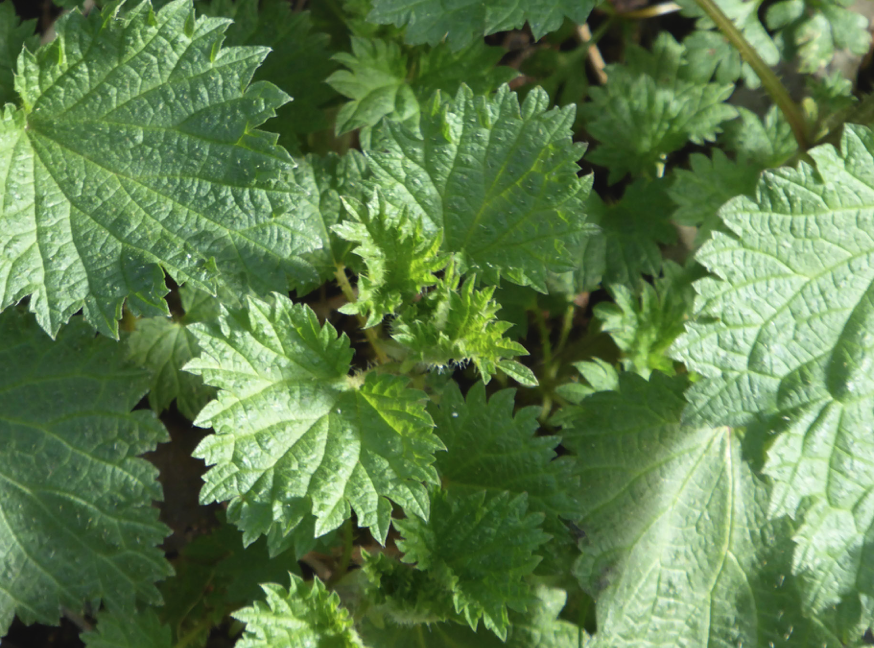
Our nettle patch was pathetic last summer so I am hoping for better growth this year. Nettles provide good habitats, and the signs so far are promising. 

Our small daffodils withstood the storm pretty well, but our crocuses became so droopy that I doubted they would pick up again. Remarkably most are now standing once more. A large Buff-tailed Bumblebee swooped down to investigate.


I was delighted to find this little Violet in the shady corner that used to be our 'wildlife patch' in the days before we turned virtually the whole garden into a home for wildlife. I don't ever recall seeing Violets here before and this discovery has made me think I will try to record species of wildflowers as they appear.  

This is my fledgling list for 2021:

1. Daisy

2. Violet

I hope it will continue to expand. 


P.S. I saw my first Grey Squirrel of 2021 this afternoon, and two Buzzards flew overhead.


Sunday, 28 February 2021

First Go with TrailCam and a Mixed-Bag of Garden Sightings

The top photograph shows David installing our new TrailCam in the hope that we might be able to record a few night visitors over the coming weeks. We have never used one before, but spurred on by reports from a couple of friends who have recently set up these cameras, we thought we would buy a fairly basic model and see what happened. I have a good idea of the creatures who visit our garden by day from the Homepatch Species List I have been keeping for the last few years, but little idea of what happens after dark or when we are inside. 

The second photo shows a kind of tunnel between the ivy and the fir tree. We have often seen cats in that area, but two of the regular felines have now moved elsewhere with their families, and we rarely see a cat in the garden. 

36 hours on and we uploaded the film. There are no great revelations to date (and thankfully perhaps, not even a rat), but the camera had been triggered several times, mainly in the dark, once yesterday morning in thick fog, and a few times in the daylight. 

The Blackbird below is the first identifiable creature to be caught on camera. Watch this space!


We have checked the garden for more ladybirds, and have located more 7-spot and Pine varieties. We have also seen a couple of bees . . .


. . . and a hoverfly (below), complete with shadow.


The 7-spot below is definitely keeping company with what are probably spiders, though I haven't been able to count their legs with any accuracy. I had wondered if they were Dock bug nymphs as we get a lot of Dock bugs in this part of the garden, but I don't think they are a good enough match.


We have had wasps' nests in the garden the last couple of years (well, one in the shower vent, so perhaps more in house than garden), so it was no real surprise to see this insect inspecting last year's nest site, which, thankfully was definitely in the garden and not in the house. I am fascinated by most insects, but do not get on well with ticks or the Common Wasp. I shall post this picture on to iSpot.


It has been a joy to see our Crocus, Miniatire Iris and other bulbs opening in the sunshine. We have a good show, albeit a miniature one, of Tête-à-têtes, in readiness for St David's Day (though these may technically be more Narcissus than Daffodil ... I wonder if you know).


Back to our mix of ladybirds again ...


And finally for now, a rather gruesome photo of what seems to be some kind of (perhaps beetle or weevil) larva demolishing an earthworm. A tiny corner of roofing felt came adrift from the old shed and this is what was underneath it ... I am hoping the folk on iSpot can enlighten me as to what exactly is going on.
 

After some fairly dormant months in our home patch, it suddenly seems as though there is a lot of activity even if I am still awaiting my first butterfly sighting!

Tuesday, 9 June 2020

Day 9 #30DaysWild - Further Knapweed Developments


Those who have followed this blog for the last couple of days will know that I have been keeping a close eye on a Common Knapweed plant which has sprung up in our unmown garden. There is still only one flower, but it is keeping the insects busy. Today I noticed this bee collecting pollen.


I am not sure what tiny insect this might be at the end of my white line above. We have Mint Moths in the garden at present, but it didn't seem to be one of those, and I was unable to get a better picture. I'm not sure what the black staining is: do let me know if you do. Perhaps it is something to do with the Blackfly?


No prizes for recognising the ant. 


This small fly in the photo above was in a particularly tricky part of the plant to reach. I am not entirely sure what it is, but I think it may be a species of Tephritid fly.


I apologise for the quality of some of today's photographs: I think the lack of good light was a factor and in some cases the small size of the insects. Perhaps I changed settings on the camera inadvertently. In any case, you will still be able to see that there are at least three species in the photo above. Three of yesterday's green larvae had disappeared (and I am still waiting for an ID from iSpot). I don't know whether their disappearance was due to predation: we have about 20 young Blue tits in the garden at present, along with a Great Spotted Woodpecker, nesting Blackbirds and hungry Great tits. You can see the remaining caterpillar at the end of line 2 above. I feel sure that the rimmed Pine Ladybird (line 3) was heading for the Blackfly (line 1).


I took a last daylight 'look around' at about 6pm. There were five 7-spot Ladybirds on the Knapweed. I went out one last time once it was almost dark to watch the Cockchafers zooming round the Acer and Silver Birch. 

I wonder what tomorrow will bring. I am longing to see more butterflies in the garden, but it has been too cold this week for more than a single sighting.