
We had noticed that the Wasp Spider population in our wild Suffolk garden seemed to be declining ... and now we know why!
Apparently, it's not uncommon for females to cannibalise their males, presumably after mating has occurred.
We had noticed that the Wasp Spider population in our wild Suffolk garden seemed to be declining ... and now we know why!
Apparently, it's not uncommon for females to cannibalise their males, presumably after mating has occurred.

We looked out the window yesterday morning at about 10.30 ... and were greeted with the sight of this rather magnificent toad. This is the second time we have seen the toad on our patio this summer.

I have decided to post the extremely poor record shot above as much as a note to myself as anything.
The point is that I saw the Migrant hawker in the lower half of this image, and took a quick photo, little realising that there was actually a second dragonfly above (see black arrow). Result: the top dragonfly has been cut in two unnecessarily. It was only a record shot (a quick first image in case the creature flew away), and as such the quality doesn't worry me too much; but what concerns me is the fact that even after this photograph had been taken, I still failed to notice the second insect. I have been thinking about William Blake and his famous, albeit metaphorical, line about seeing a universe in a sand particle; well, it seems I need to sharpen up my powers of observation and concentration considerably.
Below: this is a better image of the top dragon (which in mind at the time was the lower and only one, so presumably by this time the lower one had flown), showing off the distinctive yellow golf-tee marking on S2, just below the wings:

The photo below shows one of our two Wasp spiders. You can see a white food parcel near the top and what will become a second once the spider has completed her task. I'm wondering if she has wrapped up a small bee.


There have not been many butterflies about this week in the garden; perhaps it has been too windy. Even so, we have logged Peacock, Red Admiral, Large and Small White, Gatekeeper, Meadow Brown, Comma and Holly Blue. I wonder what the weekend will bring. I am still hoping to see my first Painted Lady of the season.
 |
| Today's sighting: Wasp Spiders at Snape, Suffolk |
 |
| You can see the web and the start of a stabilimentum |
 |
| Underside - with bound-up grasshopper |


 |
| The watery reedbed habitat at Snape, looking across to Iken church |
Sadly we have not seen any of these extraordinary spiders in our wild garden this year. I am wondering if they were eaten either by the grass snake or the resident frog.



 |
| The underside |

We have been keeping an eagle eye out for these colourful spiders, unlike the False Widows under our porch, which are, I feel, rather too close for comfort ...
We had almost convinced ourselves that we would not have any Wasp Spiders in the garden this year when, lo and behold, we found one this morning! I apologise for the quality of this record shot, but I will hope to get some better pictures tomorrow.


We are delighted to find that the hedgehog has been around again. We put out some suitable hedgehog food last night for the first time, but discovered a neighbourhood cat eating it soon afterwards, so it may be that the hedgehog was simply coming for the water we leave out in a tray. It was evidently another very mild night. The Trailcam is coming into its own ... and I'm glad to report that there have still been no sightings of rats!


We are much enjoying almost daily visits from the Hummingbird Hawk-moth. These insects are very fluttery and a joy to watch. The white Buddleia flowers are nearly over, but I hope they will last a bit longer ...
What an age it seems since I last posted on this blog. There have been various reasons (largely Christmas plans and festivities); but here I am, emerging from a kind of hibernation and finding myself two days into the New Year!
We have been been keeping a sharp eye on our coconut feeders as a Sparrowhawk swooped right down a few weeks ago, and might well have ended up inside if our sliding doors had been open at the time. There were no casualties on that occasion, but the raptor came surprisingly close to the glass. Perhaps she noticed the butterfly stickers at the eleventh hour, which are supposed to warn birds to keep away from the window pane.
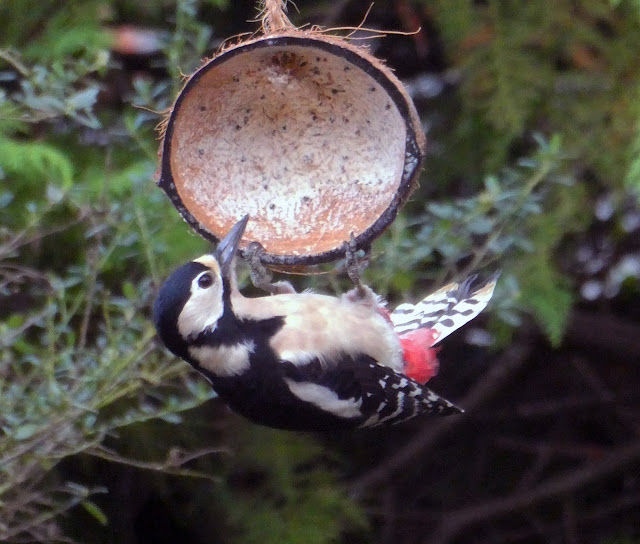
Since that hair-raising moment, we have had scores of Blue tits, good numbers of Great tits and Long-tailed tits. We have also had regular visits from a female Great Spotted Woodpecker, the one in the photo above. Well, yesterday we suddenly realised that the bird we were watching had a red nape. This means we have also have a male in our neck of the woods. Will there be young ones later on?
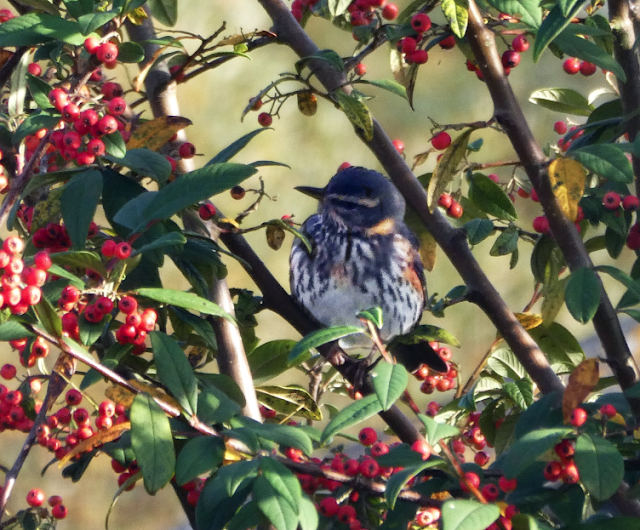
We were delighted to look out on 16 November, such a long time ago now, and find this Redwing enjoying the berries. We occasionally see these beautiful winter migrants in the garden. It is always a joy when we do.
And by the way, we checked on the Wasp-spider egg-sac just outside the glass door. It has survived the winter so far.
I look forward to finding new species in our wild garden this year. I wonder who will be first on the 2022 list ... Sadly we had no hedgehogs to report last year. When we first moved here to our Suffolk garden a decade ago, we had fairly frequent sightings, sometimes of a mother with young in tow. Let's hope we can somehow buck the current downward trend.
 |
| Female Wasp Spider, home patch |
We first encountered these fascinating spiders (Argiope bruennichi) in September 2020. Between 5th and 9th September last year I recorded four females, the large striped ones, in our home patch.
We have enjoyed watching them again this year, though we have never seen more than three at a given time. This morning we discovered a second egg-sac in the long grass, so we hope this means that there will be more Wasp Spiders in 2022.
These spiders like natural grassland, and we suspect it is our lack of mowing, the result of a pledge we made at the Suffolk Wildlife Trust Summit, that has attracted them to our wild garden. The long grass has certainly attracted grasshoppers, a key food source.
The discovery of a new egg-sac seemed a good moment to post some of our Wasp Spider photos. I hope you enjoy them!
 |
| Female with prey |
 |
| Ditto |
 |
| Female with egg-sac |
 |
| Female near the stabilimentum |
You can read about the 'ultra-violet reflective' stabilimentum or zigzag section of web here in the beginning of an article.
 |
| Underside of female (with egg-sac) |
 |
| Female with egg-sac |
 |
| Damp weather; female with parcel of prey |
 |
| Stabilimentum |
 | |||
| Evidence of two different spider species in close proximity |
 |
| Female upside-down, with egg-sac |
 |
| Female and egg-sac |
 |
| Female |
 | ||
| Underside of female. Stabilimentum |
 |
| Stabilimentum |
 |
| Do you see the tiny spider on the right? Is this a different species? |
The male Wasp Spider is much smaller than the female. It is light brown and has two yellow lines running along the underneath of the abdomen.
 | |
| Is the same spider as the tiny curled creature in the photo above? |
 |
| ... and this? Do leave a comment if you know. |
 |
| Wasp Spider egg-sac spotted on Sutton Heath near Woodbridge |
My thanks to David (Gill) for a couple of the photographs in this post.

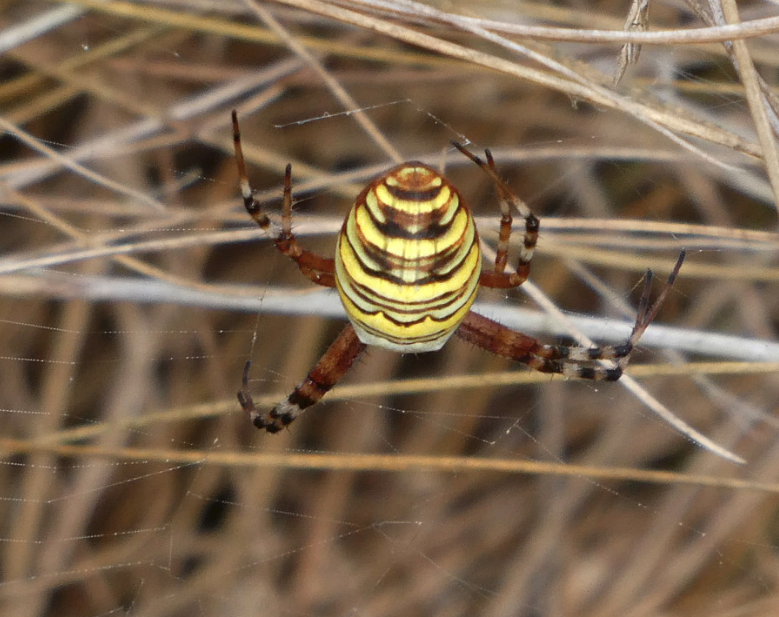
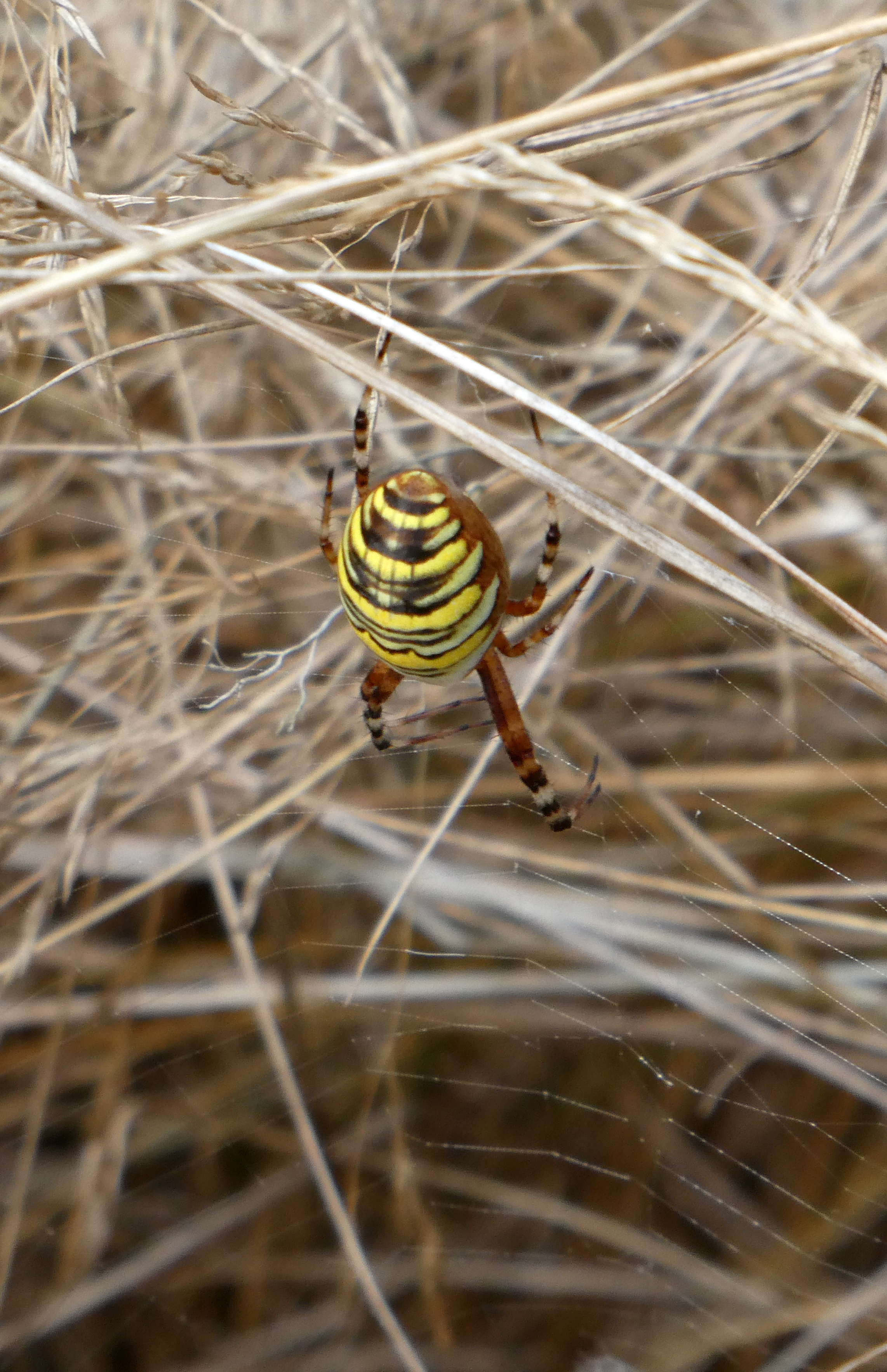
Having kept a careful eye on last year's Wasp Spiders and then their extraordinary egg-sacs, we were beginning to think that the small 'colony' in our Suffolk garden had died out over the winter. This however was not the case, at least not the case entirely, for (while the photo below was taken in 2020) the photo above was taken yesterday. What fascinating arachnids these are! The one above shows the underside; and the one below, the top of the spider's abdomen.

As a postscript to this post I should add that some hours after taking the top photograph, we returned to 'check on' the spider, only to find a large wasp in the grass by the web. What we failed to ascertain was whether the spider was attacking the insect or the other way around. I rather thought the spider had had its day; but no, a little later on there it was, and the wasp had disappeared. Do leave a comment if you can explain what was going on. I have failed to find a website that explains how Wasp Spiders and wasps behave towards one another.
*
Previous post (here): Tiger moths, Butterflies ... and Driftwood by Starlight, my new poetry collection.

Those who follow this blog will know that last summer we encountered Wasp Spiders in our Suffolk garden for the first time. We also noticed four of their extraordinary egg sacs. I read this morning in the latest issue of The Suffolk Argus, the magazine of our local Butterfly Conservation branch, that 'Suffolk County Council has just agreed a biodiversity plan to protect species such as the Wasp Spider'. I see this development was reported in our local paper, the East Anglian Daily Times (EADT), back on 5 December 20212.

We took advantage of a break in the cloud and enjoyed an hour in the garden. I confess I was not the one digging, but it was good to recycle some earth from last year's tubs. We came across a few insects waiting to emerge ... and ensured that these woodlice were covered up again.


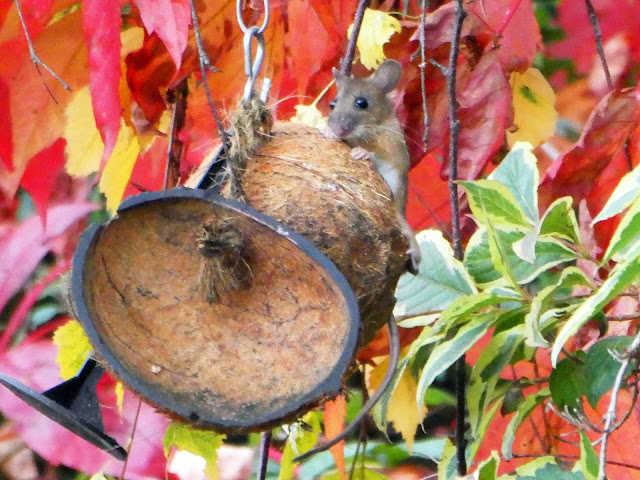
P.S. It seems we are in agreement over the presence of the mouse on our Trailcam photo. Thank you to those who took a careful look!
