Showing posts with label Small White Butterfly. Show all posts

Wednesday, 17 June 2020

Day 17, #30DaysWildCreativity: Nourishing Things That Grow Nearby


The world had hardly changed

when I planted twenty-five seeds, each one a dry husk from which the vibrancy of life would spring. I waited, willing the first shoots to spike through the soil, hoping the slugs and snails would find other sources of nutrition. Within a month, green plants began to take shape, bearing stems that became umbrella handles underneath a ring of miniature leaves.

Some days raindrops pattered down from brooding skies. A few bounced off the seedlings: others landed on the leaves and became tiny snow-globes of life. As rainbows gave way to bursts of sunshine, the plants grew and began to develop a range of markings. This morning there were three distinct colour forms; vibrant green, deep kale green, and mottled green and cream.

Each stalk propels its leaf towards the light. Each leaf spreads in diameter, providing the perfect wet-weather shelter for a mouse. I pick a single stem and twiddle it round between index finger and thumb. I check for signs of butterfly eggs and blackfly, but there are none. I roll the small leaf and squeeze it, inhaling an earthy draft of pepper. I am reminded of piquant pasta suppers in last year’s heatwave. 

But no eggs could mean no larvae, which in turn could mean a dearth of white butterflies.


* * * 

This post was written in response to Dr Miriam Darlington's #30DaysWildCreativity meme for Day 17 of #30DaysWild. We were invited to look 'more closely at things growing nearby and see how nourishing they are'.  

Thursday, 21 May 2020

The Appeal of the Dandelion

Peacock butterfly

Inspired by Crafty Green Poet's post on the Dandelion Appreciation Society roughly three weeks ago, I decided to photograph the insects in our garden that perched on these vibrant flowers. All the images below have been taken since the start of May. I don't know what all the insects are yet; but while I try to discover, I hope to continue to keep an an eye out for more, and will add them when I find them. I am not always good at distinguishing a Dandelion from a similar species, so it would be good to be able to identify at least some of the 240 species we have in the UK.


Small White butterfly


----------------

Yesterday morning's butterfly, a Common Blue, I think. I have placed this photo below the line because I have a hunch the host plant is not a Dandelion. Do enlighten me!


Thursday, 24 September 2015

Nasturtiums (again) ... snail, trail and butterfly eggs

You can see the snail's slime trail lower right.

I took another look at the Nasturtiums yesterday. In fact I positioned a garden chair next to them so that I could have a proper look. Unlike the day before, there were no Small White caterpillars in sight, but there were a few snail trails. It was not long before I noticed the tiny snail in the photo above. Its shall was considerably smaller than my little fingernail.

I know incredibly little about snail identification. Certainly the spire was very flattened (a contradiction in terms, it seems to me!), which might suggest a species similar to Oxychilus cellarius, though the body is not the typical blue-grey.


There was also a cluster of yellow eggs, which I imagined would belong to the Small Whites ... I flipped the leaf over gently for a couple of photographs and let go afterwards.


... however, a bit of research showed that Small Whites lay single eggs. Large Whites lay clusters at the rate of four eggs a minute, so I think these are Large White butterfly eggs. 


As I made my way back to the house, I noticed this Cranefly checking out (or perhaps 'checking in to') one of our insect hotels ...


... I'm not sure how well it would fit through the bamboo holes! 

Wednesday, 23 September 2015

Whose been nibbling my Nasturtiums?

I thought the nasturtiums were looking a bit droopy, and wondered if it was just on account of the heavy rain. A quick glance was all that was needed to show that there was an additional reason for their appearance ...


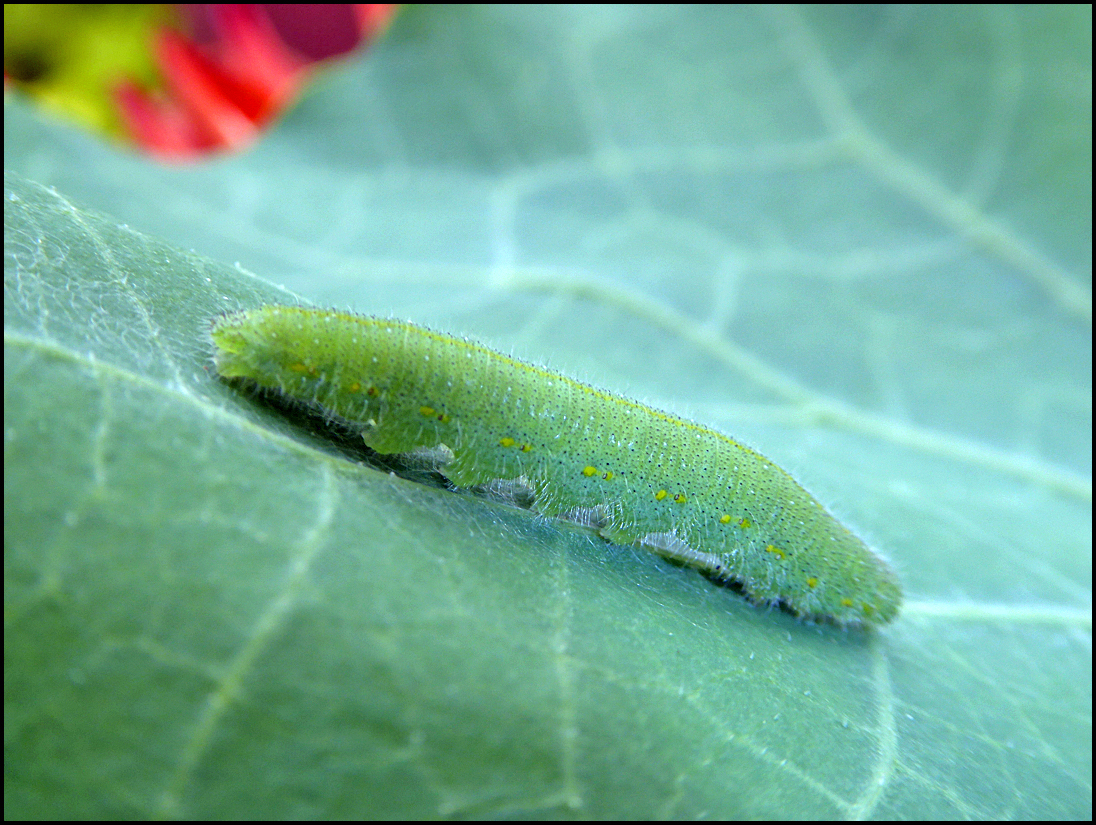
These fine caterpillars will turn into Small White butterflies. At this larval stage, their favourite foods are cruciferous vegetables and, no surprises here, nasturtiums!

There has been a recent flurry of books about butterflies and moths. A couple are high up on my current wish-list. Meanwhile here is a link to an excellent article entitled Butterfly Enchantment by Sue Brooks on the Caught by the River site. Happy reading! 

Wednesday, 9 September 2015

Early Autumn ... a mixed bag

Hoverfly Syrphus sp. (I think) on the last of my Californian Poppies

I spent ten or twelve minutes in our garden with my camera this afternoon, having a look around to see what was about. There was a dragonfly, but it was on the wing and never gave me the chance to see it properly. I could hear a few birds rustling in the bushes, but the only one to break cover was a female Blackbird. There were a number of insects, as you will see ...


Hoverfly Syrphus sp.
.
Marmalade Hoverfly Episyrphus balteatus (I think)

Early autumn berries on the Hawthorn

Blackberries arriving over the garden fence!


The photograph above intrigued me. There is a Small White (Pieris rapae) caterpillar on my Nasturtium leaf, but what is that white mark at the tip of of my orange arrow?

As far as I can see, caterpillars do not leave a trail of slime in the way that slugs and snails do. However, I have discovered from Reg Fry on the UKLeps website (you will need to search or scroll down once you have clicked the link) that White (Pierid) caterpillars spin a silkpad as part of the pupation process.

Intriguingly, it does not actually look to me as though the 'silk' in my photos is going to be used in this way. Do let me know if you have any thoughts.

I wish my photographs were clearer, but I was leaning over an unruly clump of wild honeysuckle, and had no wish to topple over! 


Close-up of ?silk


The photo above shows a couple of Nasturtium plants that have largely survived the onslaught of the caterpillars thus far. However, as you can see the leaves have been eroded by Leaf Miners (you will need to scroll down once you have clicked the link). I blogged about these two years ago in July. My Nasturtiums have been much later this year.

What interests me, though, is whether any of the parasitic wasps that have frequented this part of our garden around my insect hotel have been laying eggs in the Miner larvae. This thought may not be for the squeamish!


Above: something more straight forward - a Daddy Longlegs or Cranefly. I expect these will soon be making their way into our homes. 


And finally, a Shieldbug nymph (I think it is the Common Shieldbug nymph, 4th instar, but, as ever, please let me know if this is not correct).

I shall try out my ten to twelve minute observation exercise again. Who knows what I may have missed this afternoon!

Monday, 11 June 2012

Butterflies and Moths (6): Small White


We enjoyed watching this male Small White butterfly at Helmingham Hall. I have only just learned these butterflies (along with Large Whites) are also known as Cabbage Whites. It is, apparently (and presumably for reasons of camouflage) particularly attracted to white flowers.