Showing posts with label Nature Reserves. Show all posts

Friday, 8 July 2016

Holiday 1: Red Squirrel Quest ...


We have just returned from a holiday in Dumfries and Galloway. We had looked in vain for Red Squirrels in several places where they were known to live, but had failed to see more than a chewed or discarded pine cone.

We had perched in a Red Squirrel hide, ordered coffee in a Red Squirrel cafe and asked and asked for suggestions, but our quest continued.

We ended up at Eskrigg Reserve, a beautiful forest near Lockerbie. We sat patiently, watching a Great Spotted Woodpecker, a Jay, a Mute Swan, a Treecreeper ... but no sign of a squirrel.

We were beginning to think that we would have to move on when we came across a hut, and there, just outside, hanging from a nut feeder was ... a Red Squirrel.

We went on to see three more, and thoroughly enjoyed watching these magnificent animals as they interacted with one another, sat up on their haunches and ran up and down the pine trees.

I have reported our sightings on the Saving Scotland's Red Squirrels site. What a privilege to be able to watch - and log - these exquisite creatures.


Tuesday, 29 September 2015

A Minsmere Medley

7-spot Ladybird, a native species. I have logged it on the UK Ladybird Survey.
We spent a sunny afternoon at RSPB Minsmere on Saturday. We may not have seen many birds (and indeed we looked in vain for Bearded tits on this occasion), but there were some lovely insects out and about. Our visit gave me the chance to pick up a copy of the site leaflet (previous post) that contains my Minsmere soundbite.

A small Hoverfly


A Darter (?Common Darter) perching in the sunshine


Poisonous toadstool, Fly Agaric (Amanita muscaria)


Another Common Darter (?female)

Emerald Damselfly


Migrant Hawker Dragonfly


Close-up, showing yellow 'golf tee' mark on S2

A magnificent Fox Moth caterpillar

The windswept beach that adjoins the Minsmere reserve

Tuesday, 19 May 2015

RSPB Minsmere - The Adder Trail

Sharing with Eileen at Viewing Nature With Eileen ...


There is certainly a BBC Springwatch buzz at RSPB Minsmere.

We decided to take a look along the Adder trail for signs of snake.

We had a very satisfatory sighting, but it was not only the reptiles who caused a stir.

The Avocets were on their nests. There were several Little Egrets on the scrape.
The Bearded tits were hard to photograph but a delight to watch. 
The Bluebells were a joy to behold. We saw (and heard) two Bitterns.
We heard a Water Rail and were serenaded by a Cuckoo.
The Sand Martins were busy re-claiming their nests.
David saw our first dragonfly of 2015 - a Hairy Dragonfly.
I came across my first Grasshopper of the season.

N.B. Adders are dangerous when they bite.
I took all the photographs below from the path side of the roped-off viewing area.


A seasonal sea of Bluebells


Camouflage! Adders head to head ... (look for the eyes)


Both snakes look right ...


It can be hard to see where one Adder ends and the other begins!


Such fine markings.

Snakes in the grass ...

Close-up. I wonder if the Adder can feel those thorns!

You can see how mottled shade in the undergrowth provides the perfect habitat.

A personal favourite!

Prepare for action ...

I see that the Springwatch team will be following specific Adders this year. 
You can read about the plans if you click here and scroll down 
to the BBC Springwatch paragraph called 'Adders on the Move'. 
It will be fascinating to see what traits are revealed. 

* * *
My blog
  • Previous post: Red insects including the Fire Bug and (green and red) Ruby-tailed Wasp ...

The RSPB blog

Saturday, 9 May 2015

Lifer ~ Stone Curlew at Weeting Heath

We spent part of the Bank Holiday at Weeting Heath, one of the Norfolk Wildlife Trust's flagship reserves on account of its population of Stone Curlew.


My photos are barely record shots, but at least we saw a Stone Curlew in this distance. If you click on this link, you may begin to realise how camouflaged they can be when lying low


In fact we saw two, but the other kept popping its head below its dusty parapet as I positioned my camera!


It's always a thrill to see a bird for the first time, particularly a species that you have failed to see on a previous occasion. Perhaps next time the photos will be better!


  • RSPB Stone Curlew news
  • Tip: the hides are pretty close to the car park. 
  • You might also like ... my Tree Following post for April to May here

Tuesday, 24 February 2015

Swan Feed at WWT Welney


Last Saturday was cold day, teetering on the brink of spring,
but with one foot definitely still in winter. 
We headed off to Norfolk (UK) in search of swans at WWT Welney
This is the migrating season,
so we were not sure how many would still be there ...


We left Ely and Littleport and drove through the fens, 
between dykes and wide fields of black soil. 
You can see which way leads to the swans! 


A hare-spotting walk was in progress when we arrived,
and while we were too late for this,
we kept an eye out for these lovely animals.
We were rewarded with a couple of fairly distant sightings.


The wind was brisk at times,
and there were bursts of activity on the marsh
during the calmer spells. 
We enjoyed keeping an eye open for Reed Buntings. 


We love looking out over the Ouse Washes,
and enjoying the sense of space.
East Anglia is renowned for its wide skies.


Almost all of the Bewick's Swans had already departed 
for their breeding grounds in Russia.
However there were some stunning birds left, 
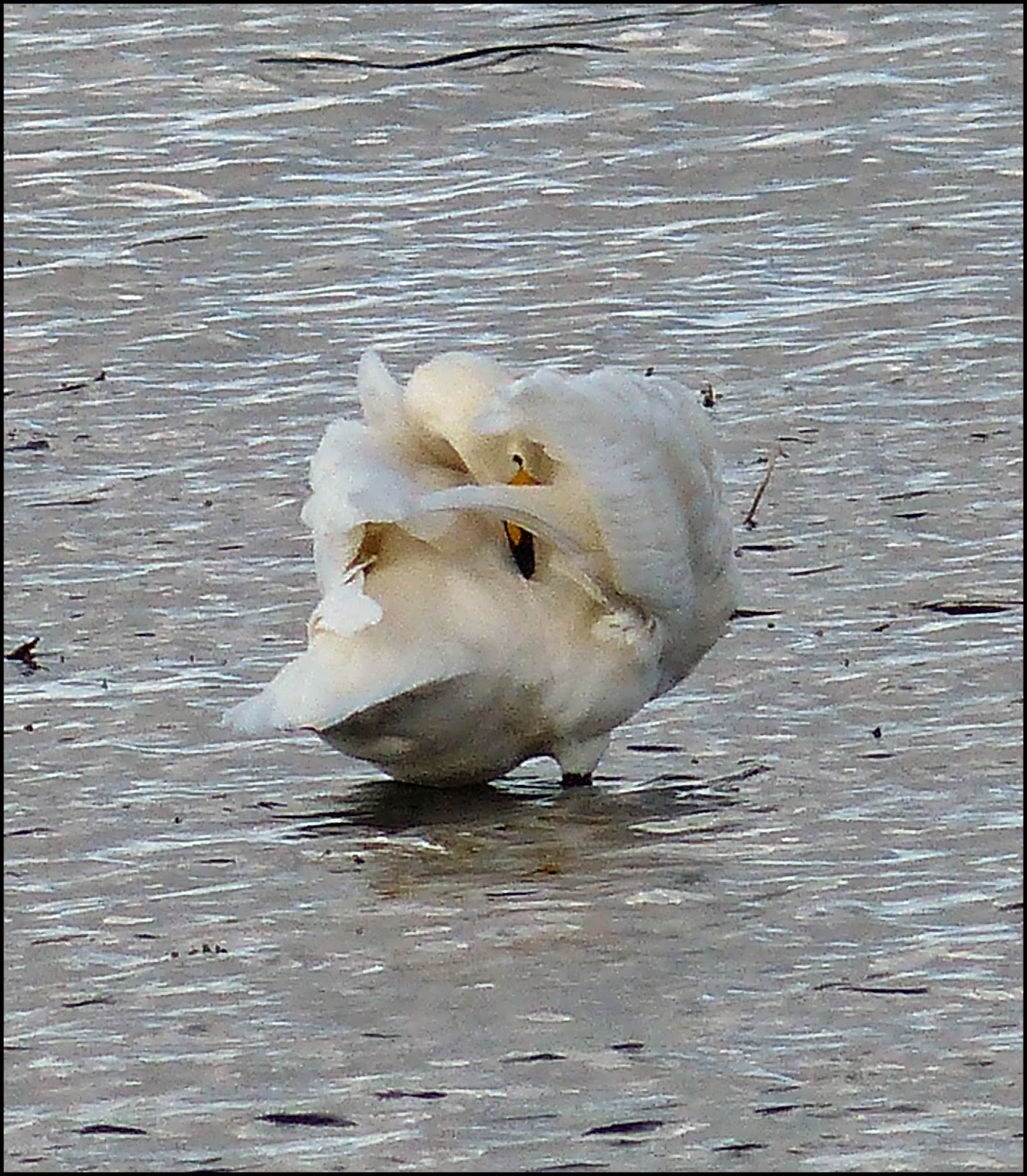
like the Whooper above and the Mute swan below. 


We watched two swan feeds during our time on the reserve,
each accompanied by a commentary.
I found it particularly helpful to learn
that Whooper swans have a yellow wedge 
(beginning with 'w' for Whooper) on their bill, 
while Bewick's swans have a distinguishing yellow blob
('b', of course, for Bewick's).
Mute swans are easy to recognise
with their orange bills - no mnemonic necessary!
There is a useful swan ID chart here.


The swans were surrounded by male Pochard. 
Most of the females are currently in Spain.


Whooper swans are so elegant ...


... and so are the Wigeon.


How's this for waterfront camouflage?


Pochard have bright eyes,
but the camera seems to have enhanced this particular one a bit! 


There was a bit of feather ruffling going on ...


... and a bit of sleeping. I love the feathers. 


I'm guessing that this duck
 is probably a domestic variant of the Mallard. 


The hares were not very active - but just wait until March arrives!


As the daylight began to fade,
we noticed a Kestrel hovering above the water. 


The sun began to set as huge flocks took to the sky. 
We particularly enjoyed watching the Lapwing. 


A sense of peace pervaded the reserve
in between the frantic bursts of activity.


The sunset was stunning ...


... and the Shelduck were still going about their business.


Welney - what a place!


Every so often it got very stormy. 
This was the view from the the hide
as the dark clouds tried to get the upper hand.


It was soon time
for the evening swan-feed ...


... which was a popular event for birds and humans alike ...


... in bitter temperatures beneath the February moon.

*


Postscript

This was the car roof the following morning.